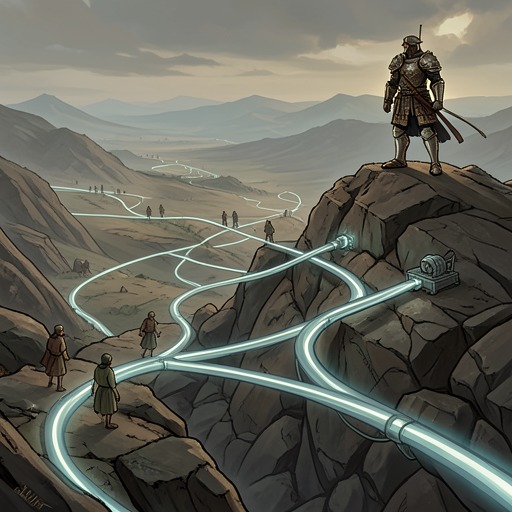
Tornok Brothers Battle
Systema Delenda EstTornok Brothers Battle is the encounter that establishes the lethal gap between conventional System power and Cato’s improvised biotechnological warfare. Onek and Golsan, newly minted Tornok Clan Platinums, discover and attack Cato at the moment a dungeon collapses around him. Their rank and physical coordination make them a serious threat even to Cato’s Warframe, but the battle ends when Cato applies the Sneeze of Doom, also known as the Gesundheit Surprise, and follows the attack by destroying the brothers’ bodies before their regenerative abilities can restore them.
Causes and Setting
The battle grows out of the Global Defense Quest, whose displayed objective is to destroy the incursion across the Southern Jungle Conflict Zone, the Azure Canyon Border Zone, and the Azure Canyon Dungeon. Onek and Golsan are investigating the Southern Jungle Conflict Zone after ordinary searching has failed to locate the threat. Their Platinum senses should have made anything unusual easy to find, but the disturbed essence inside a strange doppelganger corpse has already indicated that something connected to Cato has passed through the area.
The quest identifies the brothers as participants with institutional backing as well as personal capability. They are Tornok Clan Platinums, and the System rewards even their relatively minor victories with Essence. Their confidence is therefore grounded in the established logic of the System: rank supplies perception, skills, physical superiority, and measurable rewards. The brothers also have practical experience with the local dangers. They know that the low-rank lizard beings cannot Identify a peak Gold threat, and they expect their own Platinum senses and coordinated skills to compensate for the uncertainty surrounding the incursion.
The immediate setting is the Azure Canyon Dungeon as it begins to collapse. The ambient Essence trembles, the ground shakes, and the lake’s water dances as the dungeon’s structure destabilizes. Golsan recognizes the phenomenon from a previous encounter and understands the tactical consequence: whatever is inside must emerge or be destroyed in the collapse. The brothers prepare to ambush the escaping creature, converting a dungeon failure into what they believe will be a controlled kill.
The Brothers’ Assault
Onek and Golsan fight as a pair rather than as two isolated Platinums. Their thin, whiplike swords amplify skills such as Wind Cut and Gale Volley, while their bodies are themselves adapted to violent speed and aerial movement. When Cato emerges, Golsan detects him more through Wind Perception than through sight: the massive Warframe pushes a pressure wave ahead of it and displaces the air within the dungeon’s dome. The brothers release Gale Volley together, adding a thunderous snap intended to deafen and disorient their target before the attack lands.
The first exchange confirms their competence. Their attacks cut into stone, explosions reverberate, and the blue dome begins to crumble, but Cato avoids the volley. He responds through altered perception, experiencing the brothers’ projectiles as sluggish while optimizing his movement and preserving lines of retreat. He uses feints and calculated angles to make the brothers interfere with one another, but the advantage is temporary. Once they descend to flank him at sword range, their speed and strength become even more dangerous than their ranged attacks.
Cato’s Warframe cannot simply overpower them. A claw strike drives one brother backward and scores lines across his armor, yet the whiplike sword is not even cut by the Warframe’s monomolecular edge. The second brother exploits that opening and drives an air blade through Cato’s side. System-enhanced physics pierces the Warframe’s fullerene-and-metal plating and reaches the flesh beneath, destroying one sub-brain, damaging specialized organs that support Cato’s passengers, and coming close to one of the preserved brains he carries. The impact throws ten tons of bioweapon across the ground, although Cato rises before the brothers can capitalize on the opening.
The damage makes the tactical reality unmistakable. Cato concludes that he cannot defeat the brothers through physical combat alone and estimates that a few more direct hits would leave the Warframe severely impaired. The likely result would be a downward spiral ending in self-destruction, with only the uncertain survival of his backup as a possible consolation. The brothers have found the precise vulnerability of a massive combat frame: superior bulk and armor do not matter if two faster opponents can repeatedly penetrate its defenses.
The Sneeze of Doom
Cato escapes the trap by drawing on a tactic developed by Earth’s defenders, who had previously faced System entities without the benefit of orbital overwatch or a particle beam summoned from the sky. The tactic’s original name was the Gesundheit Surprise, but its more widely used name is the Sneeze of Doom. Its grotesque construction reflects the conditions under which Earth’s defenders have been forced to fight: bioweapons are the available substitute for conventional firearms, and biological engineering must supply the precision that ordinary weapons cannot.
Cato partially aerosolizes cell structures designed to induce a small amount of nuclear fusion and loads them with as much deuterium fuel as his reserves permit. Motile cells and neuron threads create System-blocking static, leaving the mixture with the appearance of something like snot. He divides it into packets, arms two rear tendrils, and lunges while tracking the brothers’ large muzzles. The attack is not a general blast. It is a precise delivery system aimed at the most vulnerable available openings.
Cato sneezes directly onto each brother’s nose. The deuterated organelles slide into their nostrils, forcing the brothers to disengage and rub furiously at their muzzles. Cato then turns and runs rather than remaining close to the targets. Moments later, the organelles trigger simultaneously, fusing half a gram of deuterium inside each brother’s sinus cavities. The result is disproportionate to the apparent scale of the weapon: fusion plasma vents from their eyes, noses, and mouths, and their heads more or less explode.
The tactic converts the battle’s values in an instant. The brothers had represented the System’s confidence that rank, skill, and coordinated physical force could contain the incursion; Cato’s improvised weapon reveals that their own anatomy can become the route by which they are destroyed. The victory is neither elegant nor safe. It depends on biological manufacture, uncontrolled fusion, precise timing, and a retreat timed to the detonation. Cato later recognizes that the method cannot easily be converted into a gun because the fusion process offers only vague control over its yield.
Death, Recovery, and Consequences
Cato does not assume that the brothers are permanently dead. High-ranked System beings possess extraordinary regenerative abilities, and even the Sneeze of Doom may fail to prevent them from recovering. He therefore reverses course and eats the bodies. Cut off from the System, they have far fewer options, while Cato can direct their remains into the Warframe’s molecular disassembly chambers, the closest equivalents it possesses to stomachs.
The chemical foundry tears apart the bodies, studies their biochemistry for possible future use, and reclaims whatever rare elements can be extracted from their armor. This is both a practical safeguard and a declaration of Cato’s method. He does not merely defeat opponents; he treats their bodies as material, information, and potential technology. The brothers’ death therefore yields immediate tactical security and a biological archive that may improve later resistance to System forces.
The encounter also clarifies why Cato’s larger campaign is so difficult to stop. The System’s enemies are accustomed to quests, ranks, skills, and rewards, while Cato combines preserved brains, specialized organs, System-blocking biology, fusion-producing cells, and remote technological infrastructure. His methods are ugly because they emerge from a world denied ordinary weapons, but their ugliness is inseparable from their effectiveness. The brothers’ superior combat statistics do not disappear; they become irrelevant once Cato changes the terms of engagement.
Narrative Significance
The battle foreshadows the broader conflict between Cato and the System. Elsewhere, the System makes killing feel good by pushing Essence into a victor’s body and granting rank or tokens, turning violence into a reinforced behavioral loop. Cato experiences that reward when a quest is fulfilled and recoils from the fact that the sensation of killing can help create murderous psychopaths at the top of the ranks. The Tornok brothers’ battle supplies the physical counterpart to that critique: the System turns combat into a legible progression path, while Cato survives by rejecting the path’s expected rules.
Muar later interprets Cato’s actions as a threat requiring a Crusade. Having experienced the blank System-less space as lifeless, purposeless, and horrifying, Muar regards Cato’s project as an assault on direction, reward, motivation, and meaning itself. He leaves Uriva to warn worlds deeper toward the core, arguing that they must recognize Cato’s presence and prepare before his agents compromise them. The brothers’ defeat thus becomes more than an isolated ambush: it is one of the concrete events that validates the Crusade’s fear of Cato’s methods.
The battle’s logic recurs on a larger scale. Cato later uses orbital railguns, firing one-ton precision rods at targets from more than a hundred thousand miles away, and faces Kosch’s shadow attack, which creates a circle of absolute darkness across half a continent. The Crusade also produces the purification of worlds such as Sunac and Enksa, while the Core eventually burns under an assault that turns its air into white-hot plasma. Against this escalating background, the Tornok Brothers Battle is a miniature of the entire war: a System force expects to win through superior rank and conventional power, Cato survives through an improvised asymmetric weapon, and every victory carries consequences that reach far beyond the immediate battlefield.