True Core Essence Source
Systema Delenda EstThe True Core Essence Source is the immense font of essence at the heart of the System, a reservoir whose function extends beyond storage. It gathers essence from elsewhere in the System, spontaneously generates additional essence, and supplies the resource on which the System’s quests, dungeons, rank advancements, worlds, and divine institutions depend. Because the System’s growth appears gradual until its accumulated industrial and metaphysical capacity reaches a threshold, the Source embodies both the hidden abundance and the structural fragility of that order.
Appearance and Location
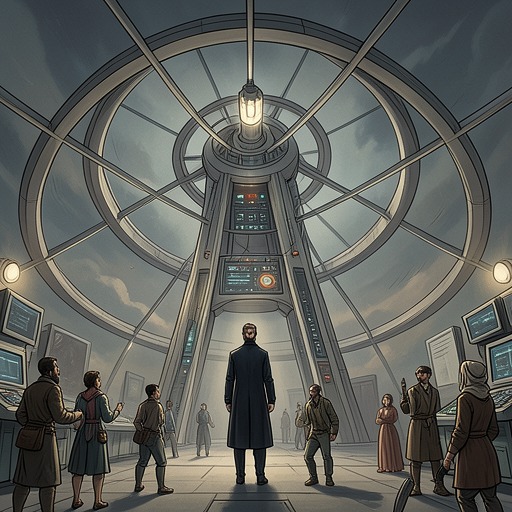
Misse and Muar discover the Source at the summit of an otherwise deserted tower in the Core Worlds. The tower contains scry-views of the surrounding Core Worlds and stairs leading through its interior, but the flow of essence draws them upward to a vast, sunlit stone ring miles wide beneath a glass dome. The sun above it is genuine rather than one of the false suns usually created for Domains, giving the chamber a scale and physical reality unlike an ordinary administrative office.
At the center floats a liquid sphere between two rings of crystal pylons. The essence has become so dense that it has taken physical form. One ring sends essence inward, apparently drawing it from elsewhere in the System, while the other extracts essence from the sphere. Yet the Source is not merely being depleted: Misse and Muar can feel new essence forming spontaneously within the vortex. Its appearance therefore makes the System’s central resource visible as a material phenomenon, simultaneously reservoir, engine, and circulation point.
Function in the Essence Economy
The Source is the benchmark against which the System’s entire production can be measured. Misse’s later access to the True Core’s expanded Interface shows that a small share of the System’s surplus comes from the Inner Worlds, while a much larger share comes from the War Worlds. The records also identify the individuals producing the greatest amounts of essence, most of them Alums whose names Misse does not recognize even as a deity.
The economy is sharply stratified by rank. Transactions before Bismuth are almost irrelevant beside the transition into Bismuth, which draws heavily on the System’s reserves and marks the point at which mortals begin generating essence rather than merely consuming it. Those who continue advancing remain effectively in debt until Alum; at Alum, their activities begin producing large quantities. The entire Inner Worlds can barely match the output of the top thousand Alums in the Core, while the whole Core population, including the many Alums outside that leading group, only barely matches the amount supplied by the True Core Essence Source itself.
This comparison reveals the Source’s extraordinary disproportion. The System’s worlds and inhabitants are not the primary explanation for its continued abundance; the Source remains the dominant contributor. At the same time, the System’s rules allow failed or incomplete advancement to contribute something, preserving a connection between ordinary populations and the larger economy. The Source thus sits at the intersection of extraction and grace: it sustains the hierarchy, but its output also compensates for the limited production of those who never reach the highest ranks.
Relation to Growth and Industrial Power
The Source’s importance becomes clearer beside Cato’s expansion. At an early stage, Cato hides in a lunar crater with only a few drones, a rudimentary solar array, and a hacked-together manufactory. The arrangement can process silicon, carbon, and lighter elements, but proper metals remain scarce, making growth painfully slow. The narrative’s observation that exponential growth can be incredibly slow at first describes a material accumulation that has not yet reached critical scale.
Later, the same principle operates across hundreds of worlds. Cato establishes factories, mines, refineries, solar-panel production, atmospheric extraction from gas giants, and the processing of frozen volatiles on icy asteroids. Only a small fraction of the resulting industrial base is devoted directly to weapons and Warframes, while a larger portion can be rapidly retooled between industry and war. The Source belongs to the same logic of delayed accumulation followed by overwhelming consequence: a system may appear stable while resources build beneath the surface, then become vulnerable once production, access, and weaponization converge.
Vulnerability and Final Confrontation
The Source is not invulnerable simply because it is immense. When Misse assumes the role of True Deity, she gains access to the True Core and shares that access with Muar, but Cato remains outside the reach of the System’s Interface. His presence and works cannot be found through its normal authority. This makes the Source both the center of Misse’s power and the place where that power cannot fully comprehend its enemy.
During the confrontation with Cato, Misse and Muar restrict the System’s influence. The System warns that the action is dangerous and requires additional authorization, which Misse supplies. The System then withdraws toward the True Core, the essence drain stops, and the Source provides the supply instead. Misse initially believes that this change has neutralized Cato’s weapon and treats the result as proof that his attack no longer matters.
The apparent victory reverses almost immediately. Around the War Worlds, physics resumes: a hundred suns that had been held apart are suddenly close enough for gravity to take hold. The System forcibly accelerates and relocates Misse and Muar to the Source as warnings erupt. From the Source, the Core region appears only as furious white through the scry-views, yet the essence totals fall rapidly even under the fastest available acceleration. Cato’s weapon has evidently carried a hidden trigger, waiting for Misse to respond.
The Source therefore changes from an unseen foundation into an exposed crisis site. Misse’s instinct is not to defend a single chamber or preserve a symbolic treasure, but to prune everything possible in an attempt to stop the loss. The reservoir’s significance lies precisely in this scale: an attack on it threatens the lifeblood of the entire System, and the response becomes a desperate effort to reduce the network before its central source is emptied.
Narrative Significance
The True Core Essence Source gives physical form to the System’s central contradiction. The System presents itself as an ordered structure of advancement, reward, and administration, yet its deepest power depends on a hidden concentration of essence whose output exceeds that of whole populations and even the greatest assemblages of high-ranking individuals. The Source is the material secret beneath the visible hierarchy.
Its movement through the narrative also mirrors the book’s treatment of exponential growth. First it is encountered as an astonishing, almost sacred object: a liquid sphere of raw essence, enclosed by crystal pylons and capable of generating more than it consumes. Later, its output is quantified against the Inner Worlds, War Worlds, Alums, and the Core’s population. Finally, it becomes the site of rapidly cascading loss. The object’s apparent permanence gives way to systemic dependence; the font that seems to guarantee endless supply becomes the point at which the System’s accumulated vulnerabilities converge.
As a result, the True Core Essence Source is not merely a power reservoir. It is the System’s heart, accounting ledger, reproductive engine, and exposed failure point. Cato’s conflict with the System reaches its decisive material expression through the Source: whoever controls its flow can preserve, restrict, or destabilize the order built around it, while the Source’s collapse threatens consequences far beyond any single world or deity.