True Core Interface
Systema Delenda EstThe True Core Interface is the master administrative intelligence of the True Core, the ancient system from which the lesser Interfaces appear to have been patterned. Its discovery transforms Misse Eln from a powerful participant in the System’s politics into its uncontested administrator. Through it, she claims the vacant mantle of True Deity, receives access to the True Core’s functions, and attempts to reshape the System against Cato. Yet the Interface also reveals a decisive boundary: it cannot find or directly affect anything belonging to Cato, and its defensive measures ultimately fail to prevent the catastrophic loss of essence caused by his weapon.
Discovery in the True Core
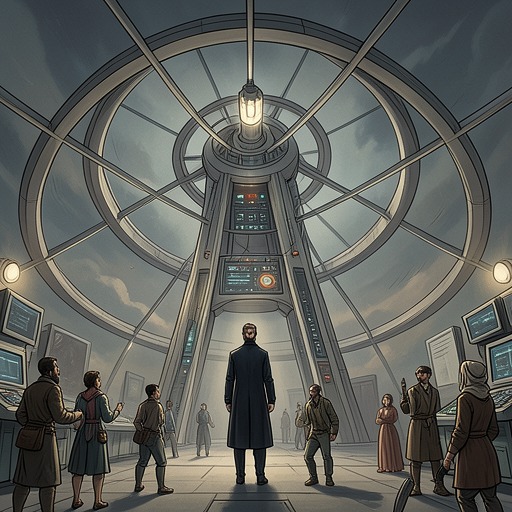
The Interface becomes accessible only after Misse Eln and Muar reach the innermost region of the True Core. They find a vast sunlit ring of stone beneath a glass dome, with crystal pylons surrounding a liquid sphere of extraordinarily dense essence. The sphere is not merely stored energy: it functions as a Font that generates more essence while one set of pylons feeds it and another draws from it. In that setting, the Interface announces that 6.7 million years have passed since it was last accessed, that its protections have lapsed, and that its administrative functions have reset. It then presents Misse with the decisive question of whether she wishes to claim it.
Misse interprets the prompt as evidence that the elder gods of the True Core departed long ago, leaving the highest authority for a successor capable of taking it. She also recognizes the political danger of the discovery. The gods who can reach the True Core have generally been confined by Clan interests, while the established wisdom that the Core must never be disturbed has allowed its abandonment to remain untested. Misse selects the only available choice, and the mantle of True Deity settles onto her as her personal Interface merges with the immense intelligence.
Authority and Functions
The merged Interface offers Misse an immense range of powers and possibilities, although she immediately closes the display rather than attempting to master every function at once. Its authority is not merely symbolic. The True Core Interface gives her access to all True Core functions, and the narrative presents her new rank as unchallengeable by anyone else in the System unless she voluntarily shares that access. Muar, who has not yet reached Alum and therefore does not qualify for Deity status, receives access because Misse chooses to trust him and because he is committed to the System rather than to his Clan or to the senior gods who dominate its politics.
The Interface enables direct adjustments to the structure and development of the System. Misse finds options for changing the rate of expansion and even for converting a world into another True Core, though she rejects the latter as strategically ruinous: it would divide the essence gathered by the existing Core, consume enormous resources, and weaken the protection she is trying to build against Cato. The same menu allows her to promote worlds from Inner Worlds to Core Worlds or from the frontier to Inner Worlds. Such elevation can shield her Clan while increasing its prestige, and the Interface gives her the means to accelerate a process that would otherwise occur naturally.
Portal connections are equally mutable. Muar proposes removing the restrictions that impede the frontier, arguing that Cato’s presence across the System has already made those limits crippling. Misse accepts the recommendation and revokes the restrictions through a simple instruction. She and Muar then begin planning a broader rearrangement of the System’s connections, reasoning that millions of years of uncontrolled expansion and Clan politics have made its structure unnecessarily tense and inefficient. Muar takes responsibility for changing portal connections, while Misse reserves world promotion and the larger administrative decisions for herself.
The Interface also makes it possible to examine the System at a scale unavailable to ordinary gods. Misse works through hundreds of display windows at once while searching for the controls she needs, and later uses the True Interface to assess the state of the System, the frontier, and the Core. Its power is therefore both executive and diagnostic: it can alter the network, elevate worlds, regulate expansion, and expose the consequences of those interventions.
Cato and the Boundary of System Power
The True Core Interface initially appears to offer Misse the perfect instrument for confronting Cato, but its reach stops at the boundary between the System and what lies outside it. Misse discovers that none of Cato’s works or his presence can be found within the Interface’s reach. His industrial expansion, forces, and preparations remain absent from the administrative field, confirming that Cato is not simply another System actor with hidden permissions. He is external to the structure the Interface governs.
This limitation shapes Misse’s strategy. She infers from Cato’s lack of immediate aggression that his presence in the Inner Worlds may not represent his full force, or that he is constrained in ways she can exploit. She hopes to use the time he gives her to consolidate power, understand the True Deity functions, and pull worlds into the Core, where she believes he cannot breach the barrier. The Interface thus becomes an instrument of defensive centralization: it cannot attack Cato directly, but it can strengthen the territory and institutions he has not yet reached.
Cato’s own expansion gives this limitation sharper meaning. His growth begins from a crater on the moon, where a few drones excavate regolith for volatiles and metals while a rudimentary solar array powers a hacked-together manufactory. Later, after industrialization spreads across hundreds of worlds, factories, mines, refineries, gas-giant atmosphere extraction, frozen-volatile processing, and immense solar-panel fields turn that modest beginning into a distributed production base. The Interface cannot register or command this external industrial network, even though it becomes one of the decisive forces in the System-wide conflict.
Failure at the Font
The Interface’s administrative supremacy does not guarantee control over the consequences of Cato’s attack. When Misse and Muar restrict the System’s influence, the System requires additional authorization, which Misse supplies. The System then withdraws toward the True Core, stopping the essence drain and leaving the Font to provide for them. Misse believes the maneuver has neutralized Cato’s weapon and treats the result as proof that his attack no longer matters.
The apparent victory reverses almost immediately. Once the System’s influence is restricted, physics resumes around the War Worlds: a hundred suns that had been held in an unnatural arrangement are suddenly close enough for gravity to take hold. The disturbance is only a prelude. The System forcibly accelerates and relocates Misse and Muar to the Font while warning them that something is happening in the Core region. The scry-views show only a furious white glare, yet the essence totals fall rapidly even under the fastest available time acceleration.
Misse realizes that Cato’s weapon contains a delayed or hidden trigger, activated by her attempted response. The True Core Interface can issue warnings, move its administrators, and display the collapsing essence reserves, but it cannot simply undo the attack. Misse orders that everything possible be pruned, turning the Interface from an instrument of confident expansion into an emergency mechanism for limiting systemic loss.
Narrative Significance
The True Core Interface embodies the paradox at the center of the System’s power. It is ancient enough to have been untouched for millions of years, broad enough to regulate expansion and rewrite the relationship between worlds, and authoritative enough to make Misse Eln’s claim effectively uncontestable. Nevertheless, it is also dependent on the boundaries and assumptions built into the System. It can reorganize what belongs to the System, but it cannot comprehend Cato’s external infrastructure; it can restrict influence and monitor essence, but it cannot guarantee that a defensive command will produce a stable result.
Its role therefore changes from revelation to weapon, from weapon to administrative instrument, and finally from instrument of mastery to witness of systemic failure. Misse’s claim of the Interface makes the True Core politically active again, but the later collapse demonstrates that supreme access is not the same as omnipotence. The Interface can centralize authority, accelerate growth, and rearrange the System’s architecture. It cannot abolish the external enemy whose industrial logic grows beyond its map, nor prevent the consequences when an attack has already entered the structure it was built to govern.