War Worlds
Systema Delenda EstWar Worlds is the System’s vast militarized region, defined by hostile environments, high-rank monsters, elite adventurers, and the political struggle among the great factions. It functions simultaneously as a frontier, a proving ground, a resource network, and a strategic barrier around the Core. Cato’s expansion turns the region into the principal theater of a conflict between industrial growth and inherited power: his production systems spread across hundreds of worlds, while guilds, clans, independent gods, and System authorities attempt to contain or redirect that growth.
Definition and Strategic Setting
The War Worlds are not a single planet but a region composed of multiple dangerous worlds and associated settlements, dungeons, outposts, and factional territories. Their scale is difficult to grasp even from the perspective of advanced observers. The region includes at least five enormous war-worlds arranged in a Klemperer Rosette around a System construct. Each has a diameter greater than Jupiter’s, while several white dwarf stars orbit them in arrangements that defy ordinary gravitational expectations. Their apparently aesthetic orbits demonstrate that the War Worlds are governed not only by physical mass and distance but also by the System’s reality-altering rules.
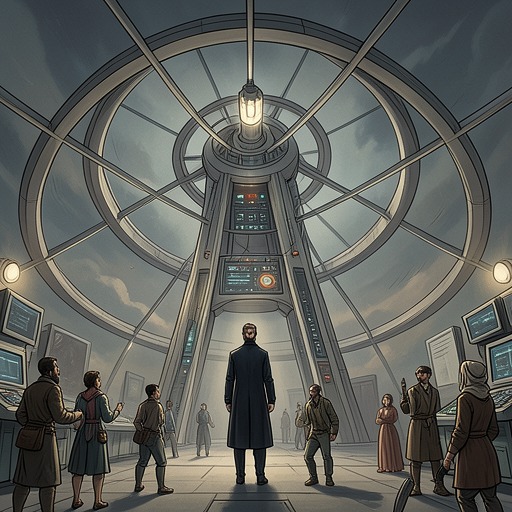
The five-world arrangement surrounds a construct whose details cannot be resolved by ordinary eyesight, and there is no anchoring star to make the region obvious from the Inner Worlds. This concealment gives the War Worlds a double character. They are visibly immense once reached, yet their most important structure is hidden behind the System’s unusual spatial and physical organization. The region therefore serves as both an observable military theater and a threshold to a deeper, partially inaccessible center of power.
The War Worlds are also tied to the System’s resource economy. Their inhabitants rely on essence, rank advancement, dungeons, monsters, artifacts, and factional support networks, while the System’s physics prevents the worlds from being treated as ordinary planets. When the System’s influence is later withdrawn, the consequences reveal the artificiality of the region’s stability: suns that had been held in impossible proximity immediately begin to respond to gravity, creating a catastrophic interaction among a hundred stars.
Factions, Guilds, and Local Power
The region’s political order is fragmented among large factions, clans, independent gods, and specialized guilds. This fragmentation makes military coordination difficult, especially because forces cannot be moved through the portals in any meaningful way. Each world must maintain its own armies and production capacity, and the worlds belonging to independent deities are particularly vulnerable because they lack the support networks and essence reserves available to clan-controlled worlds.
The Guild House of Punchy Bastards illustrates the region’s unusual political culture. Despite its name, which is notably irreverent beside the grander institutions competing for power, the guild is exceptionally elite. Its invitation to Raine and Leese comes from an Alum, the first member of that rank they have seen, who appears only long enough to tell them to join and then vanishes. The guild has no clear recruitment policy, remains highly insular, and owns exactly one town on each War World. It conducts no visible political maneuvering or recruitment campaign and owes no fealty to the major factions, making it an independent power rather than a subordinate branch of a larger authority.
The guild’s facilities express the extreme scale of War World combat. Its arena is not a simple circle but a miniature world covering several hundred square miles of mountains and valleys. Such an arena is necessary because Azoths can treat ordinary terrain as almost irrelevant: Raine and Leese can cut mountains in half, and Lorraine may possess comparable ability. A two-against-one sparring match there is therefore less a casual duel than a controlled demonstration of power, skill, and uncertainty. Even experienced fighters must account for the possibility that a human operating within the System may possess unexpected advantages.
The region also contains formal religious and factional institutions. Muar and his companions belong to the Five Gods Alliance, which has aligned itself with Misse. After a successful assault, Muar receives System rewards for killing a Unique Guardian Elite with a single party and claims Outpost Magon. The outpost is protected by heavy walls against Azoth-ranked wildlife, contains a dungeon entrance beside its Nexus, and includes a plant-specialty crafting building. Its unclaimed status allows Muar to enter simply by touching the gate, turning military success into both personal advancement and a strategic asset for the alliance.
Industry, Expansion, and Surveillance
Cato’s relationship with the War Worlds is defined by industrialization rather than by the movement of a single centralized army. Over years of growth, his operations spread to hundreds of worlds. Each world develops factories, mines, refineries, solar-panel production, atmospheric extraction from gas giants, and the processing of frozen volatiles from icy asteroids. A small portion of each production base is devoted to weapons and Warframe construction, while a larger portion remains designed for rapid conversion between industrial and military purposes.
The distinction between a small percentage and a large force becomes meaningless at the scale Cato achieves. Even when only a fraction of each world’s infrastructure is assigned to weapons, the absolute result is staggering after years of uninterrupted growth. War Worlds therefore become part of a feedback loop: industrial capacity produces weapons, weapons secure or expand territory, and expanded territory supplies more industrial capacity. The region’s strategic balance shifts gradually and then abruptly, as exponential growth turns apparently modest local investments into a system-wide military presence.
This expansion leaves traces even when direct evidence is absent. Goyle surveys the Inner Worlds over a period of months and finds indicators of Cato’s presence on every world he visits. Nearer frontier worlds seem to contain more such evidence, although Goyle refuses to generalize beyond what he can establish. When he reaches the War Worlds at the core, however, he finds no comparable signs of Cato-related activity. He even rises above the floating islands and looks toward the Core Worlds, where the War Worlds are surrounded by the dancing structures of the region, but still finds nothing.
The contrast is strategically important. Cato’s influence is pervasive across the Inner Worlds yet deliberately concealed or absent in the core War Worlds. Goyle records the findings in memory crystals and delivers them to a Temple, receiving a divine favor as payment. The War Worlds thus become a zone of intelligence failure: they are close to the center of power, but their architecture, monsters, and System protections make direct observation unusually unreliable.
Combat, Advancement, and Social Mobility
The War Worlds are a setting in which personal advancement and military danger are inseparable. Raine and Leese rise rapidly after joining Punchy Bastards, aided by their cooperation with Lorraine and by Cato’s continual improvement of their combat brains. Their development is so extreme that they can fight Alum-rank monsters, a feat normally requiring multiple groups of Azoths. Their progression is not merely a matter of higher numerical rank; it depends on coordination, augmented biology, tactical refinement, and the unusual advantages created by their partnership.
Even so, the region preserves a sharp hierarchy. The sisters remain unable to challenge Alum-rank people such as the guild’s senior members, and their encounter with Goyle exposes how vulnerable they are to someone operating at that level. The combat brains help suppress panic and preserve concentration when an immensely powerful observer discovers them, but emotional stabilization cannot erase the underlying disparity in power. The War Worlds make advancement possible while constantly reminding ambitious characters that every new rank reveals a larger order above it.
Kiersten’s ascent with Morvan, Justin, and five others shows the same structure from another angle. After more than sixty years of effort, an eight-person raid under severe restrictions carries them to Alum, the highest rank the System appears to offer. Their celebration is triumphant, yet the achievement immediately produces uncertainty: the old goal of rising through the ranks has ended, and a new schema of advancement begins beyond it. The War Worlds therefore convert success into a fresh threshold rather than a final resolution.
Their dangers are not limited to ordinary combat. Azoth-ranked wildlife roams the region, Alum monsters occupy floating islands, and dungeons and world elites provide both advancement opportunities and lethal risks. A blow that would kill someone at a lower rank may only draw blood from an Azoth, while artifacts can deflect or mitigate apparently fatal attacks. The War Worlds’ violence is consequently governed by layered thresholds of durability, status, equipment, and System protection.
The Core Boundary and the Region’s Collapse
The War Worlds become decisive when Cato attempts to understand and reach the Core. Telemetry from the Sydean Lineage reveals the five-world rosette and the System construct at its center, allowing Cato to locate the region by matching spectral signatures from telescopes distributed across the Inner Worlds. Yet reaching the Core is not equivalent to conquering it. The worlds are too large, too dependent on System processes, and too thoroughly stabilized by essence for ordinary industrial or military methods to work.
Cato’s planning therefore treats the War Worlds as a structural problem rather than merely an enemy territory. If essence-based physics were removed, the worlds would collapse and their stars would undergo violent interactions. The danger is eventually demonstrated when Misse restricts the System’s influence and forces it to pull back toward the True Core. Essence drain stops, but the War Worlds’ ordinary physics returns: a hundred suns are suddenly almost touching, and gravity begins to act on them.
The resulting image transforms the region from a battlefield into evidence of the System’s hidden fragility. Misse is forced into fast-time and relocated to the Font while the Core region becomes an unreadable field of furious white. Essence totals fall rapidly, suggesting that Cato’s weapon has triggered a deeper crisis. The War Worlds’ apparent permanence is exposed as a maintained condition, and the region’s immense military architecture becomes inseparable from the System’s vulnerability.
War Worlds therefore occupy a central structural position in the narrative. They are the place where elite combat, guild independence, clan politics, industrial expansion, intelligence gathering, and cosmological instability converge. Their worlds are arenas, factories, fortresses, and traps at once. For Cato, they represent the obstacle that cannot be solved by ordinary conquest; for the System’s factions, they are the foundation of inherited power; and for the narrative as a whole, they embody the principle that a civilization built on artificial stability may appear invincible until the conditions sustaining it are withdrawn.