Younger Urivan Lineage
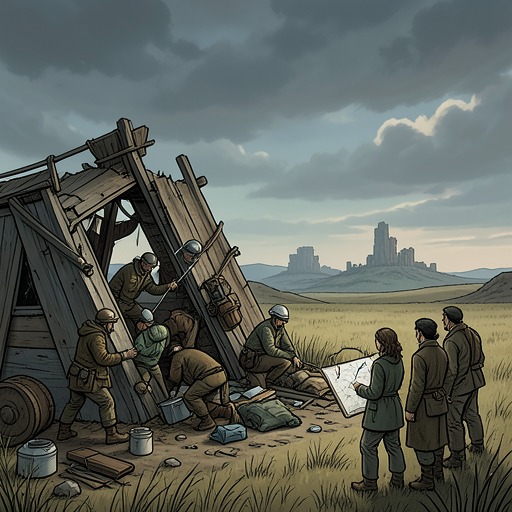
Systema Delenda EstThe Younger Urivan Lineage is a Urivan lineage devoted to protecting and managing the people in its charge. Its significance lies less in a detailed institutional history than in the contrast it creates with Yaniss’s alternative model of postbiological reconstruction: where Yaniss wants rapid integration and education, the Younger Urivan Lineage is remembered for guarding its dependents closely, preserving a more controlled relationship between custodian and community.
Custodial Structure
The lineage appears in the context of postbiological populations being reorganized after their contact with the System. When Temek Uriv and Meshka Uriv arrive as fully digital entities at Yaniss’s orbital habitat, Temek remarks that the Younger Urivan Lineage had been highly protective of its charges. The observation identifies the lineage’s defining method: it does not merely provide shelter or technical access, but actively controls the conditions under which its dependents encounter outsiders and new information.
That protectiveness also connects the lineage to Initik’s broader project on Uriva. Yaniss explains that her own program is designed to bring the inhabitants of her habitat up to speed as quickly as possible, while the Uriv project is essentially arranged so that Initik can take over. The Younger Urivan Lineage therefore belongs to a political and educational structure whose endpoint is Initik’s authority, not simply the autonomous development of a newly formed community.
Contrast with Yaniss’s Program
Yaniss’s habitat operates according to a different philosophy. She grants the digital visitors permission to speak with the local Ikent population, while warning them not to harass those who are fresh from the System. Her administrative control allows her to restrict access to communications and surveillance systems, but she treats the visitors as guests and wants her residents to acquire knowledge quickly. She has even adopted cultural material from the history of Summer Civilizations rather than spending effort reconstructing an entirely distinct Ikent culture for people who remember nothing from before the System.
Against this background, the Younger Urivan Lineage’s protectiveness becomes a meaningful institutional contrast. Its charges are treated as a population requiring insulation and supervision; Yaniss’s residents are treated as people who must be exposed to useful knowledge and accelerated into competence. Neither approach is presented through a complete constitutional description, but the difference is concrete: the lineage limits contact, while Yaniss opens contact under controlled permissions.
Relation to Uriva and Initik
The Younger Urivan Lineage is part of the wider political environment of Uriva, a world Initik has guarded against foreign warlords, clans, and gods since the System’s arrival. Initik monitors promising candidates, divine users, and advanced buildings, while presenting his role as guidance rather than total surveillance. The lineage’s protective behavior fits this larger custodial order, in which Urivan society is defended from external intrusion while its development remains subject to the direction of its divine guardian.
Initik’s own history explains the depth of that arrangement. He remembers the System appearing while he was still hunting, before his people had settled into agriculture or animal husbandry. The System ended hunger and wandering by supplying a ready-made framework for survival. That early intervention produced a long institutional path: Urivan society did not develop outside the System’s structures, and later lineages became responsible for managing populations already shaped by them. The Younger Urivan Lineage’s guarded treatment of its charges is consequently not an isolated habit but part of a civilization-scale response to dependence, continuity, and the danger of outside influence.
Narrative Significance
The lineage embodies the tension between protection and agency that recurs throughout the System’s history. Its guardianship can preserve vulnerable people from manipulation, yet the same protective boundary can also keep them dependent on the authorities who claim to defend them. Yaniss’s impatience with that model does not erase the danger she recognizes; she retains administrative safeguards and can cut digital visitors off from the habitat’s networks. Her difference is that she uses control as a temporary means of education, whereas the Younger Urivan Lineage is associated with protection as an organizing principle.
The brief reference is therefore important because it gives the reader a political vocabulary for competing forms of postbiological governance. The Younger Urivan Lineage represents continuity through custody and Initik’s eventual assumption of control. Yaniss represents rapid preparation through selective openness. Their contrast sharpens the broader question of whether a population emerging from the System should be sheltered until it is safe, or exposed to wider knowledge so that it can become capable of governing its own future.