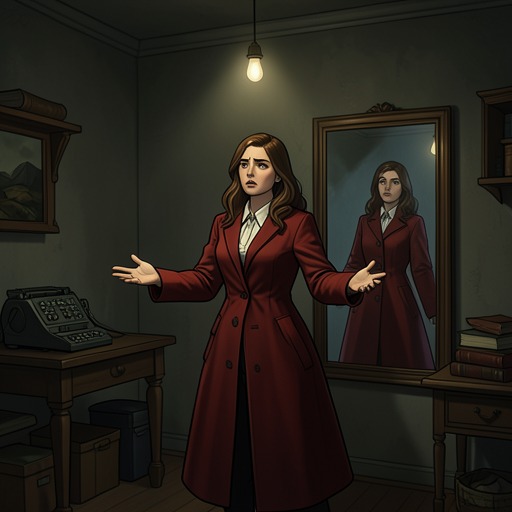
“By the powers of three times three” invisibility spell
Tales From Otherworld: Collection OneThe “By the powers of three times three” invisibility spell is the charm Camille D’Artigo attempts after years of failed practice, only to discover that its backfire makes her clothes disappear while leaving her visible. A spell meant to hide its caster instead turns an ordinary afternoon at The Indigo Crescent into a public embarrassment and then a practical trap: Camille cannot safely leave the shop until nightfall, and the effect lasts a week.
Purpose and Form
Camille has been working on the spell for several years, but her previous attempts produced only a fizzle and spurt, then nothing. On an unusually quiet, sunny afternoon in Seattle, with customers out enjoying the parks rather than browsing her bookstore, boredom prompts her to try magic that has repeatedly gone wrong. She specifically avoids anything offensive and chooses this charm partly because it requires no components.
She retreats to the back hall, focuses, and whispers the three-line incantation: “By the powers of three times three, / By cape and cloak, by breast and knee, / Let others lose their powers to see me.” Its wording calls for others to lose the ability to see Camille, making concealment the apparent aim. The rhyme moves from a broad invocation of power to the clothing and body, then states the intended result. That concentration on cape and cloak becomes sharply ironic when the spell’s actual effect is confined to what she wears.
The Backfire and Its Discovery
After casting, Camille waits and sees no change. Her hand remains visible, and she concludes that the attempt has failed as before. She returns to the front of the shop and resumes shelving used books. About twenty minutes later, a young customer enters, heads for the science-fiction section, and turns toward her as if to ask for help. Instead, he stares at her breasts and then looks down at her crotch, unable to speak.
Camille initially reads his behavior through her awareness that her Half-Fae heritage gives her an effect on human men. She is angry at his staring and demands to know whether he cannot see her face. When Iris enters and urgently tries to get her attention, Camille assumes the house sprite is interrupting her reprimand. Iris’s alarm, followed by her insistence that Camille is naked, supplies the recognition Camille lacks: Camille can see her own clothes, but Iris cannot. The mismatch between Camille’s perception and the view available to someone else exposes the spell’s real operation.
Camille protests that she is dressed and describes her skirt, panties, and bustier, but Iris sees none of them. When Camille grabs a jacket from the coat rack and puts it on, Iris cries out that the jacket has vanished too. This second demonstration turns the first misunderstanding into a clear rule: garments become invisible as Camille puts them on, while her body remains visible. The customer’s staring is thus explained without making his response simply a consequence of her natural allure; the spell has left her apparently unclothed to everyone around her.
Confinement and Immediate Response
Once Camille understands what happened, she tells Iris about the charm and recognizes that it backfired rather than fizzled. Iris laughs at the absurdity, and Camille admits that the situation sounds funny even to her, though the laughter does not solve the immediate problem. Camille cannot walk to her car without exposing herself to everyone who might see her, and she does not know how long the magic will last. Blushing, she drops into her office chair and describes herself as trapped.
Iris proposes a specific way through the predicament: Camille should stay out of sight in the back of the shop until dark, when one of her sisters can come and get her, then remain at home until the spell wears off. Iris offers to take care of the bookstore in the meantime. Camille also worries about the customer she had just scolded and wonders what he must think of her; Iris says she will handle him. The episode turns a failed experiment into a short-lived restriction on Camille’s movement, while Iris’s practical intervention keeps the incident from becoming a public spectacle.
Duration and Significance
The spell does not wear off by nightfall or after a brief wait: it takes a week. Its duration makes the mishap more than a momentary comic reversal. Camille must live with a magical effect that she cannot control, cannot immediately undo, and cannot safely disregard when choosing what to wear or whether to go out. The evidence establishes the consequence clearly, without explaining a counterspell or any further workings of the magic.
Afterward, Camille decides to leave invisibility to somebody else. Her rueful reasoning is grounded in the spell’s most concrete consequence: a closet full of beautiful clothes is no use if nobody can see them. The charm’s failure therefore reverses its promise at two levels. Instead of making Camille unseen, it makes her clothing unseen; instead of giving her useful concealment, it prevents her from appearing dressed. The contrast between the incantation’s confident rhyme and its humiliating, week-long result captures Camille’s recurring frustration that her magic can backfire and gives this particular spell a lasting place among the mishaps she remembers.