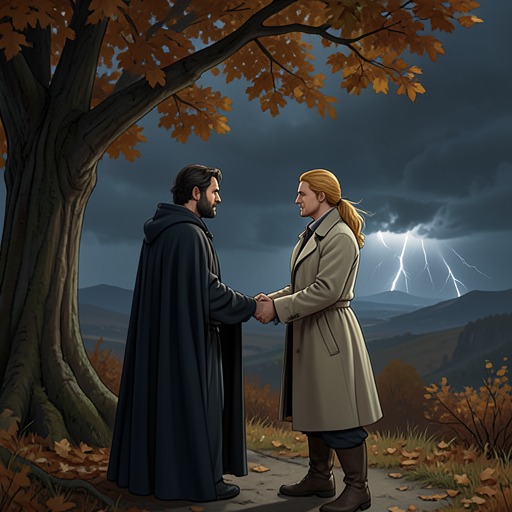
Autumn
Tales From Otherworld: Collection OneAutumn in the book is more than a calendar setting: it brings a particular weather and landscape, but also gathers death magic, family ritual, intimacy, and foreboding into the same part of the year. In Delilah D’Artigo’s account, the season is at once melancholy and comforting, a time when the world’s dangers seem closer and its familiar places take on renewed meaning.
Seasonal Identity and Magical Associations
Autumn is identified as the season of The Autumn Lord, and Delilah feels Hi’ran’s presence in the trees, flames, and chill air. The season’s natural signs are concrete: leaves are leaving the trees, the mid-October night is cool and clear, and stars shine above the gathering. Yet the season is not simply a backdrop. Delilah experiences it as a force that gives the evening a distinct atmosphere and connects the surrounding landscape to powers beyond the human household.
The approach of Samhain intensifies that connection. Autumn becomes the season of death and of the witch, associated with Camille D’Artigo’s Death magic; it is also Menolly D’Artigo’s season, linked to vampirism. For Delilah, newly a Death Maiden, the season has become hers as well. This gathering of different identities and powers makes autumn communal as well as personal: the three sisters’ roles meet within one seasonal frame, though each encounters it through a different supernatural condition. Delilah describes the resulting world of darkness and flame as both sorrowful and reassuring, holding melancholy and comfort together rather than resolving one into the other.
The Autumn Gathering at Birchwater Pond
Shortly before Autumn Whispers, Delilah and Shade spend an October evening at Birchwater Pond, where the household has installed picnic tables, a fire pit, and a covered shelter for rituals and holidays. They choose the pond for privacy, sitting beside a bonfire as leaves whirl in the wind. The scene’s seasonal details—the crackle of burning wood, the clear sky, and the bite of the cold—make autumn a setting for closeness as well as reflection.
The Smoky quartz ring on Delilah’s finger has not come off since she accepted it. She feels it as part of her nature and as a bond to Shade that she does not yet fully understand. Their evening moves through small, bodily moments: Shade hands her a stick and marshmallows; she roasts four, burns her mouth by biting too soon, and jokes about living dangerously. This domestic play sits beside a stronger awareness of the season’s supernatural charge. Delilah senses Hi’ran, and Shade says that the Harvestmen are alert and that something is approaching, though he cannot place it within the natural order. Samhain’s nearness therefore carries both intimacy and warning: the lovers draw closer while the world around them feels unsettled.
Weather, Work, and the Household Calendar
Autumn also appears through the practical work of preparing for weather. About a month before Autumn Whispers, one year after Camille D’Artigo and Trillian’s wedding, Camille is in Belles-Faire on a crisp October day. Rainy weather is approaching, and she thinks ahead to the first frost. In the herb garden, the kitchen herbs have been moved to the greenhouse attached to Iris’s cottage, while Camille’s magical herbs remain inside the magical circle where she planted them until they are ready to harvest. She considers composting around the perennials to protect them from the coming cold.
These tasks place magical cultivation within ordinary seasonal care. The herbs have different needs and locations, but both the plants and the household require preparation for the coming weather. Camille’s walk toward Birchwater Pond is interrupted when Delilah gives her the household notebook and asks her to plan repairs and replacements before the rainy season. Iris is near having twins, and Hanna does not yet know enough about running the household and cannot read English. The exchange makes autumn’s approach a matter of shared responsibility as well as changing conditions: the season’s work must be taken up by someone even amid personal frustration.
A separate Thanksgiving scene gives this seasonal domestic rhythm a more comic register. The kitchen is busy with preparations, including soup, biscuits, potatoes, eggs, and pies, when Smoky arrives carrying a large, still-living turkey. The bird’s unexpected presence disrupts the intended meal. Set against the ominous autumn atmosphere at Birchwater Pond, the episode shows the season also as a time of crowded kitchens, holiday plans, and unruly household surprises.
Memory, Danger, and Seasonal Change
Autumn’s landscape can carry memories that are not easily softened. On her way to Birchwater Pond, Camille passes the place where Hyto captured her and shudders as the memory returns. Trees destroyed by his father have been cut down, and rose bushes have been planted in their place, an effort by Smoky and the men to replace painful associations with something more beautiful. The roses bloom well into autumn, and their spicy scent briefly holds Camille’s attention. The planting changes the appearance of the site, but it does not erase what happened there; on this October evening, Camille still feels anger and distress even as she pauses to breathe and continues toward the pond.
At dusk, she notices lights at the grotto that should not be there at that time of year. The picnic tables, benches, and shelter are familiar places for rituals and holidays, but the unexpected lights make the familiar setting briefly strange. Camille considers possible supernatural dangers before she hears music from one of her favorite bands and recognizes that the scene is not what she first feared. Autumn thus repeatedly unsettles the boundary between routine and threat: a cultivated garden can preserve the trace of violence, and a known gathering place can look ominous when encountered unexpectedly.
Seasonal Position in the Narrative
Several short episodes are anchored by explicit seasonal dates rather than by a single continuous autumn narrative. The pond gathering is set in mid-October shortly before Autumn Whispers; Camille’s anniversary episode falls about a month before that book and one year after the wedding. Elsewhere, the first meeting of Maria D’Artigo and Sephreh ob Tanu is dated shortly after the summer solstice, marking a different point in the annual cycle. These temporal markers let seasonal change orient separate strands of family history and present-day life.
Across those strands, autumn links weather and ritual to changes in responsibility and perception. The approaching rains prompt gardening and household planning; Samhain brings the sisters’ supernatural roles into focus; falling leaves and fire frame Delilah and Shade’s closeness; and the altered garden at Hyto’s former capture site shows how the past persists within a changing landscape. Autumn’s significance lies in this double quality: it is a recognizable season of cooling air and preparation, but also a threshold where intimacy, memory, and supernatural unease gather together.