Fae
Tales From Otherworld: Collection OneFae occupy a boundary between the human and supernatural worlds, and that boundary gives them both unusual capacities and particular burdens. Their half-Fae heritage can produce a natural allure over humans, while their magical abilities may be unreliable, socially complicated, or entangled with family and communal responsibilities. Across the evidence, Fae identity is therefore less a fixed biological label than a condition lived through the body, relationships, seasonal forces, and acts of care.
Identity and Human Relations
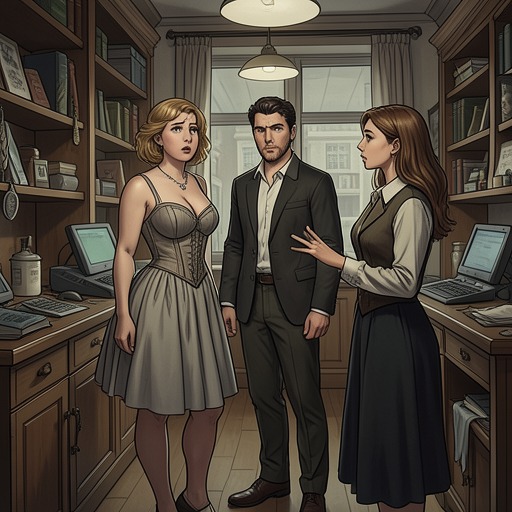
The clearest account of Fae influence appears in Camille D’Artigo’s encounter with a customer at The Indigo Crescent. Camille recognizes that she affects men because no one could be half-Fae without affecting humans. The young customer’s inability to look at her face, his stammering, and his fixation on her body turn an ordinarily familiar supernatural advantage into an uncomfortable social problem. Camille experiences the effect not as uncomplicated power but as an invasion of her own space, responding with anger and demanding that he look at her face. The scene also places Fae identity within a history longer than ordinary human adulthood. Camille regards the young man as roughly her age only by a relative reckoning, then notes that she has a good forty Earthside years on him. Her rebuke is consequently shaped by both the immediate sexualized behavior and the asymmetry between her long-lived perspective and his human one. The episode shows how Fae allure can operate without deliberate consent or conscious intent, producing vulnerability even when the Fae person appears to possess the greater supernatural power.
Magic, Work, and Unreliable Power
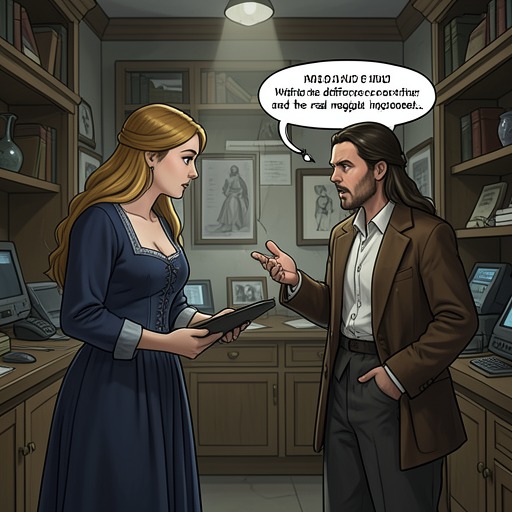
Fae magic is not presented as effortless mastery. Before Witchling begins, Camille reflects that being a Witch does not always pay and that her magic backfires half the time. During a slow August week at The Indigo Crescent, the Seattle weather keeps customers outside skateboarding and visiting parks, leaving the bookstore empty. Bored, hot, and tired, Camille decides to experiment with spells that have repeatedly gone wrong, restricting herself to harmless attempts because she does not want to blow a hole in the wall. This setting makes magic part of precarious everyday labor rather than an abstract mark of superiority. Camille is running a bookstore, watching the business fail to attract customers, and trying to turn idle time into practice. Her power is useful but unstable; it offers occupation and possibility while also creating consequences she must manage. Fae identity consequently carries a tension between extraordinary ability and mundane frustration, between the promise of magic and the practical need to avoid collateral damage.
Kinship, Transformation, and Care
The evidence repeatedly links Fae identity to families that are formed across species and states of being. In one domestic crisis, Smoky brings a live turkey into the kitchen because the birds available at the store looked too small. The roughly twenty-five-pound bird is not passive food: it is hopping mad, strutting with its chest puffed out, spreading its tail feathers, and attacking anyone who comes near. Its actions force the household to recognize it as an active participant rather than an object awaiting preparation. The confrontation also exposes the fluidity of Fae bodies. Delilah D’Artigo, six feet one inch tall in her humanoid form, shifts within the blink of an eye into a fluffy golden tabby and bounds after the bird. The turkey lunges at her, narrowly missing with its beak; Rozurial attempts to seize it and receives a hole in his hand; then Menolly D’Artigo joins the struggle, colliding with Delilah and ending up with an armful of fur and claws. The comic disorder is nevertheless a precise demonstration of a world in which species boundaries do not reliably separate person from animal, household member from prey, or domestic routine from danger. A different form of nonhuman kinship surrounds Maggie. At her crib, a large doe-eyed woodland gargoyle appears in astral form, its calico fur resembling Maggie’s. The ghostly figure bears a soft, sad expression and is recognized as Maggie’s dead mother. A bear floats down beside the child, and the resemblance between mother and daughter becomes apparent before the recognition is spoken. The scene extends family beyond biological life: the dead mother remains capable of visiting, observing, smiling, and acknowledging the living people who care for Maggie. Fae-associated supernatural existence thus does not erase familial obligation at death; it allows maternal presence to persist in another mode.
Death, Trauma, and Supernatural Difference
The Fae world also contains forms of death that remain psychologically and socially active. Hanna’s sleepwalking reveals the cost of having ended the life of her own son, Kjell, while helping Camille escape Hyto’s lair. Hanna had tended Camille’s wounds and helped her survive the aftermath of torture, but she had also saved Kjell by killing him when there was no other choice. In her waking dream, she repeatedly asks her son to forgive her, showing that necessity has not dissolved guilt. Rozurial understands the history because Camille eventually told the household about her ordeal. His response is practical and intimate: he lowers his blade, removes his duster, approaches the sleepwalking Hanna quietly, and leads her to bed. The supernatural household is therefore held together not only by magic or shared residence but by the circulation of testimony and the labor of care. Fae and other nonhuman identities exist within traumatic histories that must be carried, narrated, and answered by companions. Arial further demonstrates that supernatural identity can be governed by place-specific rules. She is Delilah D’Artigo’s twin sister, dead at birth, and resembles Delilah except for waist-length sable-brown hair. In her Were form, Arial is a leopard. Only within Haseofon, the temple of the Death Maidens, can she appear in a two-legged form; whenever she leaves, she must wander the realms as a spirit leopard. Her identity therefore cannot be reduced either to human resemblance or animal form. It is shaped by death, sisterhood, institutional space, and a restriction imposed on her movement between realms.
Seasonal and Ecological Belonging
Fae existence is also embedded in landscape and seasonal change. During a cool mid-October evening at Birchwater Pond, Delilah D’Artigo sits with Shade beside a bonfire while leaves leave the trees and stars fill the clear sky. The smoky quartz ring on her finger has not come off since she accepted it; she experiences it as part of her nature and as a bond to Shade whose full meaning she does not yet understand. Their private time is simultaneously personal and cosmological, because autumn is the season of their master, Hi’ran, whose presence Delilah feels in the trees, flames, and cold air. The Harvestmen’s alertness gives this seasonal belonging an ominous dimension. Hi’ran is understood to be watching the world, and something is believed to be underway. Nature is not merely scenery: trees, fire, weather, and seasonal power are channels through which supernatural attention becomes perceptible. The Fae relationship to the environment is consequently reciprocal and charged, combining intimacy, ritual affiliation, and foreboding. Camille’s herb garden offers a quieter version of the same connection. The kitchen herbs have been moved into a greenhouse attached to Iris’s cottage, but Camille keeps her magical herbs in the circle where she planted them until they are harvested. She greets the mandrake, watches the rain-bearing clouds, and prepares for storms, composting, and the first frost. Her care is both agricultural and magical: the garden requires attention to weather, soil, harvest, and the protective conditions under which enchanted plants can survive. Fae power is thus grounded in maintenance as much as spectacle.
Narrative Significance
Taken together, these episodes make Fae identity a structure of crossings. Fae allure crosses into human perception; magic crosses between intention and accident; bodies cross between humanoid and animal forms; the dead cross back into domestic space; and seasonal powers cross from landscape into consciousness. Yet every crossing has a cost. Camille’s allure provokes unwanted attention, her magic threatens to backfire, Hanna’s rescue leaves her burdened by guilt, and Arial’s movement is limited by the form required beyond Haseofon. The evidence also resists treating the nonhuman as simply monstrous or superior. The living turkey has agency, the woodland gargoyle remains a mother, Arial’s leopard form is a condition of existence rather than a loss of personhood, and the Fae household depends on ordinary acts of protection, gardening, cooking, and emotional consolation. Fae are significant precisely because they unsettle the human as the sole measure of personhood while preserving the concrete pressures of work, family, desire, grief, and care.