Harvestmen
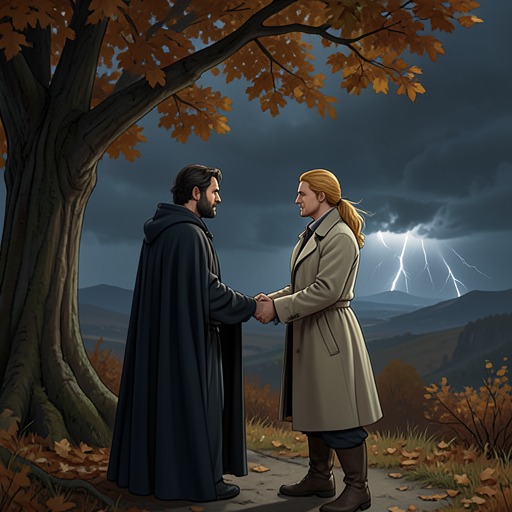
Tales From Otherworld: Collection OneHarvestmen are a supernatural force whose presence is registered through seasonal and prophetic unease rather than through a fully described institution. In the supplied scenes, they are connected to Hi’ran, the Autumn Lord, and an approaching disturbance that lies beyond the natural order. Their significance is therefore atmospheric as well as practical: they mark the point where autumnal ritual, death magic, and impending danger begin to converge.
Seasonal Allegiance and Setting
The Harvestmen appear in a scene at Birchwater Pond, where Delilah D’Artigo and Shade sit beside a bonfire in mid-October. The location has been furnished with picnic tables, a fire pit, and a covered shelter for rituals and holidays, making it both an intimate domestic retreat and a ceremonial space. Around the fire, the cool night, windblown leaves, and scattered stars establish autumn as an active supernatural environment rather than a neutral backdrop.
Delilah D’Artigo identifies the season as belonging to Hi’ran, the Autumn Lord, and feels his presence in the trees, the flames, and the chill air. In that framework, the Harvestmen are not presented as an isolated faction detached from nature; they belong to a seasonal power structure in which autumn carries the force of fire, smoke, darkness, and transition. Their association with Hi’ran gives the organization a ritual and elemental identity even though its membership, hierarchy, and ordinary duties remain unspecified.
Vigilance and Approaching Disorder
Shade states that the Harvestmen are alert because something is happening in the world. His warning follows Delilah D’Artigo’s recognition that Hi’ran is watching both the couple and the wider world. The organization consequently functions as an early-warning presence: its alertness signals that the disturbance is broad enough to concern the supernatural order, not merely the individuals gathered beside the pond.
Shade further senses that what is approaching is not part of the natural order. This distinction gives the Harvestmen’s vigilance a particular weight. They are not simply responding to the ordinary arrival of autumn or to the expected recurrence of seasonal death; they are attentive because an anomalous force seems to be moving toward the characters’ world. The narrative withholds the exact nature of that threat, allowing the organization’s alert state to create anticipation before the danger is fully revealed.
Relation to Death and Samhain
The Harvestmen’s appearance in the autumn bonfire scene coincides with Delilah D’Artigo’s reflection on Samhain. She describes the approaching festival as the season of death, the Witch, and the cauldron, while also identifying it as Camille D’Artigo’s season through death magic and Menolly D’Artigo’s season through vampirism. As a Death Maiden, Delilah D’Artigo now recognizes autumn as her own season as well.
This layered association places the Harvestmen at the intersection of several forms of supernatural identity. They are linked to a period when boundaries between life, death, magic, and seasonal transformation become especially pronounced. Yet the mood is not purely threatening. Delilah D’Artigo experiences the world of darkness and flame as comforting as well as melancholy, so the Harvestmen’s context includes communal belonging and ritual reassurance alongside foreboding.
Narrative Function and Limits of the Evidence
The organization is introduced through indirect signs: a powerful seasonal lord, a perceptive warning, and an atmosphere in which the ordinary rhythms of nature no longer seem sufficient to explain what is coming. This presentation makes the Harvestmen a force of surveillance and omen. They expand the story beyond household concerns and personal relationships toward a larger supernatural system whose agents can perceive disturbances before the protagonists understand them.
The supplied material does not establish the Harvestmen’s exact form, origin, number, leadership, territory, or direct intervention in later events. It also does not show them acting as a visible group. What it does establish is more specific: they are associated with Hi’ran, they are alert around the approach of Samhain, and their alertness confirms Shade’s sense that an unnatural development is imminent. Their narrative power comes from that restrained appearance, where the unseen organization makes the surrounding season feel watched and the approaching threat feel larger than any single character.