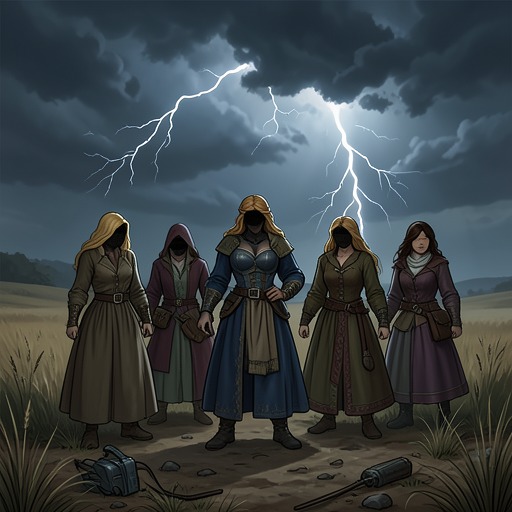
Haseofon
Tales From Otherworld: Collection OneHaseofon, the temple of the Death Maidens, is a sacred and liminal location where ordinary distinctions between waking and dreaming, life and death, and physical and spiritual form no longer hold. It is both a place of religious calling and a protected refuge for beings whose existence is otherwise constrained by the realms they inhabit.
Sacred Setting and Dream Access
Haseofon appears to Delilah D’Artigo during a dream, although the experience is more substantial than an ordinary nightmare. Her training at Haseofon has blurred the boundary between dreaming and waking, allowing the temple to stand within the sleep state as a recognizable, immense, beautiful, and stately place. Delilah approaches it with pride because she has come to love her calling and to take pride in being the Autumn Lord’s only living Death Maiden.
The temple initially presents an image of order. Inside, the other Death Maidens train, talk, read, and make music, and everything appears normal on the surface. That surface normality matters because Haseofon is not portrayed merely as a haunted or threatening site; it is a functioning community and institution whose ordinary activities coexist with prophetic knowledge and proximity to death. Its calm routines make the dread Delilah senses more unsettling rather than less.
The Death Maidens’ Threshold
Haseofon is the only place where Arial, Delilah D’Artigo’s twin sister who died at birth, can appear in a two-legged form. Arial otherwise exists as a spirit leopard whenever she leaves the temple. The restriction makes Haseofon a boundary between states of being: within its precincts, the dead can take a recognizable bodily shape, while beyond them Arial must return to a purely spiritual animal form.
That rule gives the temple a distinct authority over identity and embodiment. Arial resembles Delilah but has waist-length sable-brown hair, and in her Were form she is a leopard; Haseofon alone permits her to cross back into a humanoid appearance. The temple therefore serves not only as a residence for the Death Maidens but also as the condition that makes certain encounters possible at all, including the meeting between the two sisters.
Prophecy Within the Temple
Arial’s prophetic dream gives Haseofon its most ominous function. In a private chamber within the temple, she tells Delilah that she has dreamed of fire, smoke, collapsing buildings, people screaming as they flee lightning, and a powerful death followed by another and then ten thousand more. The vision is not treated as casual imagination. Delilah understands that no one in Haseofon dreams merely for amusement.
The Death Maidens’ dreams may concern the future or the past, but in either case they disclose realities moving across the web of possibility. Because Arial lives among them, her dreams possess the same prophetic character. She cannot identify the place, time, or people involved because the spirits will not tell her, yet she warns Delilah, Camille D’Artigo, and Menolly D’Artigo that death is coming through flame, storm, and fury, and that all three sisters will be caught within it. Haseofon thus operates as a source of partial knowledge: it reveals the scale and violence of a coming danger while withholding the information that would make prevention straightforward.
Narrative Significance
The temple separates sacred time from the ordinary world without making that separation absolute. Delilah enters Haseofon in a dream, encounters a dead sister who can briefly regain physical form, and receives a warning about deaths that may belong to the future or the past. The location consequently turns sleep into a channel of knowledge and makes death an active mode of perception rather than a final silence.
Haseofon also concentrates the book’s recurring tension between protection and helplessness. Its residents possess access to prophetic realities, but Arial’s warning remains limited to what she is allowed to say. The temple can shelter the Death Maidens and restore Arial’s humanoid appearance, yet it cannot erase the boundary that forces her to become a spirit leopard outside its walls, nor can its visions provide complete control over the catastrophe they foretell. Its importance lies precisely in that contradiction: Haseofon is a place of belonging, sacred power, and insight, but also a reminder that knowledge of death does not necessarily confer power over it.