Maria meets Sephreh ob Tanu
Tales From Otherworld: Collection OneMaria meets Sephreh ob Tanu in a small Spanish village shortly after the summer solstice, while she is abroad studying art and privately searching for family she has never known. The encounter begins as an ordinary lunch in a café and ends as a decisive turn: a stranger’s presence awakens an attraction Maria cannot explain, and she chooses to follow the possibility it opens rather than remain bound to her uncertain past.
Background and Setting
Maria has come to Spain with more than one purpose. Her inheritance from her deceased foster parents gives her enough money to travel and study art, but she has also crossed the ocean in search of family rumored to remain somewhere in the country. She has not told her friends the full reason. They consider the journey reckless, especially because Spain is emerging from civil war while another war is being waged nearby in Europe. Maria, however, has little waiting for her at home: her foster parents are gone, she has no boyfriend or close friend tying her down, and she does not know what she wants from life. Leaving is both a search for relatives and a refusal to pretend she has already found a direction.
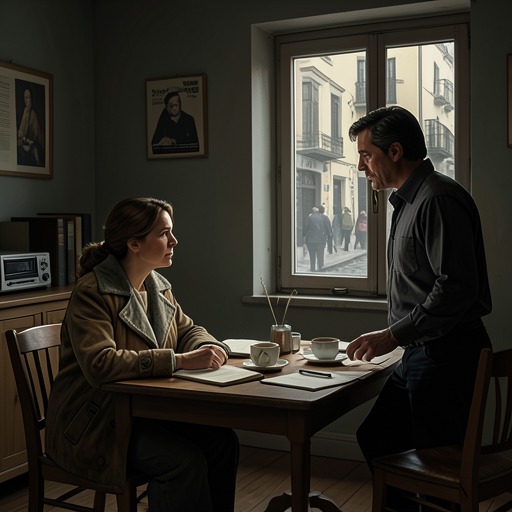
The meeting takes place during a university holiday in a little outdoor café off a back alley. Maria has eaten there many times, usually alone while sketching. Her meal reflects the scarcity around her: pastries are expensive, sugar is rare because of the war, and the chewy whole-grain pastries are made without white flour. A piece of cheese and a glass of wine make the food substantial enough for lunch. The modest routine gives the encounter a concrete, everyday setting, while the surrounding shortages and recent conflict keep Maria’s personal search within a precarious historical moment.
An Uneasy Invitation
Before she sees anyone approach, Maria feels the hairs rise on the back of her neck and stiffens. She looks for a cause, but the café and its surroundings appear unremarkable: no militarists are visible, and there are no sounds of bombers or explosions, familiar intrusions over the previous couple of years. The unexplained warning passes directly into a stranger’s arrival. He asks to sit with her in a deep, smooth, wary voice, and Maria feels an immediate chord of recognition before she has even looked up at him.
The man is slightly below or near six feet tall, with long, wavy black hair reaching his lower shoulder blades. Maria first thinks his eyes are violet, then dismisses the impression as fatigue; when she looks again, they seem pale blue and intensely frosty. His appearance also catches her through contrast: his creamy pallor stands out against his black suit. These details are filtered through Maria’s uncertain, increasingly absorbed attention. She is not simply assessing a stranger; she is trying to make sense of an encounter that already feels charged before either of them has given a name.
Although she is not accustomed to inviting strange men to join her, Maria asks him to sit. Her decision precedes any knowledge of who he is: she wants to hear more and to learn his name because something in him resonates with her. As he settles beside her, her heart beats faster, thoughts she normally keeps contained rise to the surface, and she feels heat between her thighs. The shift from vigilance to invitation is therefore both emotional and bodily. The alarm that first made her stiffen does not prevent contact; it sharpens the contrast between caution and attraction.
Names and Recognition
The stranger asks Maria’s name, and she tells him she is Maria D’Artigo and is from the United States. He identifies himself as Sephreh ob Tanu and offers to buy her another glass of wine. His hand gently brushes hers as he leans forward. That brief touch gives the encounter a physical point of no return: Maria falls into what the scene presents as a dangerous stream of thought, even though the exchange has so far consisted of an invitation, names, and a proposed drink.
The scene makes the attraction immediate without making it an established relationship. Maria has not learned Sephreh’s history or what the meeting will require of her. What changes is her sense of possibility. Faced with an unfamiliar man whose voice, appearance, and touch provoke a response she cannot reduce to reason, she experiences the meeting as more than a chance interruption of lunch. The danger in her thoughts signals intensity and uncertainty, not a resolved knowledge of what lies ahead.
The Turning Point
Maria’s final response is to understand that her life has changed forever. She imagines a door opening and commits herself to following wherever it leads. With a grin, she tosses her blonde hair over her shoulders and walks out of her past into her future. The passage thus closes not with an account of what follows, but with Maria’s decision to accept the change she senses in the encounter.
That ending connects the meeting to the uncertainty that brought Maria to Spain. She had left home because nothing there held her and because she could not yet name what she was seeking. The café encounter supplies no simple answer to her family search or her future, but it gives her a compelling new direction. Its significance lies in the contrast between the smallness of the occasion—a solitary lunch, an offered seat, a glass of wine—and the scale of Maria’s response: she treats meeting Sephreh as the threshold between the life she has left behind and the one she is prepared to enter.