Rozurial and Hanna
Tales From Otherworld: Collection OneRozurial and Hanna’s relationship begins not with courtship but with a crisis of grief. When Roz finds Hanna sleepwalking and pleading for forgiveness over her son’s death, he stays beside her, helps her rest, and recognizes in her suffering an echo of his own losses. Their first kiss turns that care into an openly reciprocated intimacy, though the scene’s emphasis remains on the shared bereavement and loneliness that bring them together.
A bond formed through shared loss
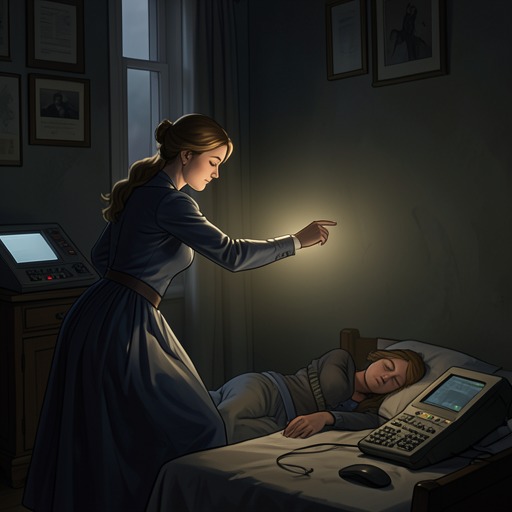
Roz first encounters Hanna in a moment when she is unaware of him. The studio’s front door is wide open, and she paces blindly, her face marked by fear. He lowers the dagger he had readied for a possible intruder and approaches quietly, careful not to wake her. His attention shifts at once from guarding against danger to protecting Hanna in a vulnerable state.
As she sleepwalks, Hanna asks her son Kjell to forgive her and to understand why she did what she did. Her words expose the guilt she carries over ending his life. Roz understands the circumstances from what Camille D’Artigo had previously told the household: Hanna helped Camille escape Hyto’s lair, tended her wounds, and supported her after Hyto’s torture. Hanna had also saved her own son by ending his life; there had been no other choice, but the memory remained a heavy burden. The relationship thus begins in the presence of a history Roz knows indirectly, through Camille’s account, before Hanna is able to speak to him about it herself.
Care in the night
Roz responds to Hanna’s distress with practical tenderness rather than questions. He encircles her shoulders with an arm, leads her into his room, and tucks her into his bed. At his touch, she quiets; once settled, she sighs softly and falls into a deep sleep. The actions are simple, but they establish the pattern of their first intimate encounter: Roz offers safety without demanding that Hanna explain or resolve her guilt.
He remains beside her through the night, holding her hand while she sleeps. In that quiet, Roz recognizes that she is lonely and has lost her husband, children, and home. She has followed her conscience into an alien land far from where she began. His understanding comes from comparison, not from treating their histories as identical: he sees that they have both lost everyone and everything they loved, and that both carry memories of the torture and death of their families. Shared bereavement gives Roz a way to understand Hanna’s isolation and to see a likeness between them.
The first kiss
When Hanna opens her eyes, she pulls back, startled to find Roz beside her. He leans down and gently kisses her. Hanna hesitates for a moment, then opens her arms and welcomes him. Her response makes the intimacy mutual: she does not merely receive the comfort he has offered while asleep but, awake, chooses to draw him closer.
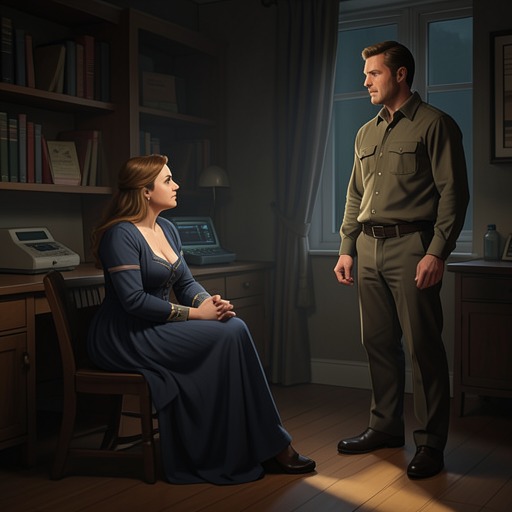
The kiss follows a night of watchful care and recognition. Its significance lies in that sequence: Roz has witnessed Hanna’s guilt without condemning her, and he has approached her through their shared experience of loss. Hanna’s brief hesitation preserves the delicacy of the moment; her open arms provide its answer. The scene establishes their attraction through reciprocal gesture rather than a declaration or promise.
Hanna within the household
Elsewhere in the household scenes, Hanna appears as part of the daily work and care that hold the group together. During preparations for Thanksgiving, she carries biscuits through the busy kitchen while Iris directs the cooking; Camille describes Hanna as Iris’s lieutenant in a household operation organized like an army. In a later planning scene, Delilah asks Camille to take charge of house upkeep because Iris is nearing the birth of her twins and Hanna does not yet know enough about running the place or how to read English. These details place Hanna in a household where she contributes while still adjusting to its routines and language.
That domestic context sharpens the significance of Roz’s response to her nighttime distress. He sees more than a capable participant in the household’s daily life: he recognizes the lonely woman displaced from her former home and burdened by a painful choice. The evidence establishes a reciprocal first kiss and an emotional connection grounded in care and common loss, while leaving their later life together unstated.