Shade
Tales From Otherworld: Collection OneShade is Delilah D’Artigo’s lover and one of the household’s most important supernatural allies. His defining significance lies in the way he joins ordinary tenderness to occult vigilance: around a bonfire, he can tease Delilah about burning her marshmallows, hold her against the cold, sense an approaching disturbance, and then become the channel through which Hi’ran’s power enters their intimacy. He is therefore not merely a romantic partner but a figure who makes the boundary between domestic affection, sacred season, and impending danger visibly porous.
Identity and Presence
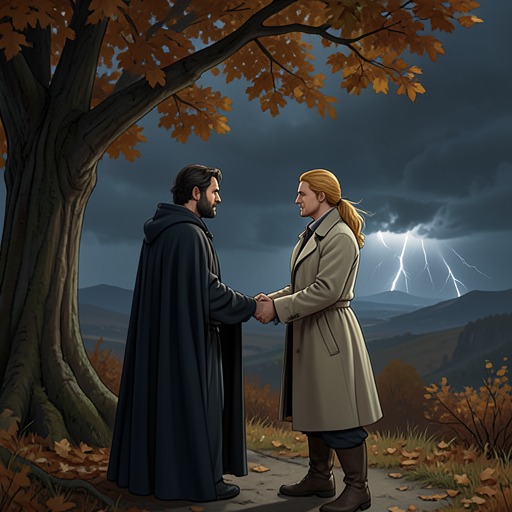
Shade is presented through his physical and atmospheric relationship to the autumn night. At Birchwater Pond, his skin is described as the color of a strong latte, while his honey-amber hair gleams beneath the pale starlight. The darkness does not erase him; it becomes a medium in which he is almost absorbed, making his body part of the scene’s shadowed visual field. This imagery supports his association with concealment, night, and the unseen forces moving around Delilah’s household.
His presence is also social rather than solitary. He sits with Delilah beside the fire pit at Birchwater Pond, a private place equipped with picnic tables, benches, and a covered shelter for rituals and holidays. The setting belongs to the household, but the couple chooses it because they need privacy beyond their rooms. Shade consequently occupies two positions at once: he is embedded in a communal home and capable of creating a secluded space within it.
Temperament and Everyday Intimacy
Shade’s affection is expressed through familiar teasing rather than elaborate verbal declarations. When Delilah burns her mouth on a marshmallow, he laughs and asks, “You never learn, do you, Delilah?” His eyes remain warm, and the teasing is clearly affectionate. Delilah notes that he seldom calls her sweetie, love, or honey, usually using her name instead; he may call her Kitten like the others, or Pussycat when he is in the mood for sex. His vocabulary of endearment is therefore specific and restrained, with the shift in address marking changes in intimacy rather than replacing his ordinary way of speaking.
The marshmallow episode gives their relationship a domestic rhythm. Shade hands Delilah a stick and the bag of marshmallows, while she impales four of them and holds them above the flames. She knows she habitually bites too quickly, burns her mouth, and repeats the mistake despite intending to wait. His amusement does not diminish her; it recognizes a recurring trait and folds it into their shared pleasure. The scene makes their bond legible through small repetition: his practical gesture, her impulsiveness, his laughter, and her willingness to be teased.
The relationship is also materialized by Delilah’s smoky quartz ring. She has worn it since accepting it from Shade, and it has become so integrated with her that she regards it as part of her nature. The ring binds her to him in ways she does not fully understand, turning their connection into something more than an emotional attachment. It is an object of commitment, identity, and supernatural consequence, a visible reminder that Shade’s place in her life has altered what she is.
Watchfulness and the Coming Threat
Shade is not absorbed entirely by pleasure or domestic calm. During the October evening, Delilah senses that Hi’ran is present in the season, in the trees, flames, and cold air. She tells Shade that he is there, and Shade answers that he knows: Hi’ran is watching them and watching the world, while the Harvestmen are alert. Shade’s response establishes him as someone capable of reading the larger supernatural environment rather than treating the night as merely romantic scenery.
His warning becomes more precise when he closes his eyes and listens to the wind. After several minutes, he says that what is happening is not in the natural order and that he senses something approaching. The gesture matters as much as the statement: Shade withdraws briefly from conversation into attentive perception, using the landscape as a source of knowledge. He then moves closer and drapes an arm around Delilah’s shoulders, combining threat assessment with physical reassurance. His vigilance does not separate him from intimacy; it becomes one of the ways he protects their shared space.
The same alertness appears by contrast in the household’s other activities. At another point, Shade is among the figures gathered with Morio, Smoky, Nerissa, Rozurial, and Vanzir to surprise Camille D’Artigo at the pond. That communal appearance places him within the family’s practical and affectionate network, while the bonfire scene shows his more private ability to detect danger. Together, these moments present him as both participant in household life and interpreter of forces that exceed it.
Love, Desire, and Hi’ran’s Power
Delilah initiates the kiss at the bonfire, placing her lips against Shade’s before he draws her into his embrace. Their physical movement carries them from the bench to the wet grass and beneath the light of the flames. The scene is not framed as a detached encounter: it grows directly from the warmth, teasing, privacy, and apprehension already established around them. Their desire becomes another form of communication, one that intensifies the atmosphere rather than resolving it.
Their union also opens onto the supernatural. During their lovemaking, Delilah experiences Hi’ran through Shade’s eyes and feels the Autumn Lord’s energy moving through her lover. Shade is thus both himself and a conduit. His body remains the immediate source of touch and motion, but Hi’ran’s presence overlays that intimacy with the imagery of death, repose, fire, and shadow. Delilah identifies Shade as her wild dragon and shadow walker, while the power associated with Hi’ran surrounds the encounter like a shroud.
This transformation does not erase Shade’s agency or his emotional importance. Hi’ran’s laughter echoes through him, yet Delilah answers the call while loving Shade fiercely. The scene makes their relationship a meeting point for personal passion and inherited or bestowed power: the supernatural does not replace their bond, but magnifies its danger and intensity. Desire becomes a threshold through which another force can be felt, and Shade becomes the person through whom that threshold is crossed.
Change, Risk, and Narrative Role
The scene ends not with uncomplicated release but with foreboding. After the intensity of the encounter fades, Delilah is struck by stark fear: something is headed their way, and this may be the last time they can surrender control before facing the danger. Shade’s earlier perception is thereby confirmed by the emotional structure of the scene. His warning was not atmospheric ornament; it anticipated a threat that turns their private moment into a fragile interval before confrontation.
Shade’s narrative role depends on this conjunction of warmth and danger. He offers laughter, physical closeness, and a private refuge, yet he also recognizes that the world around the couple is unsettled. His relationship with Delilah is attached to a smoky quartz ring, an autumnal sacred presence, the Harvestmen’s alertness, and the sense that something is approaching. Through him, romance is never sealed off from consequence. The lover who comforts Delilah is also the sentinel who hears the disturbance first, and the man who shares her desire is also the vessel through which Hi’ran’s deathly power becomes immediate.
For that reason, Shade is best understood as a liminal character: socially inside the household but drawn toward the night beyond it; tender in ordinary exchange but formidable in supernatural perception; recognizably himself while temporarily carrying Hi’ran’s voice and force. His bond with Delilah gives the book’s autumn imagery a human center, but it also ensures that intimacy carries prophecy. The bonfire at Birchwater Pond becomes both a domestic retreat and a warning station, and Shade stands at its center as the figure who makes those meanings inseparable.