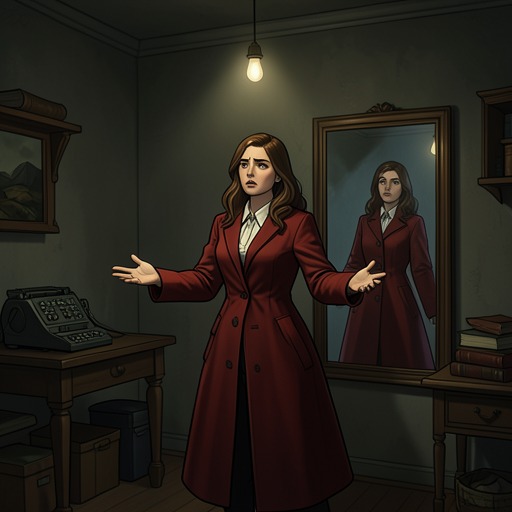
The Indigo Crescent
Tales From Otherworld: Collection OneThe Indigo Crescent is Camille D’Artigo’s bookstore in Seattle, a dusty little shop whose importance extends far beyond its uneven business. It provides Camille with a workplace after the D’Artigo sisters come Earthside, but it also becomes a protected refuge, a staging point for household cooperation, and a setting in which the hazards of her half-Fae magic collide with everyday human visibility.
Definition and Setting
The shop ordinarily does a fairly steady business, yet its atmosphere is shaped by the tension between magical possibility and mundane commerce. During one unusually sunny week in August 2014, Seattle’s residents preferred skateboarding and spending time in parks to being cooped up in a dusty bookstore. By three in the afternoon, the lack of customers had left Camille hot, tired, and intensely bored. The empty shop therefore becomes the immediate cause of an experiment: with no customers to interrupt her, Camille retreats to the back hall to test a spell she has been unable to cast successfully for several years.
The setting is not presented as an isolated magical enclave. It is a public-facing business located in the Earthside world, where being seen matters and where a problem that begins as private spell practice can rapidly become a practical emergency. The bookstore’s ordinary openness to customers is precisely what makes Camille’s magical accident dangerous: once her clothing becomes invisible, she cannot simply walk from the back room to her car without exposing herself to everyone outside.
Camille’s Spell Mishap
Camille experiments with the “By the powers of three times three” invisibility spell, which requires no components. Until this attempt, the spell has produced only a fizzle and a spurt before failing. At The Indigo Crescent, however, it backfires rather than fizzles. The first visible sign is a jacket that vanishes after Camille puts it on; she can no longer see it, and the effect soon proves broader than a single garment.
The accident changes the bookstore from a place of boredom into a trap. Camille discovers that all her clothes become invisible the moment she puts them on. She is left unable to leave openly, uncertain how long the spell will last, and forced to remain in her office chair while the public part of the business continues around her. The humiliation is as immediate as the logistical danger: the store, which normally gives her independence and purpose, now prevents her from reaching safety without being exposed.
Iris becomes the crucial practical ally inside the shop. Camille explains what happened, and Iris laughs at the absurdity before helping formulate a plan. Camille will stay hidden in the back until after dark, when Menolly D’Artigo or Delilah D’Artigo can collect her and take her directly to their car; meanwhile, Iris will take care of the bookstore. Iris also notes that Chase Johnson is fortunate not to be present, since he has been pursuing Camille sexually for months. The comment turns the shop’s public accessibility into an additional threat, while Iris’s decision to manage the front allows Camille to preserve both her privacy and the business’s operation.
Household Connections
The Indigo Crescent is tied to the wider D’Artigo household rather than functioning as Camille’s separate domain. Iris is temporarily looking for a new family to bond with and accepts the bookstore as something useful to do while she searches. Her willingness to cover the shop shows how domestic and commercial responsibilities circulate through the household: Camille’s workplace can be entrusted to a house sprite, while her sisters can be summoned to provide transportation once darkness makes escape possible.
The bookstore also stands in contrast with the household’s other shared spaces. In the shop, Camille must hide alone because her magical condition makes public movement impossible. Elsewhere, the family gathers around food, childcare, seasonal work, and celebrations. Menolly D’Artigo and Delilah D’Artigo are therefore not merely relatives in the background of the bookstore incident; they are the people whose intervention can reconnect Camille to the household when the shop has become untenable.
That networked quality is central to the location’s meaning. The Indigo Crescent gives Camille a visible role in the Earthside community, but the household supplies the invisible support that makes the role survivable. Iris’s offer to take over the storefront, coupled with the anticipated rescue by Menolly D’Artigo or Delilah D’Artigo, turns a magical failure into a collective problem rather than a solitary catastrophe.
Limits and Consequences
Camille remains trapped in the bookstore until she can safely leave after dark. The spell finally takes a full week to wear off. Its duration converts a momentary comic mishap into a sustained disruption of her work and daily movement, and the consequence is decisive: Camille resolves to leave invisibility to anyone other than herself. The lesson is expressed through the practical irony of a closet filled with gorgeous clothes that nobody can see.
The bookstore consequently becomes associated with both professional frustration and magical caution. It is where Camille’s boredom tempts her into experimentation, where the spell reveals its unexpected effect, and where Iris’s intervention prevents the situation from becoming public. The place does not eliminate the consequences of Camille’s magic; instead, it contains them long enough for the household to respond.
Narrative Significance
As a location, The Indigo Crescent joins the ordinary and the supernatural without dissolving either one. Its dusty shelves, empty afternoon, and customer-dependent routine establish a recognizably mundane workplace, while the back hall becomes the threshold to a magical experiment whose failure reorganizes the entire afternoon. The contrast gives the bookstore a distinctive narrative function: it is a place where the extraordinary is not announced by a grand ritual but erupts during slow business hours because Camille has nothing better to do.
The shop also concentrates a recurring tension in Camille D’Artigo’s life. Her identity as a witch promises power, yet the backfiring spell makes that power unreliable; her bookstore promises independence, yet the accident makes it impossible to leave; and her public position requires visibility, while the spell removes the visibility of everything she wears. The Indigo Crescent therefore embodies the unstable boundary between Camille’s magical nature and the social conditions of Earthside life. Its most important function is not simply to house a business, but to expose how quickly private magic can become a public, bodily, and communal problem.