Trillian
Tales From Otherworld: Collection OneTrillian’s significance lies in the contrast between his visible role as a dependable household companion and his talent for concealment. He participates in the shared labor of Camille D’Artigo’s family, yet he can also stage an elaborate deception that briefly makes Camille believe he has forgotten their anniversary. The resulting reversal presents him as both a source of domestic friction and a figure capable of restoring intimacy through action.
Identity and Domestic Role
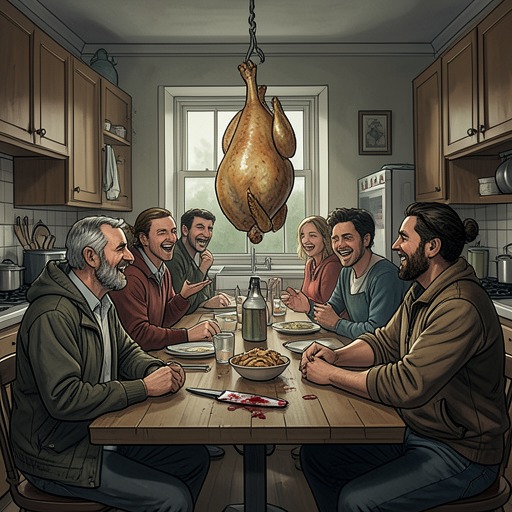
Trillian belongs to the household formed around Camille D’Artigo and her sisters’ extended family. During the Thanksgiving preparations, he is treated as one of the people responsible for making the communal celebration work rather than as a distant or ceremonial partner. When Iris asks whether he remembered the potatoes, he answers that he has bought them and that the russets are still in the car. Iris then sends him to gather basil, thyme, and parsley from the greenhouse at her house, requesting more than a few sprigs. Trillian accepts the additional errand and leaves through the back door, demonstrating his willingness to be drawn into the practical, sometimes hectic labor of the household.
This exchange also places him within the family’s informal chain of command. Iris directs the preparations, while Hanna serves as her lieutenant commander, and Trillian responds to Iris’s requests with good-natured compliance. His role is therefore defined not only by his marriage to Camille D’Artigo but also by his participation in a collective domestic world where food, errands, and holiday arrangements become shared responsibilities.
Life Among the Household
Trillian’s domestic presence is part of a broader network of mutual care. The household looks after Maggie, a young woodland gargoyle whose deceased mother visits her crib in spirit form. Camille D’Artigo reassures the ghost that they are caring for Maggie as well as they can and promises that she is welcome to visit. Trillian is not the speaker in this encounter, but the scene establishes the household in which he lives as a community organized around protection, continuity, and chosen family. His ordinary errands and later anniversary plans take place within that same environment of shared guardianship.
The evidence also places Trillian beside the household’s supernatural and emotionally complicated relationships. Rozurial’s room contains pictures of his adopted family, including Camille D’Artigo and Delilah D’Artigo, while a photograph of Menolly D’Artigo is impossible because vampires cannot appear in photographs. Trillian is not central to Rozurial’s private longing, but his presence belongs to the same crowded domestic structure, one in which affection crosses species, marriage, adoption, and the boundary between the living and the dead.
Anniversary Deception and Reconciliation
About a month before Autumn Whispers, one year after Trillian and Camille D’Artigo’s wedding, Trillian tells Camille that he is crossing over to Otherworld for several days and is leaving immediately. He slips on his backpack, gives her a perfunctory kiss, and escapes through the back door before she can respond. The manner of his departure makes the announcement especially provocative: it is abrupt, emotionally minimal, and timed so that Camille is left to absorb the apparent slight rather than discuss it with him.
Camille reacts with anger because she believes Trillian has abandoned the anniversary occasion. She thinks he knows what day it is and expects more from him than a casual farewell. Her frustration expands beyond Trillian to the conduct of all three of her husbands, leading her to wonder why she married at all and to consider leaving for Otherworld, Lake Y’Leveshan, the Grove of the Moon Mother, and a period of solitude. The thought of retreat is not merely romantic irritation; it reflects the pressure of constant danger and domestic strain. She tries to calm herself through physical work, taking out the garbage, tending the magical herb garden, and considering a walk to Birchwater Pond.
The apparent abandonment is revealed as a deliberate anniversary ruse. When Camille reaches a clearing, most of the household bursts from behind the bushes, including Morio, Smoky, Shade, Nerissa, Rozurial, and Vanzir, while Delilah D’Artigo and Hanna arrive from the path carrying Maggie. The clearing has been transformed into a celebration: picnic tables are covered with food, Christmas lights hang between the trees, music plays through a sound system wired through the woods, and wrapped presents wait on a table. Trillian then steps from behind a cedar tree and explains that Camille was not meant to believe he had truly forgotten their anniversary.
Camille’s first response is still violent irritation; she briefly wants to kill him for putting her through the ordeal. Yet the deception ends in laughter rather than rupture. She lets the day pass into the past, moves into Trillian’s arms, and kisses him. The scene completes a compact cycle of withdrawal, misunderstanding, revelation, and physical reconciliation. Trillian’s grand gesture does not erase the emotional cost of his disguise, but it converts apparent neglect into evidence of preparation and returns the marriage to affection.
Relationships and Characterization
Trillian’s relationship with Camille D’Artigo is marked by intimacy expressed through both service and surprise. In the kitchen, he demonstrates care by performing the errands necessary to feed the household. In the anniversary episode, he expresses care through concealment, coordinating a communal celebration while allowing Camille to think he has forgotten her. These two modes are deliberately different: one is visible and routine, while the other depends on temporary emotional misdirection.
His behavior also reveals a tension within the marriage. Camille’s reaction shows that the relationship carries expectations of recognition, ceremony, and attentiveness, especially on an anniversary. Trillian’s perfunctory kiss and sudden departure violate those expectations so convincingly that Camille considers withdrawing from the entire domestic arrangement. His eventual appearance among the trees therefore functions as more than a party entrance. It is a restoration of the meaning Camille feared had been denied to her.
At the same time, Trillian is not presented as an isolated romantic hero. The anniversary surprise is collective: the household contributes its bodies, food, music, decorations, gifts, and timing. Trillian’s role is to direct or conceal the plan, but the emotional payoff depends on the family’s participation. His partnership with Camille is thus embedded in communal life, and the reconciliation affirms both the marriage and the household that surrounds it.
Narrative Role and Significance
Trillian’s appearances make domesticity an active form of characterization. Potatoes, herbs, soup, biscuits, pies, garbage, a herb garden, and a path to Birchwater Pond are not incidental scenery; they show the labor and routines through which this supernatural family sustains itself. Trillian’s place in that world is established through what he carries, fetches, and agrees to do before it is dramatized through romance.
The anniversary episode gives that ordinary role a more theatrical shape. Camille’s mistaken belief creates a temporary emotional crisis, while the concealed celebration turns the crisis into a comic reversal. The narrative delays the explanation long enough for her resentment to become credible, then reveals that the apparent absence was part of a plan involving nearly everyone around her. Trillian consequently embodies a recurring tension in intimate relationships: love may be present beneath behavior that looks inconsiderate, but the hidden intention does not prevent the immediate hurt. His ending in the supplied material is therefore one of restored closeness, sealed when Camille accepts his embrace and kisses him after the surprise is exposed.