Vanzir
Tales From Otherworld: Collection OneVanzir’s importance lies in the tension between his exasperated self-protection and his willingness to serve the household. He is not introduced through a biography or a private history in the available scenes, but through movement, errands, and reaction: he is part of the group’s practical machinery, yet his attempts to avoid conflict can place him directly inside absurd danger. The Thanksgiving episode makes that contradiction especially visible. A simple shopping task becomes a test of trust, cooperation, and the household’s ability to absorb chaos without losing its sense of belonging.
Identity and Household Position
Vanzir appears as one of the household members responsible for the unglamorous work that keeps a large supernatural family functioning. During the preparations for Thanksgiving, Iris directs a crowded kitchen while soup, biscuits, apples, and pies are being assembled. Trillian is sent to retrieve potatoes and fresh herbs, and Smoky is expected to bring the turkey with Vanzir. The assignment places Vanzir alongside Smoky in a practical partnership, even though the two are not entirely comfortable together.
His role is therefore both functional and socially revealing. Vanzir is trusted to leave the house, obtain a central part of the feast, and return with it, but he is also observant enough to recognize the emotional risk in disagreeing with Smoky. That awareness shapes the explanation he later gives: he had wanted to shop at The Natural Pantry, where the household usually obtains produce that it does not grow itself, but Smoky preferred another destination. Because Smoky was still not entirely pleased about spending time with him, Vanzir chose not to make waves. His decision is cautious rather than heroic, yet it is precisely this caution that sends the errand toward its comic disaster.
The Thanksgiving Turkey Fiasco
The household expects a conventional twenty-five-pound turkey, and Camille grows concerned when Smoky and Vanzir do not return promptly. The suspense breaks when Vanzir bursts through the door asking for Delilah. His appearance immediately signals that the errand has gone badly: his hair is mussed, his forehead bears what look like puncture wounds, and he wipes blood from his cheek. He refuses to explain the whole ordeal, warning Delilah to leave the kitchen before Smoky arrives with the turkey.
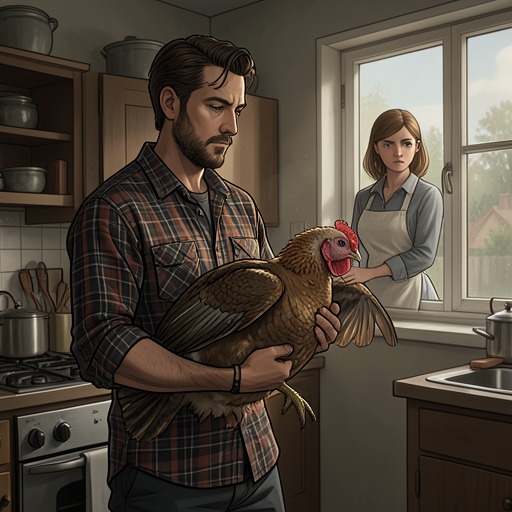
Vanzir’s warning is both practical and evasive. He understands what Smoky has done before Camille does, but his exasperation is mixed with a smirk, suggesting that the situation is so ridiculous that he can barely contain his amusement. When pressed, he identifies the source of the trouble: the pair did not obtain a dressed bird from the usual produce store. Instead, Smoky has chosen a living turkey. The decision transforms an ordinary ingredient into an active participant with its own force and resistance.
Smoky then strides into the kitchen proudly carrying the large bird under his arm. The turkey is approximately twenty-five pounds, satisfying the literal size of the request while violating its obvious culinary meaning. Smoky sets it on the floor and begins to defend his choice, but the bird immediately attacks the buckles on Camille’s boots. Camille objects that the turkey cannot be cooked while it is still alive, exposing the gap between Smoky’s interpretation of the assignment and everyone else’s understanding of a holiday meal.
Vanzir’s prior injuries become part of the scene’s physical logic. The punctures on his forehead and blood on his cheek are not unexplained decoration; they are evidence that the turkey has already resisted handling. His attempt to avoid making waves with Smoky has therefore produced a more visible and hazardous confrontation inside the kitchen. The failed shopping trip turns a domestic preparation into a struggle over whether the bird will remain food, become a household nuisance, or force the supernatural residents to reveal their animal instincts.
Participation in the Household’s Communal Life
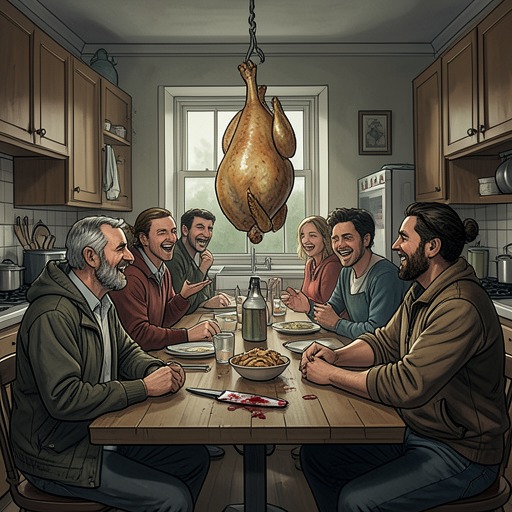
Although the turkey incident emphasizes Vanzir’s discomfort and miscalculation, his later presence in the household surprise places him firmly within its social circle. At the gathering in the clearing, the majority of the household members emerge from behind the bushes, with Morio and Smoky first, followed by Shade, Nerissa, Roz, and Vanzir. His participation alongside them indicates that he is not merely an errand-runner or an outsider tolerated for convenience. He is included in the coordinated celebration and shares responsibility for creating the surprise.
The contrast between the two scenes defines Vanzir’s place in the group. In the Thanksgiving kitchen, he returns battered and frantic, carrying the knowledge of a disaster he would rather not explain. In the clearing, he is part of an organized communal gesture involving food, music, lights, presents, and the household’s collective laughter. His presence in both settings gives him a distinctive narrative function: he embodies the group’s ability to move from danger and irritation into fellowship without erasing the earlier conflict. The same character who tries not to make waves can still become one of the people helping to create a shared celebration.
Conflict, Caution, and Comic Exposure
Vanzir’s behavior during the turkey errand reveals a form of self-protection grounded in social calculation. He does not simply choose the wrong store or passively follow Smoky; he recognizes that Smoky is still uncomfortable spending time with him and deliberately avoids provoking disagreement. That restraint appears sensible until the consequences become impossible to contain. By yielding on the destination, Vanzir preserves short-term harmony with his companion but loses control over the practical purpose of the trip. The result is an inversion of ordinary cooperation: the effort not to make waves allows Smoky’s eccentric decision to reach the household unchallenged.
His return makes that failed calculation visible before anyone knows its cause. Vanzir bursts into the kitchen asking for Delilah, with mussed hair, apparent puncture wounds on his forehead, and blood on his cheek. These details make his body a record of the errand’s hidden violence. He offers neither a complete account nor a calm explanation, instead warning Delilah to get out before Smoky arrives. The warning carries two emotions at once: exasperation at what has happened and an almost involuntary amusement at how absurdly the situation has escalated. Vanzir therefore functions as the first witness to the disaster, caught between wanting to contain it and recognizing that containment is already impossible.
The scene also places Vanzir between two different understandings of domestic labor. Iris’s kitchen is organized around recognizable holiday tasks: potatoes, herbs, soup, biscuits, boiled eggs, apples, and pies. Vanzir’s assignment belongs to that orderly chain of preparation, and his stated preference for The Natural Pantry aligns him with the household’s established practice of obtaining produce there when it is not grown at home. Smoky’s choice breaks the chain by treating the turkey as a thing to be selected for size rather than as an ingredient that must already be prepared. Vanzir understands the social problem before the culinary one, but neither form of awareness is enough to prevent the living bird from entering the kitchen.
Once the turkey is carried inside, Vanzir’s earlier injuries become an anticipatory clue to the physical comedy that follows. The bird is not merely alive; it is aggressive, large, and capable of resisting everyone’s assumptions about its role. It attacks Camille’s boot buckles, punctures Roz’s hand when he tries to seize it, and throws the room into a scramble when Delilah shifts into a fluffy golden tabby and bounds after it. Vanzir does not initiate the later pursuit, but his battered arrival has already announced the turkey’s agency. The episode turns him into the threshold between an unseen encounter and a communal spectacle: what happened outside becomes undeniable once the creature crosses into the kitchen.
Narrative Function and Significance
Vanzir’s limited appearances nevertheless give the Thanksgiving sequence a carefully placed point of view within the household’s broader communal pattern. He arrives before the living turkey, carrying visible evidence of what the others have not yet seen, so his damaged appearance briefly converts an offstage mishap into a question. The scene withholds the explanation until Smoky enters, allowing Vanzir’s mussed hair, forehead punctures, cheek blood, urgent search for Delilah, and guarded warning to function as clues before the absurd cause is disclosed. His body becomes a form of narrative testimony: the errand has already crossed from routine cooperation into physical danger, even though the kitchen remains organized around soup, biscuits, apples, pies, potatoes, herbs, and holiday canapés.
That placement also makes Vanzir a mediator between incompatible social and material orders. He knows that Smoky’s discomfort with him makes disagreement risky, and he responds by avoiding confrontation; yet the suppressed disagreement permits Smoky to redefine the task entirely. A twenty-five-pound turkey is obtained, but its life and aggression expose the difference between literal compliance and communal understanding. Vanzir’s caution thus produces an accidental revelation about how this household works: harmony cannot always be preserved by silence, because unchallenged decisions may return in a more disruptive form. The living bird’s entrance turns private hesitation into public disorder, making Vanzir’s attempt at social restraint part of the mechanism that drives the comedy.
His later appearance at the surprise gathering supplies a counterweight to that humiliation. Vanzir emerges from behind the bushes with the other household members as they arrange food, Christmas lights, music, and presents in the clearing. The narrative does not isolate him as the perpetual victim of the turkey incident; instead, it places him among the people who plan and perform a collective celebration. This recurrence matters because it shifts his image from battered witness to participating member. He belongs to the same network that can be chaotic in the kitchen and coordinated in the woods, and his inclusion suggests that acceptance within the group is not dependent on perfect judgment or immunity from embarrassment.
Across these scenes, Vanzir is defined less by a completed biography than by the social pressure visible in his actions. He runs the requested errand, calculates the danger of displeasing Smoky, returns with the consequences written across his face, and later helps sustain a surprise for the household. His function is consequently connective rather than solitary: he links the hidden mishap to the communal spectacle, the practical labor of celebration to its emotional bonds, and short-term conflict to renewed participation. The Thanksgiving episode gives him no triumphant victory, but it grants him something more characteristic of the household’s world—a place inside its disorder, where caution can fail, injury can become comic evidence, and even a disastrous errand does not cancel belonging.