Birchwater Pond
Tales From Otherworld: Collection OneBirchwater Pond is the household’s most versatile outdoor refuge: a place where private feeling, seasonal magic, remembered violence, and family ritual are brought into the same physical setting. The pond’s picnic tables, fire pit, covered shelter, surrounding trail, and grotto allow it to shift from a quiet destination into a ceremonial ground or a concealed stage for revelation. Its decisive significance lies in that flexibility. Characters go there to recover their composure, conduct rituals, seek privacy, retrieve forgotten weapons, or gather the household together, so the pond continually converts an apparently secluded natural space into a social and supernatural center.
Setting and Physical Features
Birchwater Pond lies beyond a path from the house and includes a constructed gathering area rather than being merely untouched wilderness. Picnic tables and benches stand near the water, a fire pit provides a place for flames and cooking, and a covered shelter makes the site usable during bad weather. A grotto near the shore adds a more concealed space within the larger location. These practical additions give the pond a domestic extension: the household can carry its meals, celebrations, and rituals away from the house without leaving its own grounds.
The route to the pond passes through trees and, after the violence associated with Hyto, through a deliberately altered landscape. Trees that Hyto’s father had blasted were cut down, and rose bushes were planted in their place. The roses bloom well into autumn, creating a visible attempt to replace traumatic memory with something living and beautiful. The setting therefore preserves damage while also recording the household’s effort to reclaim it; the path does not erase what happened, but it changes the terms under which the memory is encountered.
A Place of Solace and Recovery
For Camille D’Artigo, the water has a calming effect. After Trillian’s abrupt departure leaves her angry and disappointed, she decides that walking to Birchwater Pond might steady her. Before she can leave, Delilah D’Artigo calls her back into the house, but Camille later goes there at Delilah’s request to retrieve a dagger left behind during an earlier visit. The errand begins as an irritation imposed on an already difficult day, yet the walk gradually becomes restorative. Passing the rose bushes near the site of her captivity, Camille pauses over their spicy scent, breathes deeply, and finds that the movement toward the pond has eased her distress.
By the time Camille reaches the opening onto the shore at dusk, she has recovered her calm. That emotional shift gives the pond a function beyond scenery: it is a transition space between agitation and renewed perception. The approach initially carries the weight of captivity and domestic frustration, but the walk permits those feelings to loosen. The pond’s soothing presence is thus tied to movement through the landscape, with the path acting as a gradual passage from remembered harm toward a state in which Camille can recognize something unexpected.
Ritual, Season, and Supernatural Presence
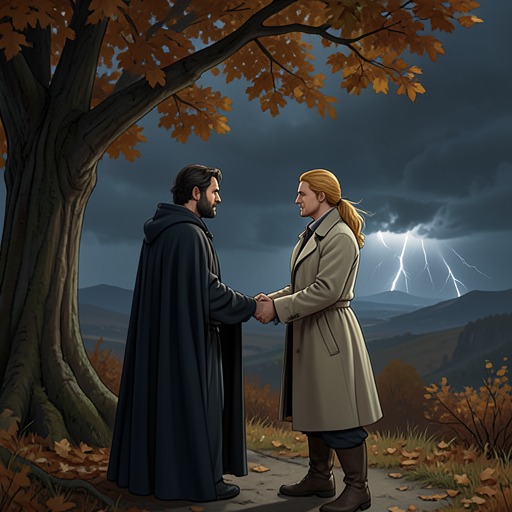
Birchwater Pond is also a ritual ground for the household. In mid-October, Delilah D’Artigo and Shade use the fire pit for a private evening. Shade kindles a bonfire while they sit among crackling flames, falling leaves, cold air, and a clear sky crowded with stars. The scene’s intimacy is physical and emotional, but it is never detached from the supernatural order surrounding them. Delilah’s smoky quartz ring, which she has worn since accepting it from Shade, feels bound to her nature and to their connection, while the fire and darkness make the pond a threshold between ordinary domestic life and the powers active around it.
The season intensifies that threshold quality. Delilah senses Hi’ran, the Autumn Lord, in the trees, flames, and chill air, and Shade warns that the Harvestmen are alert because something is approaching. The imminence of Samhain places the gathering within a season associated with death, witchcraft, and the cauldron. It is Camille D’Artigo’s season because of her death magic and Menolly D’Artigo’s because she is a vampire; now that Delilah is a Death Maiden, it belongs to her as well. The pond consequently becomes a place where the household’s individual supernatural identities are gathered into one seasonal atmosphere, comforting and melancholy at once.
The bonfire scene also turns private desire into part of the ritual landscape. Delilah and Shade seek privacy away from their rooms, but their closeness unfolds under the symbolic shadow of the Autumn Lord and amid Shade’s sense that the natural order has been disturbed. Their intimacy does not cancel the threat; instead, it exists beside foreboding, making the pond a space where tenderness and apprehension occupy the same moment.
Communal Gatherings and Reversals
The pond’s shelter and tables support larger household ceremonies, including Thanksgiving preparations and an anniversary celebration. In the Thanksgiving scene, the household is busy with potatoes, boiled eggs, soup, biscuits, apples, apple pie, and cherry pies. Although the cooking begins as a domestic activity associated with the kitchen, the pond and its surrounding grounds form part of the household’s broader communal world, where food, seasonal observance, and shared labor reinforce belonging.
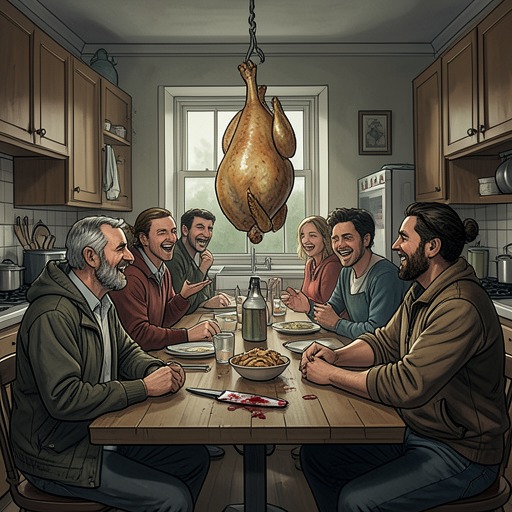
The site is also the setting for a practical joke that briefly turns celebration into alarm. Smoky brings a live turkey weighing roughly twenty-five pounds into the household’s preparations, placing the hopping, furious bird on the floor. The incident exposes the comic disorder beneath the family’s elaborate holiday labor: a feast intended to produce hospitality is interrupted by an animal that cannot simply be treated as food. The pond-centered outdoor spaces, like the kitchen, can therefore host both ritual order and unruly life.
Later, the pond becomes the concealed setting for Trillian’s anniversary surprise. Camille initially believes that Trillian has abandoned the occasion, and her anger makes her consider withdrawing from the household altogether. Delilah’s request that Camille retrieve the dagger sends her down the path, where the approaching dusk and the familiar water gradually calm her. Flickering lights at the grotto then disturb that calm, since no lights should be present at that time of year. Camille considers eye catchers and will-o’-the-wisps, including the possibility of another dangerous invasion, before hearing music from a sound system hidden through the woods.
The apparent threat reverses into a carefully arranged celebration. Members of the household emerge from behind bushes, while the picnic tables are covered with food, Christmas lights are strung from tree to tree, music fills the woods, and presents sit wrapped on a table. Trillian steps from behind a cedar tree and reveals that he has not forgotten their anniversary. The place that had just suggested supernatural danger becomes the setting for reconciliation and communal affection. Camille’s suspicion and resentment give way to laughter, an embrace, and a kiss, allowing the pond to transform a day of emotional abandonment into a renewed affirmation of marriage and household solidarity.
Narrative Significance
Birchwater Pond links the book’s major boundaries without dissolving them. It is close enough to the house for household errands and celebrations, yet distant enough to provide privacy; it is natural, yet shaped by picnic tables, shelter, lighting, and sound equipment; it carries the memory of Hyto’s violence, yet is replanted with roses; and it supports both ordinary food preparation and rites governed by Samhain, the Autumn Lord, death magic, and the Death Maiden condition.
Its repeated use creates a pattern of reversal. A walk prompted by anger becomes consolation. A bonfire meant for private intimacy becomes a place of supernatural warning. Unexpected lights that seem dangerous announce a loving surprise. Even the broader holiday setting holds the contrast between communal order and the living turkey’s comic resistance. Birchwater Pond is therefore not a static refuge but a threshold where expectations are repeatedly tested and redirected. The location’s enduring role is to bring hidden feeling into the open—grief, fear, desire, memory, and love—while allowing the household to reassemble itself around shared ritual.