Blanca and Óscar
También esto pasaráBlanca and Óscar’s relationship is defined by a persistent contradiction: their physical attraction makes them feel like a couple almost as soon as they meet, but their history and opposing needs make a shared life difficult to sustain. They have a child, share a network of family ties, and repeatedly return to one another; nevertheless, their reunions do not settle into a dependable partnership. The relationship offers Blanca immediate bodily consolation, but never a reliable answer to grief or to the question of what they can be to each other.
A shared history and its bodily language
Blanca remembers Óscar first through the force of physical attraction. Her mother recognized him when he came to her apartment, teasing him in the heat and making him laugh; Óscar later told Blanca that he thought he had just met her mother. The exchange belongs to the early ease of their intimacy, when desire could make a place feel like home. For a time, Blanca recalls, Óscar’s body was her only home, the only place in the world. They had a child, and then came the process of truly knowing one another: an encounter with the demands of life beyond instinct and desire.
Blanca describes that transition as a landing after love. While they are caught up in physical intimacy, the body seems to have made decisions before either person needs to think or speak. Afterwards, they must stand up and talk. She says they have lost count of their attempts to resume the relationship, with one or the other’s character usually coming between them. The cycle is not a simple failure of attraction. It is the repeated collision between the immediacy that draws them together and the ordinary negotiations that a continuing partnership requires.
Intimacy in the aftermath of loss
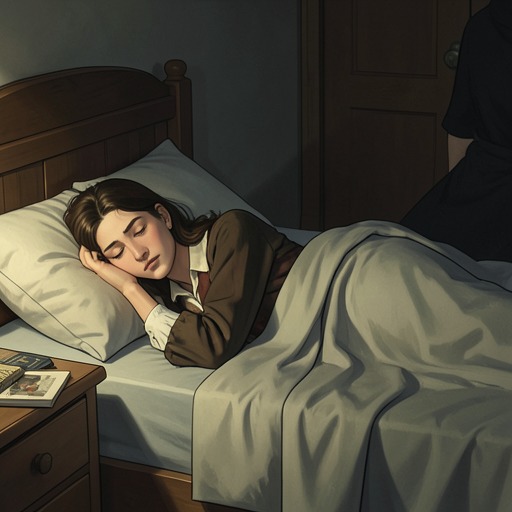
After Blanca’s mother dies, Óscar is beside her in bed. They have not slept together for a long time, and Blanca is conscious that even the smallest movement may wake him. Their renewed intimacy follows six months in which he had been with her through hospitals, doctors, and the losing struggle against her mother’s illness. The scene therefore joins sexual return to a history of care: Óscar is her ex, but not an absent figure in the period surrounding the death.
For Blanca, sex can briefly dissipate both death and life. Its effect is like a storm that sweeps away the furniture, clothes, memories, panic, and sorrow, but only for a moment; when she opens her eyes, everything has returned to its exact place. The image makes the comfort real without presenting it as a cure. Óscar believes in sex as a remedy for almost any misfortune, and sometimes it works, but Blanca’s grief remains. She slips quietly out of bed while he sleeps, facing an overflowing sink, expired yogurt, a shriveled apple, and no coffee or tea. The return to household disorder punctures any fantasy that their night together has put life back in order.
A family life that exceeds the couple
The relationship belongs to a wider, unconventional family network. At a meal in the Cadaqués house, Óscar and Guillem treat one another with respect and warmth, and each shows affection toward the other’s child that approaches paternal love. Óscar jokes with Edgar about his first mustache while Guillem ties a napkin around Nico’s neck. Their coexistence gives the household a practical ease that contrasts with Blanca and Óscar’s uncertainty as lovers: their ties to children and shared family life can be generous even when the couple itself cannot find a stable form.
Blanca’s memories of life with Óscar also identify the everyday points at which their differences became consequential. They argued over whether Nico needed another pair of sneakers, Blanca’s spending of her own money, rules about children finishing meals and watching television, and whether the children could sleep in their parents’ bed. Even a restaurant could become a disagreement over whether they might just as well have eaten at home. These are not merely differences of taste: they expose competing ideas about responsibility and freedom. During a snowstorm in Barcelona, Blanca experienced the long walk to rescue the children as a magical adventure; Óscar experienced it as an intolerable nuisance. The same circumstance could become, for her, a story of imaginative adventure and, for him, a burden to endure.
The return and the refusal
When Blanca and Óscar see each other, even for an ordinary errand such as lunch or a trip to the pharmacy, they become a couple again almost without discussion. Blanca feels that their two parts add up to the exact formula for something, although they may never discover what it is. That sense of inevitability is powerful, but it is not the same as a workable agreement. One morning, after a night of kisses and bites, she asks why they are not together again. The golden light of the room intensifies the happiness of waking beside him, while her own account of the scene already carries the knowledge that this happiness may not hold.
Blanca insists that she wants to be Óscar’s girlfriend. He tells her that nothing would please him more, but expects that she would send him away again within two days. She tries to overcome the doubt with the certainty of their sexual compatibility and her conviction that they love one another. Óscar agrees that they love each other, then adds the harder truth: they cannot stand one another, and Blanca drives him to exasperation as no one else has. Her laughter does not erase the history behind his complaint. She recalls an argument on a motorcycle after which he made her get off and left her in the street, an episode that gives their claim of mutual irritation a concrete and painful past.
Their negotiation makes the gap in their expectations explicit. Blanca suggests that they might at least be lovers; Óscar refuses the compromise, saying he wants everything or nothing. He says they have discussed the issue many times and that Blanca does not want a relationship—or does not want one with him. Then he says he has to return to Barcelona for work. Blanca knows that explanation is not true: it is Friday, summer, and he has recently spent weekends with his girlfriend. Desire does not remove the other relationship or resolve the disagreement about commitment; the reunion reaches a limit and breaks into anger and departure.
An unresolved bond
The relationship remains open-ended because its strongest evidence points in opposite directions. Blanca and Óscar repeatedly behave like a couple, are closely joined through their child and family life, and continue to desire one another. Yet they also remember the incompatibilities that made their life together difficult, and they cannot agree on whether to attempt a full partnership, accept a lesser intimacy, or separate. Óscar’s presence during Blanca’s bereavement and their sexual reunion offer closeness, not a promise of permanence.
That tension gives their bond its narrative force. Physical intimacy can quiet grief and briefly restore the feeling of belonging, while the morning after, the old arguments, and the competing demands of their lives return. Neither the body’s conviction nor the language of love is enough to settle what the relationship should become. Blanca and Óscar’s repeated return therefore remains both a source of consolation and a renewed encounter with the limits of their compatibility.