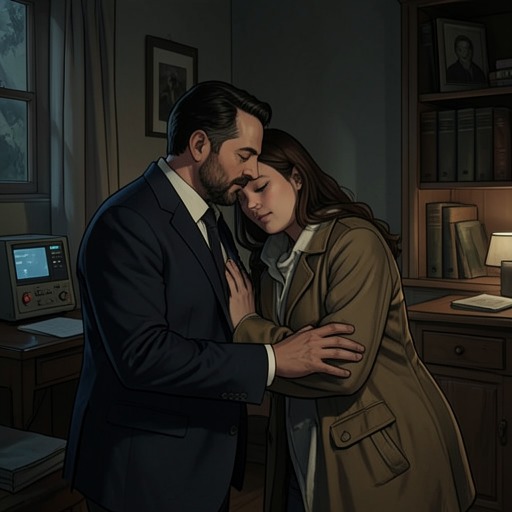
Blanca and Óscar try to get back together
También esto pasaráBlanca and Óscar try to get back together in a scene where physical closeness briefly makes their old partnership seem inevitable, but cannot settle the question of whether they can build a life together. Blanca asks to be his girlfriend and proposes marriage; Óscar answers with affection, desire, and a blunt account of their mutual antagonism. Their reunion exposes the distance between feeling like a couple and choosing to sustain one.
Background and shared life
Blanca and Óscar’s renewed intimacy takes place against a long history of separation and return. They know each other’s habits and provocations well enough to recall old fights without needing to reconstruct them: one argument on a motorcycle ended with Óscar making Blanca get off and leaving her in the street, while she threw her helmet at his head and nearly caused an accident. Their past also includes disagreements about how to raise the children, whether to buy Nico another pair of trainers, how much television the children should watch, and what counted as excessive spending. The accumulated disputes are not incidental to their reunion. They are the practical history that lies beneath its sensual promise.
Their shared family life is not simply a closed unit of former spouses and children. At a meal around a large wooden table designed by Blanca’s uncle more than forty years earlier, Óscar and Guillem treat one another with respect and warmth, and each shows the other’s son affection close to a father’s. The scene places Óscar within a wider, unconventional family network even as the two men retain distinct relationships to the children. This ease among the adults contrasts with the difficulty Blanca and Óscar face when they try to define their own bond.
Intimacy and the renewed proposal
When Blanca and Óscar see each other, even for an ordinary errand such as going to eat or to a pharmacy, they become a couple again almost without deliberation. Blanca describes them as if their two parts add up to a complete formula, though neither has managed—and they may never manage—to discover what that formula makes. The language captures both the pull between them and its unresolved quality: the reunion feels natural, but its meaning and future remain unsettled.
After a night of many kisses and some bites, they wake in a bedroom lit by warm, golden light. Óscar invites Blanca back into bed, but she says she needs to return to solid ground rather than enter that sensual current again. Still, she insists that she genuinely wants to be his girlfriend. Her appeal has the mixture of pleading and command she remembers from childhood, when she tried to persuade a nanny to buy her ice cream or let her watch an adult film. Óscar says he would like that, but predicts she would send him away again after two days. Blanca denies it and grounds her case in their sexual compatibility: she says she sleeps with nobody as she does with him, and that her body keeps insisting she is made for him even as life seems to refute the claim.
Óscar responds to her praise by admitting the force of his own desire: seeing her makes him think of sex. Blanca adds that they love one another. He agrees, but then supplies the qualification that governs the scene: they love each other very much, yet cannot stand one another. He says that Blanca drives him out of his mind more than anyone else has. Their exchange makes desire and love real without treating either as proof that partnership will work.
The terms of reconciliation
Blanca proposes marriage with the same lightness with which she says other grave things. The narration links that manner to embarrassment, indolence, and weakness of character: she can speak seriously for hours about trivialities, while love, death, and money are dispatched in a phrase, a raised eyebrow, and a nervous laugh. Óscar knows this habit and does not take the proposal as a straightforward plan. The possibility of marriage has surfaced between them over the years for different reasons, including love, jealousy, and fear. His response is laughter and a practical objection: he cannot fit in her house.
Blanca then offers a smaller arrangement, asking whether they could at least be lovers. Óscar refuses the compromise. He wants everything or nothing, and says they have discussed the matter a thousand times: Blanca does not want a relationship, or at least not one with him. His low, tired delivery makes the assessment sound less like a fresh accusation than a conclusion drawn from repetition. The divide is not over whether they desire or love each other, but whether they can agree on what form that attachment should take.
His stated reason for leaving is work in Barcelona. Blanca knows that explanation is not true: it is Friday, it is summer, and in recent weeks he has spent weekends with his girlfriend. She accuses him of leaving for that woman, choosing anger over sadness because anger feels preferable to the quieter, longer grief. Blanca jumps out of bed and shuts the door after him, deaf to his joking pleas. The scene turns a private attempt at reconciliation into another encounter with the limits imposed by their existing lives and choices.
Departure and unresolved ending
Óscar spends the rest of the morning in a cheerful mood, sending and receiving messages, and leaves after lunch. As he says goodbye, he promises that he will always be there and that Blanca will never lose him. She asks whether he means it. His assurance offers continuity, but not the relationship she has asked him to resume; the scene leaves those two kinds of permanence sharply distinct.
When he tries to kiss her on the lips, Blanca turns her face away. She imagines that perhaps their story has already made all the turns it can make and that the roulette wheel has stopped for the last time on a losing number. The image gives the ending its provisional severity: she sees them as emotionally depleted, with too many pieces missing to rebuild the world they once had. It is her interpretation of the moment, not a confirmed declaration that they will never meet or love again. The attempted reunion therefore closes without a renewed partnership. Physical familiarity brings them together, but neither their history nor their mutual desire can overcome the incompatible terms on which they are willing to continue.