Blanca and Martí
También esto pasaráBlanca and Martí’s relationship takes shape through fleeting encounters in Cadaqués, where attraction arrives before familiarity and a gesture can carry more weight than a declaration. Their first meeting is at Blanca’s mother’s funeral; later, recognition, teasing and an exchanged name draw them into a tentative flirtation. Set against Blanca’s mourning and her ambivalence about beginning another love story, their connection is presented as a possibility—not yet a confirmed partnership.
First Sight at the Funeral
Blanca notices Martí among the mourners while she is overwhelmed by heat and grief. Even at her mother’s funeral, she registers that the stranger is attractive, then wonders what he is doing there and whether the woman beside him, holding his hand and watching Blanca, is his girlfriend. She is irritated that he does not approach her, but recognizes that a funeral is hardly an ordinary setting for a meeting. Her attention to him does not cancel her sorrow: it appears alongside it, an instinctive flicker of interest on a day defined by death.
The funeral lasts twenty minutes, in near silence and without speeches, poems, prayers, flowers or music. Martí does not intervene when the elderly cemetery workers nearly drop the coffin, a detail that sharpens Blanca’s first impression of his distance. Yet the scene leaves him lodged in her mind. He is not introduced through a conversation or a shared history, but as an unknown, appealing presence at the edge of her mother’s final ceremony.
Recognition and Hesitation
Some days later, Blanca recognizes Martí at the Marítim, where he is reading a newspaper at a table used by local regulars. They exchange a smile and quickly look away. She removes her sunglasses and adjusts her dress, but does not want to impose her exhaustion or grief on a stranger, or invite another condolence. The small encounter makes attraction visible as bodily self-consciousness, while her reluctance keeps it from becoming an approach.
Sofía notices Blanca’s interest and identifies Martí as her type: a large nose, a strong but lean body, relaxed elegance, worn clothes and no conspicuous accessories. She urges Blanca to say hello, while Blanca protests that she would be too embarrassed and doubts he remembers her from the funeral. When Martí gets up to leave, he pauses and gives them a very timid nod. Sofía answers with an exuberant wave, turning his modest farewell into a comic little spectacle. The exchange leaves the initiative unresolved; Sofía even warns Blanca that she may pursue him herself if Blanca does not.
Encounters in the Village
Blanca sees Martí again at the casino, sitting in the dim area where older villagers play cards. She interprets the coincidence, half playfully, as though her dead mother had placed him there as a sign. The thought connects this new attraction to her mother’s earlier concern that Blanca had not been truly in love for a long time. Blanca recalls that, for much of her life, the love story that mattered most to her was the one between herself and her mother. The emerging possibility with Martí therefore arrives in the wake of a relationship whose centrality has been made newly painful by bereavement.
When Blanca sits at the neighboring table, Martí smiles as if they already know one another and asks whether she has lost a shoe. She asks directly what he was doing at her mother’s funeral and whether he knew her. The available scene establishes that Blanca seeks an explanation for his presence, but does not establish his answer or his connection to her mother. Their first conversation thus contains both flirtatious play and a genuine unanswered question.
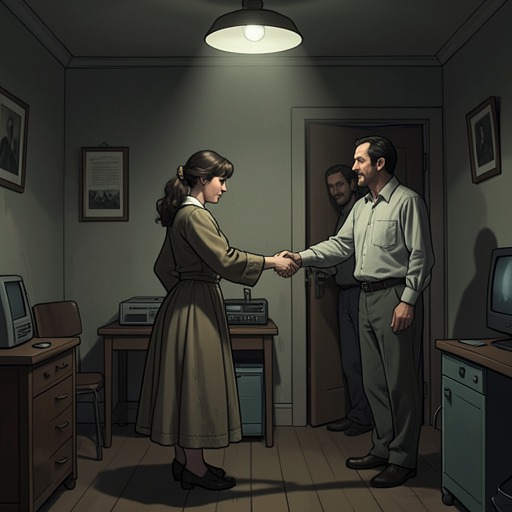
Later, on a crowded summer evening, Blanca passes the casino while on her way to meet Santi. Martí is outside with friends, alongside the woman Blanca recognizes from the funeral. He stands and approaches her. Blanca initially says she is in a hurry, thinking of Santi and of the other men who have served as patches over her deeper reluctance to attempt a lasting relationship. As Martí steps aside, kisses her, and presses his warm, rough cheek to hers, she reverses course: she says she still has time and asks his name. He answers, and Blanca introduces herself. The formal hand she offers seems almost unnecessary after the kiss, but it marks their first clearly mutual exchange of names.
The Shoe and an Open Beginning
Their flirtation turns on an alpargata, making an ordinary item of clothing a playful test of fit. Martí observes Blanca’s worn shoe and lets her try his. Its oversized shape, stiff esparto sole and salt-marked navy canvas make the exchange concrete rather than merely symbolic; Blanca finds that it fits and says she might keep it. Martí compares the moment to Cinderella finding the shoe that fits. Blanca recognizes the fairy-tale joke, returns the shoe, kisses him at the corner of his lips and hurries away, casting her departure as a race against the return of rags and a pumpkin.
The scene gives their attraction a light, provisional form: a borrowed shoe, a near-kiss, a joke, and an exit before the encounter has to become a promise. Blanca’s appointment with Santi remains part of the same evening, underscoring that her interest in Martí does not instantly resolve her complicated relation to intimacy. Elsewhere, her history with Óscar still carries the weight of mutual attachment, while her family life in Cadaqués is shared among former partners, children and close friends. Martí enters this already inhabited world not as an established partner but as a new possibility. The scenes provided end with recognition, names and playful physical closeness; they do not confirm what the relationship becomes.