Blanca and her mother
También esto pasaráBlanca and her mother share a love that is neither simple nor untroubled: it gives Blanca her sense of belonging and much of her appetite for life, but also leaves her carrying a heavy responsibility. The mother’s illness and death expose the costs of that closeness; grief then changes the bond without ending it, as memory, inherited habits, and the children preserve her presence in Blanca’s daily world.
A Bond of Love and Distance
Blanca remembers her mother as a vivid, fearless woman whose life seemed to gather people around it. As a child, she watched her mother and her friends laugh, play cards until dawn, travel, swim naked in the sea, and go out to dinner. Those scenes made the adults around her feel like a family chosen through affection and shared life. Their disappearance later deepens the loss: unlike blood relatives, Blanca reflects, such chosen families can scatter more easily.
The mother and daughter were not confidantes who told one another everything, and Blanca insists that they were never simply friends. Each tried to present a more composed version of herself to the other. Their distance could be comic as well as protective. When her mother worried that Blanca had not yet begun menstruating, Blanca calmly revealed that it had begun two years earlier and that she had chosen not to tell her. Her mother’s startled reaction ended in silence about the matter, a small episode that captures both the boundary Blanca maintained and the mother’s surprise at finding a part of her daughter’s life kept private.
That reserve did not diminish the mother’s importance. Blanca sees her as the great love of her life, a first love whose influence shaped the loves that followed, including her fierce devotion to her children. Her mother watched her fall in and out of love and recover from heartbreak from a measured distance: she took pleasure in Blanca’s happiness and let her suffer without excessive intervention. Blanca understands this restraint as a kind of care, and as recognition that no romantic attachment could displace the bond between them.
Care, Illness, and Reversed Roles
The mother’s decline makes their relationship more demanding and less secure. Once accustomed to winning her battles, she begins to feel her strength, her mind, and the surrounding circle of friends fail her. Her fierce desire to live persists even as her lucidity becomes intermittent. In Blanca’s account, the illness does not merely bring physical deterioration: it disrupts the person and the life around her, turning care into a succession of frightening, exhausting crises.
Blanca becomes responsible for finding and interviewing caregivers, many of whom leave after only a few days. Her mother keeps them awake, takes medication, leaves pills scattered among her sheets, papers, and books, dismisses carers repeatedly, and at times strikes one. She calls Blanca in the middle of the night, frightened and demanding that her daughter come over; their conversations often end with her mother hanging up. The phone, once an ordinary means of contact, becomes a source of dread. Blanca sometimes disconnects it, forgets to charge it, loses it, or deliberately leaves it behind, while still hoping that a call might bring an apology or an expression of love rather than another accusation or urgent demand.
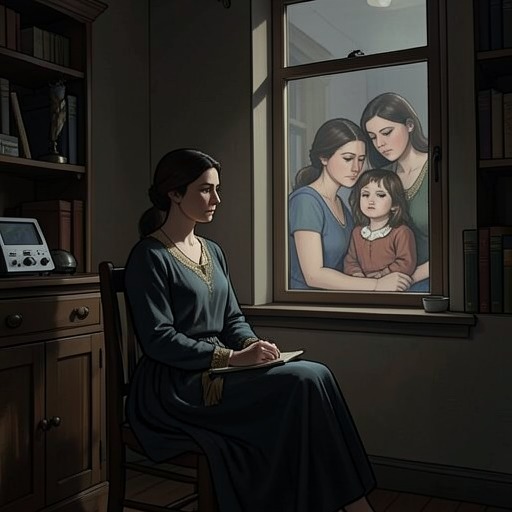
The reversal is starkest in the last hospital. Blanca reassures her mother that this is only another bout of pneumonia and that she and the children will be all right. Her mother can no longer speak, but looks at Blanca and silently cries. A friend tries to explain the tears as irritation from the air conditioning; Blanca understands them as a goodbye. She holds her mother’s hand and repeats that the family will be all right. In that moment the daughter is trying to soothe the mother, while also confronting the limits of what reassurance can accomplish.
Blanca’s care is not presented as faultless or without resentment. She remembers that her mother’s illness made her selfish and difficult, and admits that she did what she could, sometimes what she felt she had to do, but not always enough. That admission sits beside love rather than cancelling it. The difficulty of caring for her mother becomes part of the bond’s truth: Blanca can recognize the harm and exhaustion without reducing her mother to them.
Shared Inheritance and Family
The mother’s influence carries into the family Blanca builds with her children and with people connected by care rather than a single household. Guillem, the father of her older child, takes in Patum, the mother’s large dog, after Blanca’s mother can no longer keep her. He makes the dog his own, and at the funeral brings her wearing a black ribbon. Patum sits formally in the shade beside him, an image Blanca imagines her mother would have loved. The dog’s transfer marks the severity of the mother’s decline: when she agrees to let Patum go, Blanca understands that her mother is beginning to relinquish more than the dog.
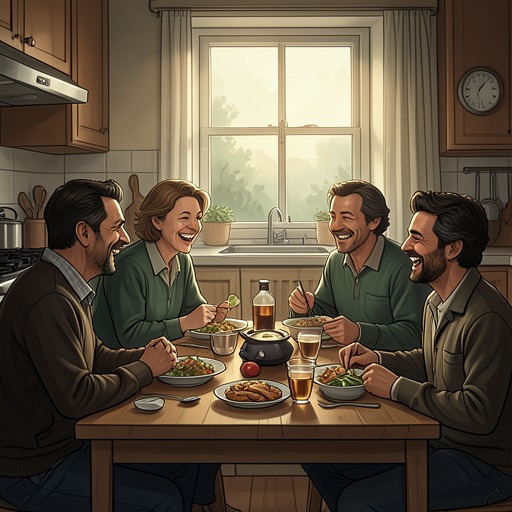
The mother’s relationship with her grandchildren also differs from the painful entanglement of her relationship with Blanca. Blanca believes the children could reach the person their grandmother had been through the illness and its fog; they did not hate her, and their drawings picture her flying above them as a mischievous witch and awkward fairy. In the family’s shared life, Blanca sees Óscar and Guillem treating one another with respect and showing near-paternal affection for each other’s sons. Such scenes extend the mother’s legacy into a family composed of former partners, children, friends, and those who take responsibility for one another.
What Blanca inherits is not only attachment but a way of responding to life. She credits her mother with laughter, rebelliousness, a sense of justice, generosity, delight in games, and an alertness to happiness while it is still present. She also recalls her mother’s tolerance for other people’s flaws and her refusal to let fear, cruelty, envy, or pettiness make life smaller. Blanca is unsure how fully she has inherited that largeness of spirit, but recognizes traces of it in her children—in their courtesy, curiosity, respect, and lack of snobbery toward unusual or wounded visitors.
Grief, Memory, and Continued Presence
After her mother’s death, Blanca finds that books have become almost impossible to open. They return her to her mother’s shelves, to the annual cleaning of the library, and to their trips to London to seek illustrated children’s books. She remembers the two of them examining their finds together in a hotel room: Blanca distracted and moving between tasks, her mother absorbed in the books like a child. The mother’s attention to how a person looks at a book becomes inseparable from Blanca’s knowledge that she will no longer see her mother looking at one—or be seen by her.
Physical contact offers a different kind of relief. During a pedicure, as someone massages her feet, Blanca finds that even brief, casual touch can soothe her since the death. She cannot use books as comfort because they evoke her mother too directly; touch helps by anchoring her in the present instead. The contrast shows how grief alters ordinary sources of consolation, while also making bodily presence newly precious.
Blanca’s sense of self is bound to being held in her mother’s gaze. She realizes that her place in the world had seemed so certain within that gaze that she never needed to find another. Her mother’s death therefore brings not only bereavement but the unsettling sense of becoming an orphan at forty, after two children, two marriages, several relationships, homes, and jobs. The loss removes the person who had made that identity feel unquestionable.
The bond continues through memory and ordinary objects rather than being neatly closed. When the family drives past the last apartment her mother lived in on Carrer de Muntaner, Blanca notices her older son silently looking up at his grandmother’s balcony. She does not tell him that his grandmother is in a better place, because she does not believe that would be true: for a long time, her mother’s greatest happiness was being with Blanca and the children. Blanca begins to breathe more easily and has fewer nightmares, though happiness returns only intermittently. She takes her mother’s jacket to the dry cleaner, arranging for its return as good as new. The repaired garment is a practical act of remembrance, preserving something tangible without pretending it can restore the person.
The Cemetery Vision
Blanca’s most vivid continuation of the relationship comes during a solitary attempt to visit her mother’s grave before dawn. Exhausted and afraid, she finds the cemetery entrance locked. She pushes and pulls at the heavy iron handle, calls softly for her mother, then pounds on the gate until her hands hurt. When dawn arrives, she sits defeated outside the cemetery and recognizes the pale light over the olive trees and Port Lligat.
From the wall, Blanca imagines seeing her mother walking along the harbor toward her boat, wearing a faded checked shirt over her bathing suit and accompanied by her dogs after a swim. Her mother turns, smiles, and tells her that this too will pass, then winks. The scene does not undo the death or claim that grief has ended. Instead, it gives the continuing bond a form Blanca can carry: the remembered mother returns in the landscape and in the habits of a life they shared, offering consolation in the voice Blanca still knows.