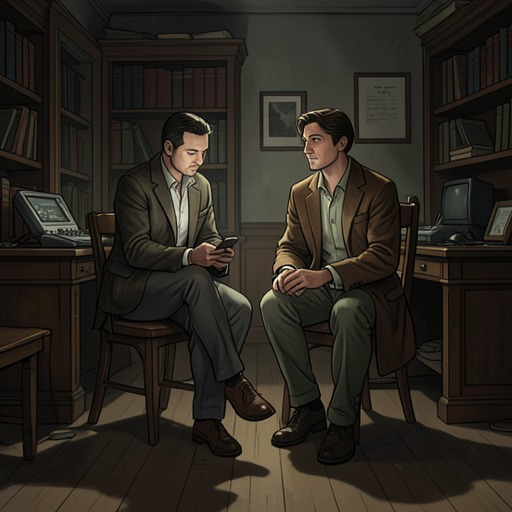
Blanca decides to end her relationship with Santi
También esto pasaráBlanca decides to end her relationship with Santi in a hotel in Cadaqués, where a meeting meant to preserve their intimacy instead makes its inequality unmistakable. The turning point is not a dramatic revelation alone: it gathers force through an unsatisfying sexual encounter, Santi’s disclosures about his marriage, and Blanca’s recognition that she has already begun to think of his love in the past tense.
The Hotel Encounter
The hotel is new to Blanca, although the view from its balcony is familiar. She describes hotels as unsettling, foreign places where even company cannot dispel solitude, and compares the brief, deep rest they offer to a warrior’s provisional respite before battle. That image gives the meeting its atmosphere: Santi and Blanca are together, but their encounter takes place in a space that feels temporary and isolating rather than secure.
Blanca arrives late, and Santi warns that he has little time. He looks like a lost child, with bright eyes, and she associates him with addiction. He does not become angry with her, even when she is abrupt; Blanca believes he treats her outbursts as the price of the imbalance between them. In her view, that imbalance means she has less to lose if they separate. The thought is already a measure of distance: she is assessing the relationship not by what it promises, but by how much each person stands to suffer when it ends.
Santi undresses her slowly and awkwardly. His eyes are red, and his mouth tastes dry; Blanca assumes he smoked a joint while waiting. She lets him proceed, attentive to the possibility that her own desire might gather and spread through her body. Instead, he climaxes after a minute and a half, gently but without bringing her with him into pleasure. He spends the next ten minutes apologizing, saying he is exhausted. Blanca tells him not to worry, but knows she is lying. Her body cools, her lips dry, and her desire remains suspended in the room without an object. The mismatch between his apology and her unmet desire makes the encounter less a shared intimacy than another instance of her accommodating what he can offer.
From Unequal Attachment to Decision
Blanca’s perception of Santi changes from a beloved figure into an ordinary man exposed to view. She watches the elements of his former allure—the tanned skin, stubble, dry martinis, wolf-like hands, and an old festival bracelet—seem to come apart. She does not decide that he is unattractive; rather, she no longer experiences him as a whole protected and transformed by love. What remains is a collection of qualities and flaws, no longer sheltered from her scrutiny by her own feeling.
Their exchange about his wife makes the difference in their stakes more explicit. Blanca thinks of the woman as someone Santi’s wife might struggle to replace, then tells him that she herself will no longer love him. Santi appears more troubled by the prospect that his wife could find another man than by Blanca ceasing to run into his arms. Blanca reads this as evidence that he treats the earlier disruption of his marriage as an impersonal disaster, not as something that might happen again. He dresses in silence.
Santi then tells her that he has not had sex with his wife for a long time. Blanca finds the disclosure repellent and insists that his marital intimacy is not her concern. Until this moment, he has not mentioned that part of his relationship with his wife. Blanca follows the disclosure with the decisive request: they should stop seeing each other. The sequence matters. His confession does not draw her into competition with his wife; it confirms that the terms of his marriage are not hers to manage, and she refuses the role of confidante or judge.
A Parting Without Reassurance
Santi reacts with distress, clutching his head and insisting that what he gives her is little, but that he cannot stop seeing her. He tells her that he loves her very much. Blanca silently recognizes that the problem lies in the tense of that declaration: she has already begun to think that he loved her, rather than loves her. She does not say this aloud. To her, a conversation in which two people try to measure their love is already too late and destined to fail.
The relationship’s unequal timing becomes concrete when Santi’s phone rings. His wife, just back from a concert in another town, is calling for him. He checks the expensive watch given to him by his father-in-law, wearing it almost like an engagement ring, and says he must leave. Blanca answers that she must leave too. He asks to see her soon and presses a passionate, clumsy kiss against her inert lips. His urgency and the intensity of the kiss do not undo her decision; the contrast between his insistence and her stillness registers how far their feelings have separated. As he walks away, she notices that his legs are crooked, a small physical detail that accompanies her newly unidealized view of him.
The Decision’s Aftermath
The scene ends without a clear practical confirmation that the two will never meet again. Santi speaks as though another meeting is possible, while Blanca has already said that they should stop seeing each other and receives his parting kiss without response from her body. The ending is therefore emotionally decisive but outwardly unresolved: his appeal leaves the relationship’s future open in words, not in Blanca’s expressed desire.
After he leaves, Blanca sits smoking on a bench in the village square while the band continues to play and the daytime family audience gives way to a larger, more dance-oriented nighttime crowd. She reflects that before Blanca’s mother’s illness and death, she had never thought to sit on a street bench; now she values the stillness of being among people without going anywhere. The public bench becomes a modest place of refuge, a change in how she inhabits the world after loss. Set beside the private hotel room, it marks a shift away from waiting for Santi’s attention: Blanca can remain among others without needing the encounter to take her somewhere.