Edgar
También esto pasaráEdgar is one of Blanca’s children, an adolescent whose quiet attention and gravity unsettle his mother’s assumptions about who is supposed to be the adult. He appears among the children on the journey to Cadaqués, listens even when he seems absorbed in his phone, and is later described at thirteen as serious, considerate, and responsible. To Blanca, he is not simply growing up; at moments, he already seems to have reached a maturity she does not expect ever to attain.
Identity and Presence
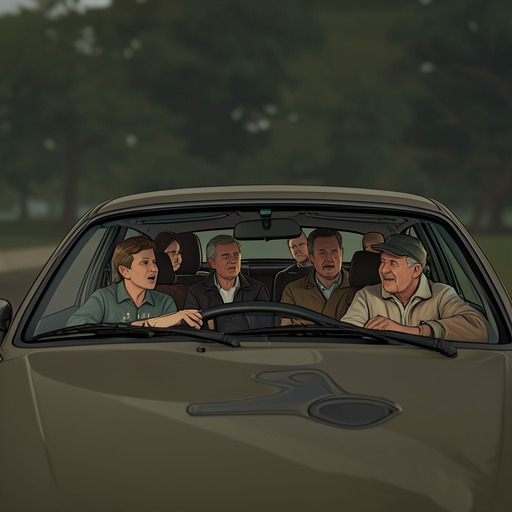
On the drive to Cadaqués, Edgar shares the back seat with Nicolás and Daniel, while Úrsula, the nanny, travels with them. Blanca drives and Sofía acts as copilot, a division of responsibility that still feels strange to Blanca: she is the one setting the departure time, instructing the nanny, choosing the children’s clothes, and controlling the car. Watching the children laugh and quarrel in the rear-view mirror, she feels like a fraud of an adult who might be exposed and sent back to the children’s seat. Edgar belongs to that lively group, but his later appearances show him both as a child among his siblings and as someone his mother regards with profound respect.
The book connects this sense of adult imposture to Blanca’s own childhood. She longs to return to the back of her mother’s car, where she was once wedged among her brother Bruno, Marisa, Marisa’s daughter Elenita, and the family’s dogs. That contrast gives Edgar’s adolescence a particular charge: Blanca is responsible for the journey now, yet she still recognizes in herself the six-year-old who watched the world from the back seat. Her reflections on how people see different things—and recognize one another through what they notice—unfold as she looks at the children, without suggesting that Edgar simply shares her view.
Watchfulness and Family Stories
Edgar’s attention is easy to miss if one takes his posture at face value. When Nicolás and Daniel ask Blanca why she warns them to be careful around dogs and ping-pong tables, Edgar fiddles with his phone and says nothing. Blanca nevertheless notices that he is listening, as he always is. His silence is therefore not presented as absence: he can remain outwardly disengaged while following the exchange.
Blanca answers the younger boys with a story from an earlier Cadaqués summer. Lali, Marisa’s large, unruly black dog, would suddenly race down the stairs, leap through an opening about four metres above the garage, and land on the ping-pong table where Bruno and his friends were playing. The frightened boys scattered, Bruno lost playmates as the summer went on, and he suspected Blanca had trained Lali to disrupt his games. Edgar re-enters the family anecdote with a teasing judgment: he suggests Bruno may have been right and recalls that Blanca’s mother used to call her bad. The joke makes Edgar a participant in the family’s inherited repertoire of stories, not merely their listener; he knows how to turn his mother’s own recollections back on her.
A Reserved Voice
In Blanca’s account of their ordinary life, Edgar’s speech comes in intermittent bursts. Since becoming an adolescent, he walks in her presence with a languid, sweeping gait, as if every place were tiresome or already familiar. His speech has the same reluctant quality: he trails off rather than finishing words, counting, or explaining. Roughly once a month, however, he talks for two hours and tells her about his adventures at school.
Those rare outpourings often happen at dinner, while Edgar is eating and laughing and speaking so quickly that Blanca can scarcely understand him, despite concentrating and straining to listen. He may repeat a story three times before noticing that he is talking to his mother; then he tells her she is deaf and falls quiet until the following month. The rhythm is intimate but imperfect: he does tell her about his life, yet their exchange can break off at the point when Blanca hopes to receive it. A different conversation also returns about once a month, when Blanca calls attention to the beauty of the trees and street and urges the family to breathe deeply and appreciate their good fortune. Together, these recurring exchanges sketch a household in which talk can arrive in sudden abundance or give way to silence.
Maturity, Respect, and Family Life
At a meadow bordered by fig trees heavy with fruit, Blanca watches Edgar inspect the trees with the air of a landowner. He is thirteen, and she thinks he will never again be as adult, aware, serious, kind, discreet, sparing with words, sensitive, and responsible as he is at that moment. The thought reverses the usual direction of parental judgment: rather than measuring a child against an ideal of future adulthood, Blanca sees a present version of Edgar that she feels she herself will never catch up to. She considers respect a higher feeling for another person than either love or adoration. His reserve, which can frustrate conversation, is part of the character she respects rather than evidence that she has failed to know him.
In another family scene, the children’s lives are registered through appetite and physical closeness. The group devours two kilograms of mussels, drinking chilled white wine after time outdoors by the sea; Blanca welcomes her children’s transformation from city princes into small, salt-skinned, sun-browned barbarians. She steals a lick of Nicolás’s plump, freckled cheek, and he pretends to object before laughing and returning the gesture. Edgar is included in this picture of the children sharing an exuberant family life, though the specific playful exchange is between Blanca and Nicolás. Set beside his measured presence at the fig trees and his sporadic school stories, the scene shows the range of the family world around him: noisy, physical, and affectionate, without erasing the thoughtful distance through which Blanca sees her son.