Estancia de Blanca en Cadaqués tras la muerte de su madre
También esto pasaráBlanca’s stay in Cadaqués after her mother’s death is an attempt to inhabit a place that is at once refuge and wound. The journey brings her back to the family home with her children and friends, but the house cannot be separated from the mother who shaped it: its remembered routines, closed rooms, and familiar view of the sea continually draw the past into the present. The summer offers company and daily activity without making grief linear or complete; memory and ordinary life take turns occupying the same rooms.
Deciding to Return
The move begins as a suggestion from someone who tells Blanca that the house is now hers and that the boat is waiting in the water. She recoils from the idea that her mother’s home can simply become her property: in her mind, the house belongs to her mother and always will. Still, Cadaqués has protected her since childhood. In her imagination, witches perched on the church tower govern the town’s welcome and rejection, its lovers’ quarrels, its stinging sea urchins and jellyfish, and even the dawns that ease the worst hangovers. The place is not merely scenery but a power she has long trusted to shelter her; now, she thinks, it has a new witch as well.
Blanca finally agrees to go, invoking a return to Tara and the promise of another day. The decision is made amid bereavement, not after it has been resolved. Earlier, she has described sex as a brief force that makes death—and life—disappear, only for furniture, clothes, memories, panic, and sorrow to settle back into place. She wakes beside Óscar, her ex, and remembers how his body once served as her only home, before they had a child and came to know one another through speech as well as instinct. The moment makes the limits of escape plain: bodily closeness can interrupt grief, but it cannot remove what returns when the interruption ends.
The Journey and Its Company
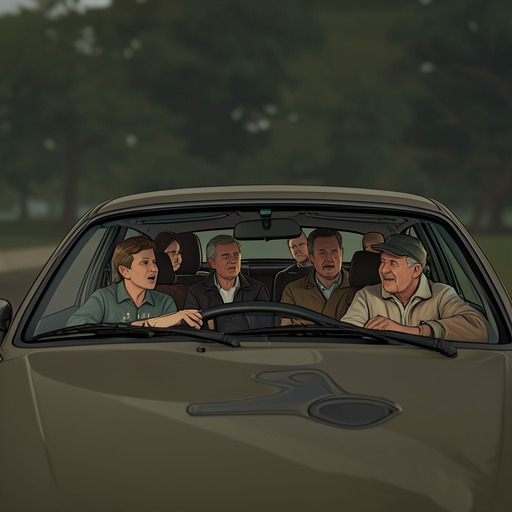
The trip to Cadaqués has the character of an expedition. Blanca drives, with Sofía beside her, while Edgar, Nicolás, and Daniel, Sofía’s son, travel in the back with their nanny, Úrsula. Blanca is startled by her own role as the adult in charge: she chooses the departure time and the children’s clothes, gives instructions, and drives, yet privately feels like a six-year-old waiting to be exposed as a fraud. The drive makes that tension visible through the rear-view mirror, where the children laugh and fight together. She longs to trade her precarious adult authority for the crowded back seat of her own childhood car, among her brother Bruno, Marisa, Elenita, and the family’s dogs.
The group breaks the drive at Tom’s home. Tom, Daniel’s father and a former partner of Sofía, had agreed to have a child with her after she approached him when she feared that time to become a mother was narrowing. He had made clear that the boy would be Sofía’s responsibility, while he would give Daniel his surname and see him occasionally; Sofía accepted the arrangement gratefully. At Tom’s rundown house, which stands on extensive land devoted to rescuing dogs and breeding beagles, the children call to him behind a wire fence. A pack of dogs runs toward them, and their unrestrained pleasure in the sun lifts Blanca’s mood. The pause also gives her relief from the road to Cadaqués, each stretch of which hurts because she travelled it with her mother.
The House as a Record of Time
Once they arrive late, Blanca carries the sleepy children to bed, leaves her friends with gin and tonics on the terrace, and goes to sleep. At dawn she returns to the view of the sea and finds that, for once, the accumulating memories do not suffocate her. She recalls the family’s repeated summer rituals: fruit brought from Barcelona, laundry taken away to be washed, enormous custards, Marisa’s gazpacho, long breakfasts of toast and butter, beach towels drying on the rail, reluctant naps, ice creams, and target shooting. The catalogue opens outward into first drunkenness, first loves, sleepless nights, drugs, dancing at dawn, the conception of her first child, and later journeys to Cadaqués with children of her own.
That history is not an unbroken idyll. The children suffer the same summer head injuries against the house’s pointed 1970s architecture that Blanca’s brother once did; separations follow, her mother ages, and the house’s formerly open doors begin to close. The daily pattern of breakfast, boat, lunch, siesta, and card games changes little even as happiness itself fades. Blanca remembers the deaths of Marisa and, a couple of years later, Marisa’s daughter Elenita, as well as the dwindling pull of visits she once felt obliged to make. At last, the house seems to have grown old with her mother, become lonely, and become her. Yet the rose-white morning light, clear air, and calm sea make the landscape look almost as it did when Blanca was twenty, holding present beauty against the losses the view cannot undo.
Her mother’s room concentrates that contradiction. It is the largest and most beautiful room, with the best view, and Blanca recalls her mother giving the day’s instructions from the stairs in long summer tunics, or calling a witty or malicious remark into a terrace conversation from her room. Now it is empty. Blanca considers installing Guillem and Patum there but cannot even enter it, and leaves the house because she wants coffee and would like to visit the cemetery. The room’s vacancy is not simply a reminder of death: it makes the mother’s former presence in the household newly legible, from the way she directed the day to the way her voice could enter a conversation from elsewhere.
Grief in the Present Tense
The stay does not convert mourning into a settled state. Blanca’s friends and the children fill the day with movement and care, but after arriving she lies awake with what she calls an inner howl. It is quiet during daylight, then wakes when she is alone in bed, clawing at her chest, tightening her jaw, and striking her temples. She sometimes opens her mouth and pretends to scream silently, but the gesture does not deceive it. Dawn, children, modesty, and daily chores can quiet it for a few hours; night brings it back.
The same alternation appears in Blanca’s response to Patum. The dog no longer enters her mother’s room, instead waiting at the door and sniffing through the house for her scent or a sign of her return. Blanca recognizes her own searching in the animal’s behavior. Guillem has told her that the veterinarian doubts Patum will live through the winter; Patum is the last of a litter born in the house, of which nine puppies survived their first hours except for one that died shortly after birth. Blanca remembers her mother arranging a large wooden box beside her bed and spending weeks tending the puppies, ensuring that the weaker ones could eat while their mother, Nana, rested. Even the memory of the litter’s care is double-edged: it preserves her mother’s attentiveness while bringing another impending loss into the house. Patum loves Blanca with an irrational, disproportionate devotion, but is now Guillem’s dog; Blanca wonders whether naming can determine belonging and fears how empty this side of the world is becoming.
Near dawn, after spending hours at a party, Blanca sets out alone. She considers going down to the beach to watch the sunrise, then turns uphill through Cadaqués’s narrow stone lanes, past an abandoned child’s shoe and the camping ground where she remembers a friend cooking spaghetti over an outdoor stove. The names of many people from those carefree summers have faded, but the road leads onward to the white walls of the small hermitage and the dark cypresses beside the cemetery. This movement toward the grave does not settle her grief. It gives the stay one of its clearest forms: the living summer continues around her, while Blanca keeps walking toward the place where the loss can be faced directly.