Guillem
También esto pasaráGuillem is Blanca’s former partner, the father of her eldest son, and one of the enduring members of her family. Their love-hate bond survives their separation: he often acts as though he dislikes her, while she loves him and trusts his character. His importance emerges less through declarations than through practical care, teasing, shared history, and the steady affection he gives their children.
Identity and Character
Guillem is an archaeologist, a drinker, and a teacher who tries to get his students to learn something about history. Blanca describes him as cultivated, intelligent, generous, stubborn, funny, strong, and solidaristic, as well as someone inclined to suspicion and to cheating at games. His sense of humor is joined to a practical temperament: he can explain the French Revolution to the children in detail and then go out to plant tomatoes. That combination—historical knowledge without solemnity, and competence without ceremony—helps account for why the children adore him.
He is notably sparing with verbal affection and conventional gestures of tenderness. When Blanca asks him to hold her hand and keep her company, he takes it with a grunt. For her, the gesture carries more weight than elaborate professions of love: she trusts that, in a serious situation, he will do what is right, decent, and compassionate. Outside such moments, he laughs at himself and other people, drinks, and teaches. Blanca admits that she did not understand the depth of this reliability when they first met or when they separated; she recognizes it now, while there is still time.
A Bond That Outlasts the Relationship
Blanca and Guillem’s former partnership has left them with a relationship she characterizes as love and hate, though his apparent hostility contains more good than the love offered by most people she has known. The affection between them is not presented as a simple return to romance. It is an accumulated familiarity expressed through barbed humor, trust, and an ease that remains available after their life together has ended.
Their domestic past also survives in Patum, Blanca’s mother’s dog. Patum belonged to Blanca and Guillem for a time before their separation. When Blanca went away, she left the dog with him; on her return, he told her that Patum would stay with him and would be better off with his mother and sister. The dog became his, as Blanca says he made his own the things he loved. Patum’s place in his household makes their shared history tangible: separation changed where the dog lived, but did not erase the care that connected them.
Fatherhood and the Wider Family
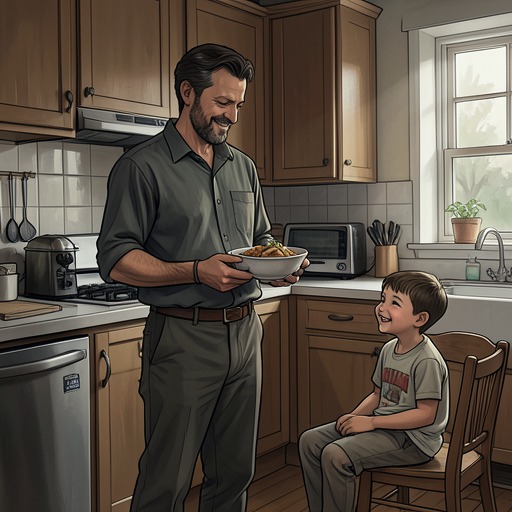
Guillem remains closely involved with his son. After the children have spent several days at his house, they return tanned and taller, carrying salads, tomatoes, and cucumbers from his garden. Blanca welcomes the gifts, though her lack of confidence in country tasks means the produce may end up in the rubbish if she discovers a bug while washing it. The exchange over organic apples turns that apprehension into a joke: Blanca worries about biting into an apple and finding a worm, and Guillem answers by pretending to offer her the poisoned kind. He mimes cutting his throat, making the children laugh. His humor lets him meet their fears and absurdities without losing his practical footing.
His care extends beyond his own son. At a family meal, he ties a napkin around the younger child’s neck to keep him from getting dirty, while Blanca’s former husband Óscar jokes with the older boy about his first mustache. Guillem and Óscar treat one another with respect and warmth, and each treats the other’s son with something close to paternal affection. The scene places Guillem within a family assembled across former partnerships: separation has not prevented the adults from sharing the work and tenderness of looking after the children.
Patum and the Funeral
Patum’s transfer to Guillem becomes a measure of Blanca’s mother’s decline. The dog had outlived Blanca’s mother and sister, and Blanca understood the mother’s unprotesting acceptance of Patum’s departure as a sign that the end was near. On that same afternoon, Blanca began arranging for her mother to be buried at Cementerio de Port Lligat. Guillem brought Patum to the funeral, the only dog there, with a black ribbon tied around her collar.
The detail is characteristic of his affectionate practicality. Patum, usually sprawled out, sat formally in the shade beside Guillem, who wore old jeans and a shirt he had specially ironed for the occasion. Blanca imagines that her mother would have liked the sight and pictures her sitting beside them, a hand on the dog’s head, witnessing the silent funeral. The imagined scene connects Guillem not only to Blanca’s own family life but also to the rituals of her mother’s death: his care for Patum carries the dog, and the family’s history, into the farewell.
Continuing Presence
Years after their separation, Guillem’s relationship with Blanca is presented as a form of enduring trust rather than a neatly resolved past. His place at the table, his ease with Óscar, and his attentive handling of the children all show a family whose ties are made through care as much as through romance or formal partnership. Even his gruffness belongs to that pattern: affection is often conveyed by what he does, while teasing keeps intimacy from becoming solemn.
Guillem’s significance also lies in the contrast between his blunt manner and the confidence Blanca places in his moral judgment. He may avoid the language and rituals through which other people dress love, but she expects him to act decently when circumstances matter. The relationship therefore remains alive in practical acts—a hand taken, a child’s napkin tied, a dog kept and brought to a funeral. These acts give their shared past a present-tense form, without requiring them to become a couple again.