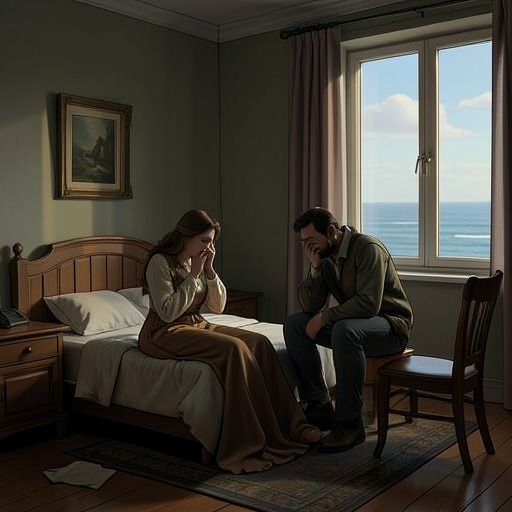
Leaving her mother alone in the hospital on her final night
También esto pasaráLeaving her mother alone in the hospital on her final night is a small, irreversible decision made under false reassurance, and it becomes one of the defining wounds in Blanca’s mourning. After a day beside her mother, holding her hand, Blanca goes home to sleep because the doctor says her mother is better; by morning, her mother is dead. The gap between the doctor’s words and what Blanca could see, and between her wish to remain and her departure, gives the loss its enduring weight.
The Last Night in Hospital
Blanca recalls that she had spent the whole day at the hospital holding her mother’s hand. The doctor then told her that her mother was doing better. Blanca knew the reassurance did not match what she could see, but she nevertheless decided to go home and sleep for a while. Her mother spent the final night alone and died before Blanca returned.
The recollection is shaped by what Blanca wishes had happened instead: she would have liked to die alongside her mother, in the same room and at the same moment, still holding her hand. Instead, the deaths are separated by a night and by Blanca’s absence. She describes herself as continuing to walk among the living, more or less cheerfully and more or less alone, while always having one foot where her mother is. The image makes the departure more than a detail of hospital timing: it is the boundary between the life Blanca continues and the death she cannot leave behind.
The Mother’s Earlier Farewell
The final night is set against an earlier hospital encounter in which Blanca tried to reassure her mother. During her third bout of pneumonia, Blanca told her that she would recover and that Blanca and the children would be all right. Her mother could no longer speak. She looked steadily at Blanca and began to cry silently; her friend Ana suggested that the air conditioning was irritating her eyes, but Blanca understood the tears as a farewell.
That earlier exchange sharpens the meaning of Blanca’s later absence. Blanca had been able to hold her mother’s hand and offer comfort when her mother was still there to receive it, but she was not beside her at the end. In the months before the death, illness had altered their relationship and the demands of care: Blanca describes calls in the night, her mother’s fear, and repeated crises that left Blanca trying to manage care while also looking after her children. The final departure follows a prolonged period of strain, but that context does not dissolve her regret.
Aftermath and Continuing Grief
After the death, comfort offered by other people cannot replace the presence Blanca longs for. She has heard many times that there are people who love her, and she is grateful, yet she wants her mother to sit beside her, take her hand, and touch her forehead. The distinction is not between having support and having none; it is between the care others can offer and the particular maternal comfort that is now impossible.
Blanca’s memory of leaving also sits within a wider pattern of moving between grief and ordinary life. Sex can briefly make death—and even life—recede, she reflects, but the room’s furniture, clothes, memories, fear, and sorrow return to their places afterward. Her mother’s death remains present amid daily routines, family memories, and the continuing business of living. The departure from the hospital does not conclude the mourning; it becomes one of the moments to which the mourning repeatedly returns.
The Story of What Passes
Blanca recalls a story her mother once told her to console her after her father’s death. In it, an emperor asks the kingdom’s sages for a short phrase that will apply in every circumstance. Their answer is that this, too, will pass. Her mother explained that sorrow and pain pass, as do euphoria and happiness. Remembered after her own death, the story becomes both inheritance and contradiction: Blanca says she will live without her mother until she dies.
The event’s force lies in that unresolved tension. The mother’s lesson gives Blanca a way to name change and survival, but it cannot make the separation temporary or undo the night she spent away. Her mother’s hand, held through the day but not through the final night, remains an intimate measure of what Blanca wanted and what she could not know in time.