Santi
También esto pasaráSanti is Blanca’s lover for more than two years, a man whose physical appeal repeatedly draws her back even as his marriage makes the relationship uncertain and limited. After Blanca’s mother dies, their renewed affair briefly interrupts her grief; ultimately, however, Santi’s attachment cannot give her the mutuality or security she wants, and she tells him they should stop seeing each other.
Presence and Appeal
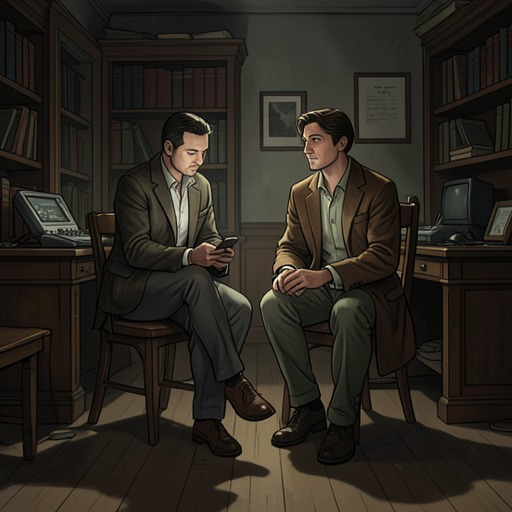
Blanca’s account first makes Santi vivid through the details that attract her. In Badalona, where they meet after she has not seen him for weeks, he rides toward her on a bicycle wearing her favorite faded-red jeans and an old khaki parka they bought together long ago. She imagines that he has put them on to please her, and perhaps as a charm against the storms in their relationship. His compact, tanned body, bicycle- and ski-developed legs, and short, thick, often bruised hands sharpen her immediate response: seeing him makes her heart lurch, as it always does.
The appeal is neither an abstract ideal nor a calculation of advantage. Blanca recalls her mother teasing her for liking handsome men, and suggests that the preference amused her because it favored appearance over power, intelligence, or money. Santi’s effect on her is registered bodily: when they meet, she feels her pulse quicken. Their reunion in Badalona turns an unpromising bar, with its terrible croquettes, into a place they regard as wonderful. The shabby surroundings and their delight belong together; what matters is the charged pleasure of being near each other again.
Their closeness appears in small gestures before it becomes overt. Over drinks, they touch almost imperceptibly, stand closer than friends ordinarily would, and make their way through narrow streets looking for somewhere quiet and out of the sun. In an underground passage Santi pushes Blanca against a wall and kisses her. The encounter brings back the disorder of early kisses and makes physical desire, rather than conversation or a settled promise, the relationship’s most immediate language.
Marriage and the Affair’s Uneasy Course
Blanca has been seeing Santi for more than two years, but deliberately avoids asking about his relationship with his wife. She describes this silence as a mixture of delicacy, respect, and fear, and believes that people eventually reveal themselves if one keeps one’s eyes and ears open. Her chosen ignorance protects her from knowledge that might force a reckoning, while leaving the central obstacle of Santi’s marriage unresolved.
The history she eventually relates explains why the affair has a stop-and-start shape. When Blanca met him, Santi had separated from his wife, who was having a love affair with one of his friends. That relationship failed, and Santi returned home, intent on tending to his wife’s hurt and repairing their relationship. In Blanca’s description, the marriage had already exchanged sex, curiosity, and admiration for comfort, companionship, and children. Santi’s return therefore does not mean that the couple have recovered their former intimacy; it means that they have resumed a familiar shared life.
Blanca and Santi’s own relationship had begun to fade after a couple of months. His return to his wife revived it through the force of what was impossible and unattainable. Blanca had not found anyone she liked more during their separation, while Santi recognized that his marriage had picked up where it had been left, as though its story had reached its final page. The affair’s renewed intensity rests on that asymmetry: both are drawn back, but neither has made the relationship an available, ordinary future. Blanca’s reflection that love cannot simply travel backward gives their reunion a sense of one-way movement even as the affair itself circles back.
Desire, Grief, and the Present
The affair takes on particular force after Blanca’s mother dies. Looking back on the months of illness, Blanca connects her sexual encounters to the struggle against death: as her mother’s disease grew more relentless, sex seemed to become more relentless too. She describes desire as the opposite of death, a way of proving that she remained alive when grief and exhaustion threatened to make her feel as depleted as her mother. This is Blanca’s account of what sex does for her, not a claim that Santi can resolve her mourning.
When Santi reappears, the relationship seems to offer a route back into bodily immediacy. Blanca likens sex to being fixed in the present, while Santi resembles a phone from which she is always waiting for an exciting message. His attention can revive her, but it also sustains anticipation: the possible future feels more thrilling than what is actually happening. The distinction captures both his emotional importance and the limit of his place in her life. He can bring her back to movement and sensation, but the relationship’s uncertainty remains part of the attraction and part of its cost.
Separation and Significance
The limits become explicit in their final confrontation. Santi tells Blanca that he has not had sex with his wife for a long time, something he had never previously disclosed about their private life. Blanca responds with repugnance and says that his sex life with his wife is not her concern; then she tells him that they should stop seeing each other. The disclosure does not persuade her that their relationship has become more substantial. Instead, it makes the boundary between his marriage and their affair more visible.
Santi protests that he cannot stop seeing Blanca, although he knows that what he gives her is very little, and tells her he loves her very much. Blanca notices that her own understanding has already shifted into the past tense: she hears his declaration as love that he has given her, rather than love he is giving now. She does not answer. For her, a conversation in which two people try to measure their love is already too late and destined to fail. His distress is real, but it does not reverse her decision.
Santi’s narrative role is therefore defined by a recurring contrast between intensity and availability. His appearance, touch, and messages awaken Blanca’s senses, particularly in the shadow of bereavement; his marriage and their reliance on an impossible future prevent that charge from becoming a dependable partnership. The affair can return, and its return can feel momentous, but Blanca finally refuses to mistake renewed desire for enough. The relationship ends not because its attraction has vanished, but because she recognizes the inadequacy of what it offers.