la memoria como forma de conservar lo perdido
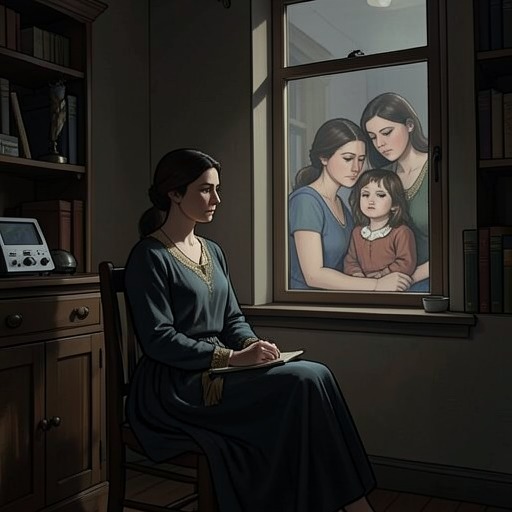
También esto pasaráLa memoria como forma de conservar lo perdido is the narrator’s way of keeping her dead mother and their shared past present without pretending that memory can reverse death. Details preserved through attentive observation—rooms, objects, gestures, and repeated family stories—make the past available to be recalled, even as each return exposes what cannot be recovered. Memory is both intimate and material: it lives in the daughter’s mind, in a house shaped by generations, and in a blue-grey coat that she cannot initially bring herself to clean.
Memory in the family house
The mother’s house gathers personal memories into a shared history. From its terrace, the narrator recalls her grandfather arriving with crates of fruit from Barcelona, Remei taking laundry away to wash, and Pepita de la Galiota bringing enormous tocinos de cielo. The remembered sequence also includes breakfasts of toast and butter, beach towels drying on the railing, reluctant siestas, trips into town, afternoon ice creams, and target shooting. These domestic repetitions make the house more than a setting: it is a record of the people who passed through it and the routines through which family life took shape.
That record holds contrasting periods together. The narrator remembers first drunkenness, first loves and dawns, summer friends, sleepless nights, laughter, drugs, and the exhilaration of feeling that the world belonged to them. Later came the conception of her first child, holidays in Cadaqués with children, separations, and the mother’s old age. The house’s routine of breakfasts, the boat, lunches, siestas, and card games changed little even as happiness altered and the mother and house grew old. By the time the house seemed to have become the mother, recollection carried both a sense of belonging and the knowledge that the life it preserves has ended.
Observation makes the past retrievable
The narrator’s memories are precise enough to feel like objects she could set before someone else. She can describe the changing shades of the mahogany bookcases in her mother’s home, from reddish brown to deep red and black as the daylight faded. She remembers the exact warmth of freshly baked bread in her father’s hands and the small glass of red wine he kept half full in the kitchen. Such attention gives memory its particulars: the past is not retained as a general feeling of family, but as colors, temperatures, and objects noticed closely.
In a conversation with Damián, this becomes an explicit account of how remembering works. He argues that attention, as well as love, makes people and places one’s own: what someone has encountered without indifference can be summoned again. The narrator resists the comfort of that idea, insisting that some things are lost for good and that loss may outweigh possession. Her view does not simply cancel his. The exchange sets a limit around remembrance while demonstrating its power: she can call up the bookcases, her father’s hands, and the wineglass in exact detail, but cannot make the dead or vanished places return as living presences.
Objects, absence, and changing distance
After her mother’s death, the narrator sorts through belongings while moving boxes crowd the entrance to her home. Some boxes from an earlier move have remained unopened for two years; she cannot remember what they contain and imagines that opening them, perhaps years later, might uncover treasures. Her mother’s boxes, by contrast, contain books, tableware, tea sets, and table linens. The daughter shifts repeatedly between wanting to give everything away and deciding to keep every last item. She understands this hesitation as part of choosing how close to remain to her mother: distance from the dead is harder to establish than distance from the living.
The blue-grey wool coat with terracotta stripes becomes the one garment she keeps. It matters not because it is valuable, but because she remembers seeing her mother wear it many times and buying it with her in the mother’s favorite shop. At first, she cannot take it to the cleaners or even check whether it still smells of her mother. Hanging among the boxes, it appears to her as a dusty, dog-haired specter greeting her when she comes home. Much later, as she says she is beginning to breathe more easily and has almost stopped having nightmares, she takes the coat to the cleaners. The change is concrete but not a severing: the remembered garment remains, now no longer left untouched as though preservation depended on keeping it exactly as it was.
Recollection continues into daily life
Memory returns amid ordinary demands rather than in a steady progression toward closure. After her mother’s death, people repeatedly tell the narrator that many people love her; she appreciates them but longs instead for her mother to sit beside her, hold her hand, and place a hand on her forehead. The contrast shows why remembrance is not interchangeable with consolation from the living. Her mother’s absence is specific, and memory keeps that particular bond in view even as family and friends continue around her.
The children’s stories and images also carry the mother into family life. Nicolás imagines her playing poker in heaven with Copito de Nieve, while the children’s drawings picture her flying above them as a mischievous witch and an awkward fairy. The narrator reflects that the children could still reach the person behind illness and its fog, and that, unlike her, they did not hate their grandmother. On journeys through Barcelona, she discreetly watches her older son look up in silence at the balcony of the last apartment where his grandmother lived. She considers explaining that his grandmother is in a better place, but cannot honestly offer that consolation: for a long time, the mother most wanted to be with her grandchildren and daughter.
A remembered encounter and an unfinished bond
The mother’s presence returns most vividly in the narrator’s failed dawn visit to the cemetery. After leaving a party, she climbs through Cadaqués toward the cemetery, but finds its gate locked. She pushes and pounds on it until her hands hurt, then sits exhausted as dawn turns the olive trees silver and the walls pink. Looking toward Port Lligat, she imagines her mother walking along the harbor in a faded checked shirt over her swimsuit, accompanied by Patum, Nana, and Luna, on her way to the boat. The mother turns, smiles, and reminds her that the present, too, will pass. The vision does not open the cemetery gate or undo the death; it gives the daughter a remembered maternal voice at the point when access to the grave has failed.
Other memories are carried by the house and its inhabitants. Patum waits outside the mother’s room and sniffs around the house for her scent or any sign that she will return. The narrator imagines revisiting Athens, Venice, and New York, places where she might find her mother, while fearing Patum’s approaching death will make this side of the world feel emptier. In the epilogue, her children’s kindness toward the unusual and wounded people who enter their home recalls qualities she associates with their grandmother. Memory thus passes beyond private recollection: it shapes how the narrator sees her children and the welcome they offer others. The bond persists not as a claim that nothing has been lost, but through details, habits, stories, and acts of attention that continue to give the absent a place in the living.