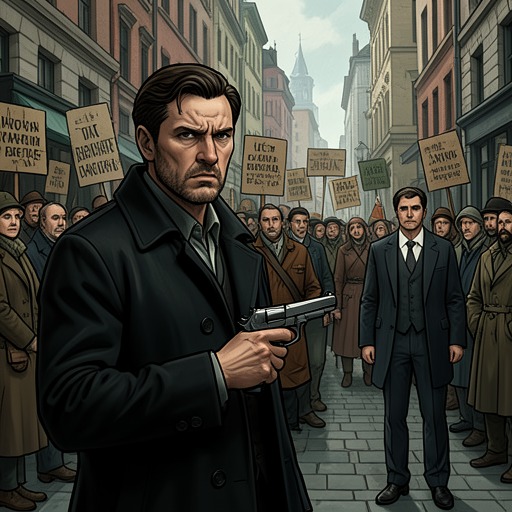
« Quand un homme a goûté au sang… »
Taxi Driver« Quand un homme a goûté au sang… » is the proverb Travis uses to give lasting meaning to an encounter with violence. He presents it not simply as a warning about danger but as a change in perception: after bloodshed, time and feeling become disjointed, and a person’s former life seems to have acquired a permanent mark. Its importance lies in how it turns a particular aftermath into a principle that helps Travis explain—and increasingly organize—his own life.
Proverb and Immediate Context
Travis invokes the saying as he leaves a tense encounter with Melio. He has put his gun back inside his jacket; Melio has set his own weapon on the counter and is reaching for the telephone to call the police. Travis crosses the threshold carrying chocolate milk and a Cuban sandwich. The ordinary errand-like details sharpen the contrast between the mundane objects in his hands and the threat still present in the room.
The proverb follows this scene, but its claim is larger than the immediate confrontation. Travis describes blood as leaving an enduring mark and insists that life afterward is not the same. The statement gives the episode a before-and-after structure: violence becomes a boundary across which the self cannot simply return unchanged. Yet the language is Travis’s own way of making sense of events; it does not establish that violence has made him wiser or that his interpretation is reliable.
A Changed Sense of Time and Feeling
Travis explains the supposed mark through disturbances in time and narrative. Minutes seem to merge, while the film of a life slips backward and forward on its track. One moment belongs to a violent, blood-covered dream; the next resembles a sentimental serial about a man and a woman, slowed down by enormous gaps between words and feelings. The comparison makes the aftermath feel less like a settled lesson than a fractured sequence in which different versions of experience interrupt one another.
This account resonates with the book’s earlier portrait of Travis’s life in New York. His first winter there finds him lonely, without love and with little self-respect. Taxi work places him amid a city he describes as filthy and brutal: after shifts he cleans the back seat, finding bodily mess and sometimes blood, while people sleep outside in the cold. He wonders why life in the city seems harder to bear than military life. The proverb’s blood therefore belongs to a wider landscape of war, urban exposure, and accumulated violence, even though Travis does not explicitly identify any one earlier experience as its single cause.
From Exposure to Deliberate Preparation
After the encounter with Melio, Travis increasingly stays in his room. He likens the place to a cave, cleans his .38, watches television, and eats directly from jars. He believes that something remains for him to do, but that it will require time, cunning, silence, caution, and precision. The proverb’s permanent mark thus accompanies a change in conduct: withdrawal and repetitive gun-cleaning become part of a private preparation for action.
That preparation takes place against the city’s geography. Travis begins carrying weapons into neighborhoods he considers dangerous, including areas around 128th Street and Amsterdam, Harlem and Seventh Avenue, Lenox Avenue, and the Lower East Side near Tompkins Square, B Street, and Avenue B. He says he wants to know what would happen if he had to use the guns, and imagines making his dream visible to himself—to become real through the weapon. The phrase’s metaphor of crossing an irreversible threshold now shadows a pattern of deliberately approaching situations in which violence might occur.
Violence and the Desire for History
Travis’s later ambition to become somebody, a celebrity, and enter history gives the proverb another edge. Before the encounter, he has already bought guns and declared that he will never return to war alive. Afterward, his emphasis on doing what he must, while remaining silent and precise, links his private preparations to that wish for historical recognition. The saying can make this course sound fated, as though exposure to blood itself dictates what comes next; the narrative also shows the concrete choices through which Travis gives that idea force.
His relationship to Charles Palantine brings the contradiction into view. Travis admires the senator and America even while imagining himself in a role shaped by death; he associates the country with both the teaching of killing and the commandment against it. In public, he can present himself as a politically engaged supporter, while his private thoughts turn toward violence and fame. « Quand un homme a goûté au sang… » therefore works as more than a maxim about what violence does to a person. It is also a piece of Travis’s self-explanation: a compact, proverb-like form that makes a fractured experience sound permanent and his chosen path sound almost inevitable.