Charley T.
Taxi DriverCharley T. is a Black taxi driver in Travis Bickle’s professional orbit, seen among the night-shift drivers who gather at the Belmore. The novel gives him no independent narrative voice: Travis describes his talk, manner, and dealings with other drivers, and sometimes doubts the truth of what he says. Charley’s appearances therefore reveal both a distinct colleague and the limits of a portrait filtered through Travis’s suspicious, often racialized gaze.
Identity and Introduction
Charley T. is a familiar figure at the Belmore, where Travis often sees him with other drivers. Travis singles out Charley’s race while describing him, then emphasizes the contrast between that identity and the racial insults Charley directs at passengers and people around him. In Travis’s account, Charley does not simply describe a passenger as a passenger; he sorts people by ethnic or racial category, including Jews, Italians, and people of color. The language belongs to Charley as Travis reports it, but the narration itself is not neutral: elsewhere Travis reduces the city to a string of racialized and classed figures. Charley’s characterization thus sits inside a wider view of New York City in which people are quickly classified and judged.
Travis also renders Charley through striking visual details: a large, pirate-like moustache and a wool cap compared to Marvin Gaye’s. These details make Charley memorable in the crowded, recurring company of the drivers, while the comparison and description remain part of Travis’s subjective account rather than an independent portrait.
Talk, Performance, and Credibility
Charley’s way of addressing people appears to be a performance of recognition. If someone is Spanish, Travis says, Charley will speak Spanish to that person; he behaves similarly with French speakers, Jews, and Italians. Charley seems to use another person’s language to demonstrate that he knows who they are. Travis calls him a foolhardy talker, yet acknowledges that what Charley says can sound true; he immediately qualifies that impression by wondering whether the words are even real. This combination of apparent fluency and narrative doubt leaves Charley’s linguistic skill unresolved. What is clear is the social effect Travis attributes to it: Charley turns a brief encounter into a display of knowingness, attaching a category and a voice to the person before him.
That uncertainty also governs Charley’s gossip. He claims that Lindsay’s wife is unfaithful and that everyone knows it, makes a similar assertion about Rockefeller, and spreads a sexual rumor about Jackie Kennedy and her limousine drivers. These are presented as Charley’s allegations, not as established facts. Travis reports them as examples of the talk Charley produces, while leaving their accuracy unverified. Charley’s role in the drivers’ company includes circulating stories about people far beyond the cabstand, but the novel offers no corroboration for those stories.
The Drivers’ Company
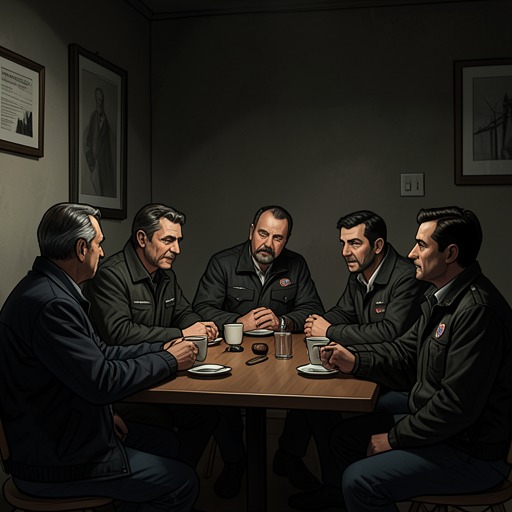
The Belmore’s late-night gathering gives Charley a setting among coworkers rather than passengers. At about 3:30 a.m., Travis sits with fellow drivers comparing the familiar pressures of the job: customers who squeeze them for money, the way passengers speak to them, the loneliness of driving, and women whom the drivers believe are trying to cheat them. The conversation presents taxi work as both constant contact with strangers and a deeply solitary occupation. Charley belongs to this group, where banter and complaints provide a temporary form of company.
A separate account of the same kind of workplace exchange shows how readily teasing and accusations move among drivers. After Travis has been cheated by a passenger on a trip to Sunnyside Gardens in Queens, one colleague boasts that he would confront the first person who tried the same trick; another mocks him for taking extra money from a passenger during rush hour. Charley is not identified as a participant in that particular exchange, but it helps establish the cabdrivers’ conversational world: money, fares, and the suspicion of being taken advantage of recur as subjects. At the later Belmore meeting, Charley’s own comments and gossip take their place in this rough, competitive talk.
The 3:30 A.M. Encounter
After a period of keeping to himself and avoiding the other drivers, Travis goes to the Belmore one morning at 3:30 to sit with a colleague over coffee. He says he wants simply to talk and perhaps to preserve some contact with other people, rather than remain entirely absorbed in his dream of entering history. Charley arrives while the two are together. Travis greets him in a way that sounds almost sincere, but Charley’s response quickly changes the tone: he addresses Travis by the nickname “Killer,” then repeats it while asking how he is.
Charley reinforces the nickname by shaping his hand into a pistol, aiming it, and making a gunshot sound with his lips. Another driver tells Travis that he is acquiring a reputation. The exchange turns Travis’s violence from a private aspiration into something recognizable within the taxi circle, though the scene does not establish exactly how widely that reputation has spread or what Charley knows about Travis’s intentions. Travis says the greeting nearly spoils his effort to reconnect with the others; he feels cold as Charley sits down and orders coffee and scrambled eggs.
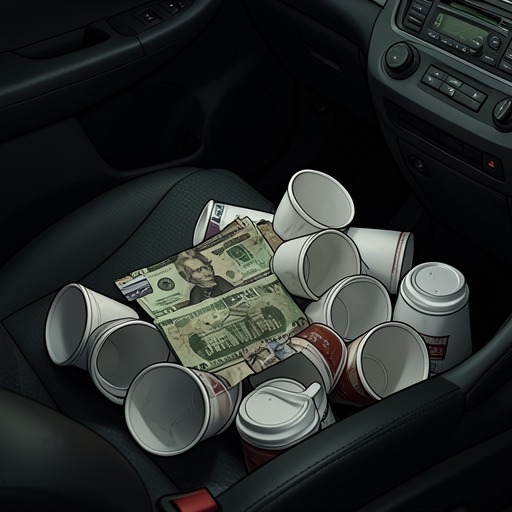
The encounter then becomes concrete in a small exchange of money. Charley asks Travis for five dollars. As Travis reaches into his jacket for his roll of bills, a twenty-dollar bill from the previous night in the Lower East Side comes out too. He stares at it for a long moment, as if reluctant to touch it, finds a five, gives that to Charley, and returns the twenty to his jacket. Charley then describes a quiet night rescued by a wealthy suburban passenger: he drove slowly and got the man to pay twenty-five dollars. His story makes money-making part of the same conversation as the nickname and the gun gesture, joining the ordinary calculations of cab work to the darker reputation Charley has just invoked.
Narrative Role and Limits
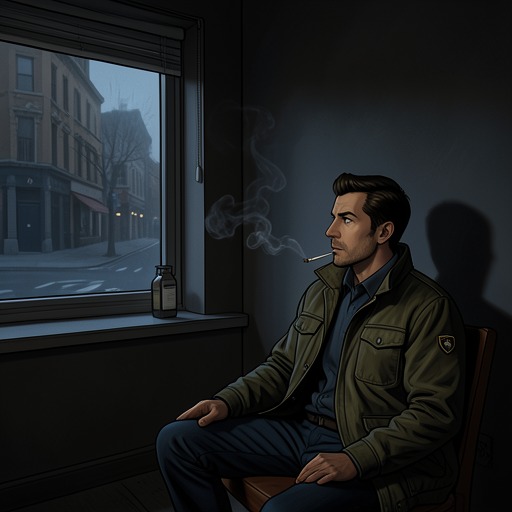
Charley T. is a recurring witness to Travis’s identity as it is formed in public, not merely in Travis’s private thoughts. His joking title and finger-pistol gesture make the word “Killer” a social label; Travis’s reaction indicates that the label touches the fame he wants, even as he had gone to the Belmore to keep from retreating wholly into that fantasy. Charley does not explain Travis or endorse a course of action, and the scene does not show him learning the details of Travis’s plans. His importance lies in the brief but telling recognition: among the drivers, Travis’s violent self-image has begun to acquire an audience.
At the same time, Charley’s portrayal remains limited by Travis’s point of view. His racialized talk, language displays, gossip, and money stories are all filtered through a narrator who judges the city in similarly reductive terms. The text gives concrete evidence of what Travis observes and reports, but little access to Charley’s motives or private life. That gap matters: Charley is both a participant in the drivers’ nightly company and a figure whom Travis turns into a set of sharp impressions, leaving the reader to distinguish the reported behavior from the narrator’s framing.