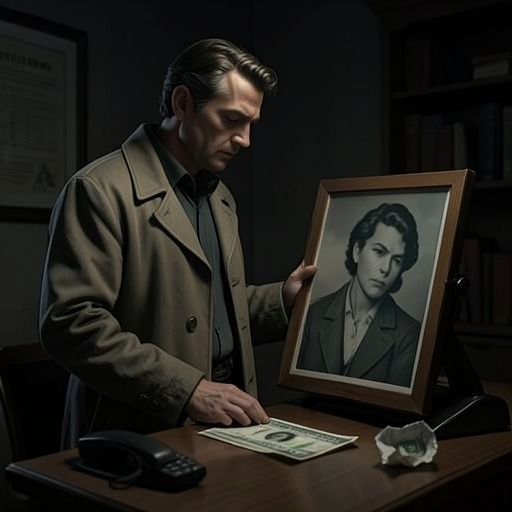
Hedda Dugan
Taxi DriverHedda Dugan is the older woman Travis Bickle remembers as his girlfriend before Vietnam. In his account, she offered him affection and constancy, while he felt too young and insufficiently attached to return her love. Their relationship ended when he left for the army, but its unequal intimacy—and his later news of her distress—remained part of the story he told about arriving in New York City and beginning again as a taxi driver.
Identity and Background
Hedda Dugan worked on an assembly line in a Ford parts factory. Travis recalls her as older than he was by more than a decade: he estimates that he was nineteen or twenty, while she was already past thirty. His description mixes disparagement with warmth. He says she was not conventionally beautiful and was not his usual type, yet remembers her as exceptionally kind, gentle, and a good person. These judgments are Travis’s retrospective portrait, not an independent account of Hedda’s character.
The relationship’s imbalance is apparent in the details he chooses to recall. Hedda called him Pickle, using a nursery-rhyme-like pet name and an elaborate pickle joke. Travis presents this as playful affection, but also as a sign of how closely she centered her life on him. He remembers her saying that she loved him and that she would follow him wherever he wanted to go. She waited for him at breakfast, lunch, and dinner, and, in his comparison, followed him around town like a puppy.
Relationship with Travis Bickle
Travis says he liked Hedda but did not love her with anything like the same intensity. He describes her as one woman among many rather than someone who stirred his imagination, and believes that he hurt her. At the same time, he recalls feeling dominated in her company: although she expressed love, he felt as if she possessed him. His account thus holds together two different impressions of the relationship—Hedda’s devoted attention and Travis’s unease at being its focus.
He also portrays their connection as emotionally blurred. In retrospect, he says Hedda was more like a mother than a girlfriend. The comparison suggests that he experienced her care as protective and persistent, but did not describe it as the mutual romance he wanted. He presents his youth as part of the explanation for keeping her at a distance: he believed he was too young for the future she seemed to imagine. This is his explanation of their mismatch, not evidence that Hedda herself accepted it.
Departure and Separation
When Travis left, Hedda cried. He recalls that neither of them had anyone else in their lives, a detail that makes the departure more consequential than his brisk description of simply leaving might suggest. He did not introduce her to his parents. He says he knew she was not the sort of woman they would have wanted to see him with, and reports that Hedda never forgave him for the omission. His decision to keep her separate from his family therefore remained a specific grievance between them, alongside the larger fact that he had not returned her attachment.
Travis then spent a long period with the United States Army, among career soldiers and what he calls temporary friends. During that time, he learned that Hedda had gone away and had done something terrible with scissors. He does not explain precisely what happened, so the account supports neither a definite diagnosis nor a more specific description of the injury or act. He does say that hearing this news was when he seriously considered coming to New York City and working as a taxi driver. Hedda’s later fate thus enters his story indirectly: as a painful report from a life he had left behind and as part of the background to his decision to relocate.
Retrospective Significance
By the time Travis describes his first winter in New York City, roughly two years before the narrative present, he recalls having no love, almost no one to love, and little respect for himself. His recollection of Hedda sits against that account of isolation. She had offered him a relationship in which he was wanted and cared for, but he had not valued it on equal terms and had left without making her part of his family life. The contrast helps explain why her story matters to his recollection without establishing that it alone caused his move or his later loneliness.
Hedda is present only through Travis’s memory, and that limitation shapes her narrative role. Her tenderness is visible in the routines and pet name he recalls; her hurt appears in her tears and her refusal to forgive his failure to introduce her to his parents. Yet the story gives no account of her perspective on the relationship, her reasons for following Travis, or what happened after the news about the scissors. The resulting portrait remains deliberately partial: Hedda is both a person Travis remembers as kind and a figure through whom he exposes his own youth, emotional distance, and inability to meet another person’s devotion with the same commitment.