New York City
Taxi DriverNew York City is both Travis Bickle’s workplace and the landscape through which his loneliness and appetite for danger take form. Seen almost entirely from his moving taxi or through his journal, the city is not a neutral backdrop: its weather, neighborhoods, crowds, and routes accompany his changing sense of purpose, from finding work to trying to make himself feel real.
First Winter and the Search for Work
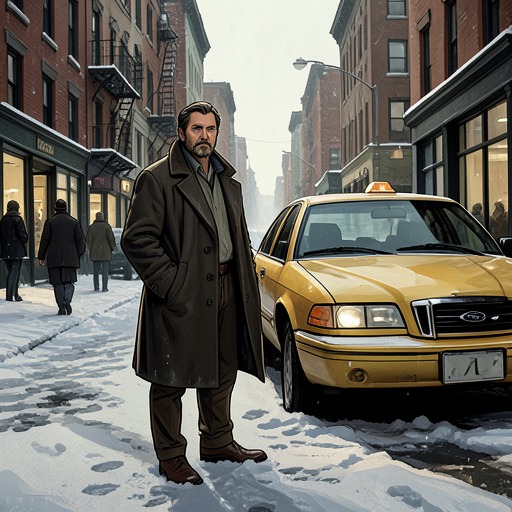
Travis recalls arriving in New York City during his first winter there, about two years before the events he is recounting. A war was still underway. The cold, snow, and dirt make the city feel bleak, and Travis describes himself as having no love, almost no one in his life, and little self-respect. That first impression joins the physical desolation of the streets to his private isolation.
With his army money running low, Travis goes to a taxi depot to obtain a license, then heads to a Manhattan taxi center to look for work. On a cold morning, he sees the city through a harsh, prejudiced lens, reducing its early street life to drunks, sex workers, and other people he regards with contempt. He begins keeping a journal that day, partly to remember and partly to keep himself occupied; dirty snow and falling soot become the concrete details through which he records the city’s condition.
The City as Workplace
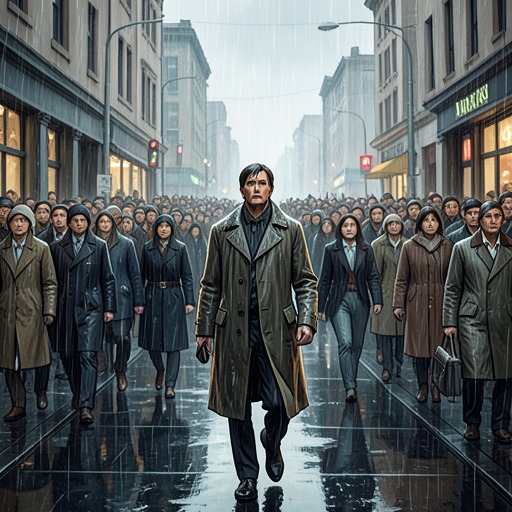
By March, Travis has been working through weeks of nearly constant rain. The wet, close weather brings a practical advantage: in poor conditions, he believes drivers can choose whom to pick up and where to go. The taxi gives him mobility and a measure of control over his working environment, even as he remains largely an observer of the people he carries.
He starts in the cinema district but soon tires of its customers. He finds visitors and affluent passengers irritating and unpredictable, and contrasts them with people from the East End, whom he regards as stingy, and visitors from Kenosha, who expect him to know an assortment of local information. He rejects the sociable, advice-giving role associated with veteran driver Maxey. For Travis, driving down Fifth Avenue in fog beside a half-eaten burger does not make him a guide to weather, flights, films, or restaurants. The city brings him into contact with strangers, but work does not become companionship.
The taxi depot and the Belmore also expose the social attitudes circulating among drivers. Travis observes Charley T. making racist remarks about passersby and people at the depot, sometimes displaying his supposed knowledge of others by speaking their languages. The episode matters to the city’s portrait because Travis’s own descriptions of New York are also racially charged: the account registers prejudice in the street culture around him while making clear that his view of the city is itself far from impartial.
Night Routes and the Search for Danger
Later, Travis deliberately drives into neighborhoods he considers dangerous. He works around 128th Street and Amsterdam in northern Harlem, hoping to discover what would happen if he had to use his guns. He imagines that such an encounter might make his dream visible and make him feel real. Instead, the passengers he describes are polite, mind their own business, and give him tips; the trouble he seeks does not materialize.
His patrol extends across Harlem and Seventh Avenue, past wine bottles in the road and the crowded blocks of Lenox Avenue, then down through the Lower East Side toward Tompkins Square, B Street, and Avenue B. He moves among teenagers he considers abandoned and people he sees as solitary, inviting the night to admit him into its darkness. These routes connect ordinary taxi work with a more ominous purpose: Travis is no longer only crossing the city to earn money but using its streets as a stage for his imagined transformation into someone real and historically significant.
Crowds, Campaigns, and the Journey Home
The city’s public spaces also bring Travis close to political spectacle. On a hot June day in Harlem, he sits in his taxi with the occupied sign showing while Charles Palantine’s campaign speech carries through a loudspeaker nearby. Travis notices his isolation in the crowd: he is the only white man on the block apart from police, security staff, and journalists. The senator speaks about racism, poverty, war, and national division; the audience applauds, while Travis listens only partly and writes a letter to his parents in his mind. The scene places collective political language beside his private, disconnected attention.
After a later violent episode, Travis’s movement through Manhattan becomes flight. His taxi scrapes the curb, pedestrians scatter, and he crosses a bridge over the subway before reaching Canal Street, where clocks and pagodas make the surroundings seem like another country. He drives north, runs traffic lights, and follows the West Side Highway home. The noise in his head has subsided, and he checks that his letter to Iris has been collected before going inside. The ending does not resolve his relationship with the city so much as shift its immediate role: after serving as workplace, patrol ground, and route through chaos, New York City recedes into a search for somewhere quiet beyond its reach.