Palantine presidential campaign committee
Taxi DriverThe Palantine presidential campaign committee is the New York City organizing base for Charles Palantine’s presidential campaign, but in Travis Bickle’s account it becomes more than a political office: it is a recurring public stage, the workplace of Betsy, and a focus for his fantasies of recognition. Its staff and rallies make the campaign visible across the city, while Travis’s increasingly personal attention to its people turns that visibility into a dangerous fixation.
Headquarters and Organization
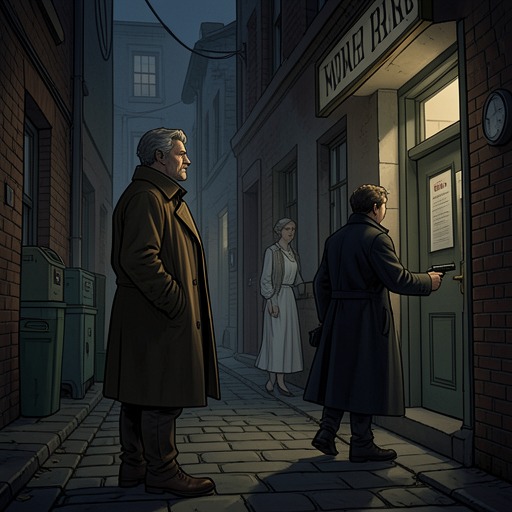
The committee’s headquarters occupies a storefront at the corner of 58th Street and Broadway in Manhattan. Its window identifies it as a committee supporting Palantine’s run for the White House, and a changing display tracks the candidate’s arrival in New York. The primary elections are still some distance away when Travis first spends time there, but the office already appears busy with campaign activity and expectation.
The organization’s work is presented through the people staffing the office rather than through a formal hierarchy. Betsy works there, alongside Tom and other employees. When Travis asks to help, Betsy explains that the campaign has many kinds of work beyond canvassing: paperwork and putting up photographs are among the tasks available. She directs him to Tom for an assignment, while Travis says he would rather work with her. The exchange conveys a practical, task-based operation in which volunteers or prospective helpers can be directed toward routine work, even as Travis’s interest in joining is bound up with his interest in Betsy.
The scale of that work emerges during Betsy and Travis’s coffee-shop conversation. She tells him that the campaign has 1,500 volunteers and that organizing them presents formidable difficulties. The number makes the committee more than a small office: its local staff must coordinate a large volunteer body. Yet the novel offers no account of how the volunteers are distributed or how the campaign resolves those problems; organization is registered through Betsy’s brief description and Travis’s comparison with his own difficulty managing his room and belongings.
Palantine and the Campaign’s Public Image
Travis initially describes Palantine as a candidate he might vote for, while insisting that this is not the reason he spends time near the headquarters. He sees Palantine as personable rather than slick: a smiling man in his fifties, with graying hair, fine suits, and an appearance Travis reads as honest and approachable. This is Travis’s impression, not an independent assessment of the candidate, and it establishes the gap between the campaign’s public image and the private meanings Travis attaches to it.
The campaign’s work extends from the storefront to public appearances. Travis follows Palantine events around Brooklyn, the Bronx, and Queens, making a point of attending and watching the candidate in action. At one rally in Queens, held in a supermarket parking lot, roughly 500 people gather beneath red, white, and blue decorations as country music plays over loudspeakers. Local politicians and campaign employees take their places on a platform. Travis recognizes the security personnel by their gray suits, sunglasses, and athletic builds, and tries to behave inconspicuously among the crowd.
At another appearance, in Harlem, Palantine’s speech calls for an end to racism, poverty, and war, and argues against division and racial hatred. The audience applauds and answers his appeal for unity. The campaign thus presents Palantine through the language and staging of public consensus: a candidate speaking from a platform, surrounded by officials, received by a crowd. Travis, however, listens only intermittently. From his taxi he watches the event while composing an imagined letter to his parents, so the same rally that projects a collective political message also becomes a backdrop for his private sense of separation.
Betsy, Travis, and the Headquarters
The committee’s most sustained importance in Travis’s account comes through Betsy. He repeatedly passes the headquarters between fares to watch her at work, idealizing her as exceptionally beautiful and set apart from the people around her. Their first exchanges take place through the window and at the office; when she offers him campaign work, he prefers to work with her rather than take the assignment she suggests through Tom. The campaign office therefore functions both as a workplace and as the setting in which Travis attempts to turn watching into personal access.
After they have begun seeing one another, the committee remains the point around which his attention gathers. Travis records calling Betsy at the office on April 27 and arranging to go to the cinema with her the following evening, his day off. Later, he begins parking near the headquarters at night, saying that he wants her to know he is still around, while observing that she is not among the employees working late. A notice in the window counts down the days until Palantine arrives in New York. Its routine campaign update becomes, in Travis’s account, part of the scene of his waiting and watching; the committee’s public schedule and his private fixation occupy the same space without being the same purpose.
Political Stage and Narrative Consequences
As Travis becomes determined to enter history and become a celebrity, he attends Palantine events with a new intensity. He describes a need both to see Betsy again and to be onstage with Palantine. At the Queens rally, he sees Tom look in his direction, speak quietly with Betsy, and indicate him; Betsy shakes her head. These are events as Travis interprets them, and the moment offers no independent account of what the staff say or why they react. It does, however, show how his presence at campaign events has become conspicuous even as he tries to remain unnoticed.
The committee does not share Travis’s aims, and the account gives no indication that it knows the full extent of his plans. Nevertheless, its headquarters and public appearances supply a political figure and a visible stage around which he organizes his pursuit of recognition. Travis’s trajectory reaches an attempt to assassinate Palantine, converting the campaign that he had watched from the margins into the object of a violent plan. The narrative’s later account of Travis being celebrated in the press as a hero follows a separate outbreak of violence; it sharpens the contrast between the public image of political service promoted at campaign events and the notoriety Travis eventually receives, without making the committee responsible for that transformation.