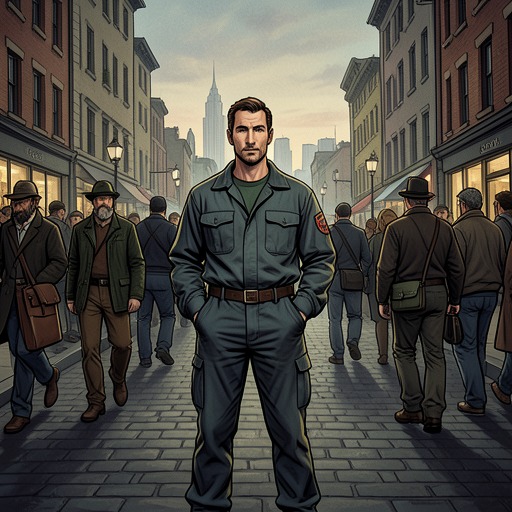
Travis Bickle becomes a taxi driver
Taxi DriverTravis Bickle becomes a taxi driver in an attempt to turn unstructured time into purposeful labor. The decision establishes the cab as both his livelihood and his nightly vantage point on New York City: a place where he moves among strangers while struggling to make work, contact, and purpose mean more than mere survival.
The Decision and Its Motives
On a cold, miserable day, Travis reasons that too much free time can lead him in the wrong direction. He gives work a moral and almost intimate meaning: labor, in his formulation, is a form of love that can be given to other people, to oneself, and to the world. The idea is not presented as a settled philosophy so much as an attempt to find a usable principle for his life.
Insomnia sharpens that need for occupation. Travis observes that spending his free time watching pornographic films is taking him in the wrong direction, while remaining awake night after night leaves him with hours he does not know how to use. He decides to seek a taxi license, aware that the money left from his Army service will not last. A few days later, on another bitter morning, he goes to Manhattan Central looking for work. The choice is practical, but it is also an effort to impose direction on a life marked by wakefulness and drift.
The Night Shift and Its Conditions
By March, Travis has been driving through weeks of nearly continuous rain. He sees the weather as changing the balance between driver and passenger: in rain, cab drivers can take customers where they choose, and, as he understands the depot's saying, the driver becomes the city's boss. The job gives him mobility and control over his immediate route, though not over the larger conditions of his life.
He begins in the cinema district but soon grows tired of it. He finds visitors from outside the city difficult to deal with, and regards wealthy customers as at least as irritating and unpredictable as junkies or sex workers, even if they differ in their tipping. He describes East End customers as stingy and says visitors from Kenosha expect him to know an assortment of obscure things. His account of the work is not that of a genial guide: unlike Maxey, a Bronx driver with thirty years on the job who entertains people with advice, family stories, and celebrity anecdotes, Travis does not consider weather reports, flight information, films, or restaurant recommendations part of his duties.
The schedule is punishing. He works without a break from 6 p.m. until 6 a.m., sometimes staying out until 8 in the morning. He can earn as much as $200 or $250 in a week, with extra money on top, but he remains wary of the cinema district. At home, where the kitchen is filthy, the sink is blocked, and the room is crowded with cockroaches and pornographic photographs, he spends little time beyond collapsing to sleep when he can. The work occupies him, yet leaves him exhausted, with a damaged back and little time to write in his journal or see even one film a week.
The Cab as a Route Through the City
Driving makes the city a sequence of districts, roads, and encounters rather than a settled home. Travis deliberately takes his cab into dangerous areas, including around 128th Street and Amsterdam, because he wants to know what might happen if he had to use his guns. He also works Harlem and Seventh Avenue, passes crowded Lenox Avenue, and travels through the Lower East Side toward Tompkins Square, B Street, and Avenue B. In these journeys, he imagines the night opening a door into its darkness and making him real through the weapon he carries.
That movement exposes a sharp divide between what he anticipates and what he encounters. He goes looking for danger, but reports that people are polite, tip him, and mind their own business; there is no confrontation. The cab therefore becomes a means of testing a violent expectation against ordinary encounters, even as Travis continues to read the city as a possible stage for becoming somebody and entering history.
The work also brings him into contact with people whose circumstances he interprets through his own convictions. Iris's earlier attempt to leave in his taxi, stopped by Sport, becomes the basis for Travis telling her he will get her out. But Iris says that the place is where she lives; later, she explains that when she is not intoxicated she has nowhere else to go and that the people around her are protecting her from herself. At a late breakfast, she tells Travis she came from Pittsburgh, says her parents hate her, and asks why he thinks she should return to them. He insists that her life in the city is dangerous. Their disagreement shows the limits of the driver's imagined authority: his work brings him close to other people's lives, but does not make his judgments about them correct.
Return to Work and Continuing Contacts
After the violent events in the narrative, Travis resumes driving. He explains the return through the same conviction that work is a form of love, while also acknowledging how little work or love seems available around him. For a time, the men at the depot call him Killer, a reputation that eventually fades. He stops carrying guns and concludes that a man with his temperament does not need them. The job remains, but the armed fantasy that had accompanied his nocturnal routes recedes.
The cab continues to create encounters beyond the night shift's anonymous traffic. One evening outside The Plaza Hotel, a familiar voice calls to Travis: Betsy wants a ride only a short distance, to 56th Street. Their meeting places an earlier personal connection back inside the ordinary transactions of his work. The taxi job began as a way to fill sleepless hours and earn money; it becomes the recurring setting in which Travis encounters the city, tests his ideas about other people, and, later, crosses paths again with someone from his past.