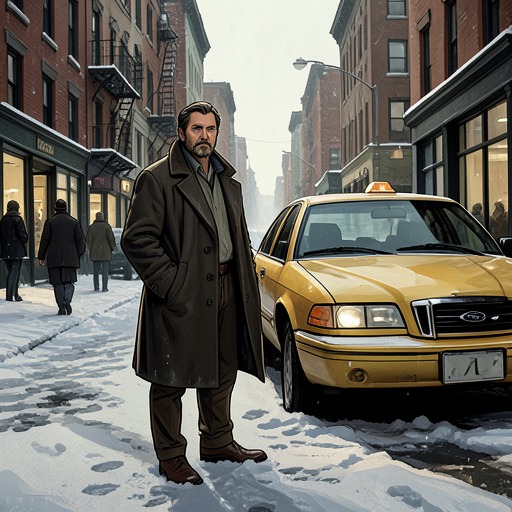
Travis begins working as a night-shift taxi driver
Taxi DriverTravis begins working as a night-shift taxi driver during his first winter in New York City, a decision that turns his need for money and purpose into a prolonged passage through the city after dark. The cab becomes at once his workplace, his means of contact with strangers, and a vehicle for the dangerous fantasies that grow around his solitude.
Background and Decision
The job begins against a bleak personal and urban backdrop. Looking back on that winter, Travis describes having almost no one in his life, no love, no one to love, and little respect for himself. It is cold and snowing; the city is dirty, and the continuing war belongs to the period’s background. He has some money left from the Army but knows it will not last. With insomnia keeping him awake and much of his free time going to pornographic films, he decides that simply having time to himself is not necessarily a good thing.
He gives work a moral as well as practical value: in his private reasoning, labor is a way of giving something to other people, to oneself, and to the world. That ideal is tentative rather than settled, but it helps explain why the decision feels like more than a search for wages. Travis goes directly to a taxi depot to ask for a license, then, a few days later, seeks work at Manhattan Central on a bitterly cold morning. The step supplies structure to days and nights that had otherwise been marked by insomnia and isolation.
The Work and Its Conditions
By March, Travis says he has been working through weeks of rain, with wet, close weather continuing on most days since he started. Rain gives cab drivers unusual control over movement: they can take the passengers they choose and go where they want. For Travis, the taxi is therefore both a job and a position from which to traverse the city on his own terms.
He first works around the cinemas but soon tires of the customers there. Visitors unfamiliar with the city and affluent passengers strike him as more irritating and unpredictable than junkies or sex workers, though he distinguishes them by their tipping habits. He finds people from the East End stingy and says visitors from Kenosha expect him to know an assortment of obscure things. The contrast with Maxey, a Bronx driver with thirty years behind the wheel who can tell stories, offer advice, and talk about celebrities, makes Travis’s own preferred distance clear. He does not regard explaining the weather, airport departures, films, or restaurants as his job. The cab puts him among people, but it does not make him want to perform the sociable guide’s role.
The physical residue of the work is less abstract. Most mornings, he returns to the depot and cleans the rear seat, usually of semen and sometimes of blood. After a night in the cab, he struggles to get up and suffers severe back cramps; at times he goes to work high. His account sets these intimate traces of passengers’ use of the vehicle against the city’s visible poverty: at five in the morning, older women eat from garbage, and people sleep on the street. At least, Travis observes, he has a roof over his head. The job gives him one, but its nights leave him sore, exhausted, and repeatedly confronted with the city’s most exposed lives.
Night Routes and Growing Danger
As Travis acquires weapons and becomes preoccupied with what he might do with them, the job’s mobility takes on a darker purpose. He deliberately drives through northern neighborhoods around 128th Street and Amsterdam, expecting danger and wondering what would happen if he had to use his guns. Instead, passengers are polite, tip him, and mind their own business; he encounters no trouble. The uneventful rides do not dispel the fantasy. They leave him continuing to imagine that the night might open a way for him to make himself real through violence.
His routes extend through Harlem and Seventh Avenue, past bottles in the street and crowded blocks of Lenox Avenue, then down through the Lower East Side toward Tompkins Square, B Street, and Avenue B. He describes moving among young people who are adrift and people alone, roaming in the hope that the night will admit him into its darkness. The cab’s ordinary function—carrying him from one neighborhood to another—thus becomes entangled with his stated ambition to become somebody, even a celebrity, and to enter history. The route is no longer only a working circuit; in his imagination it is a passage toward an event that will give his life consequence.
Encounters and Significance
The taxi also brings Travis into contact with people whose circumstances he interprets as calls for intervention. He later tells Iris that she once tried to escape in his cab, but she says she does not remember and suggests she must have been high. He promises to get her out of her situation; she answers that this is where she lives. When she explains that, while sober, she has nowhere else to go and that others keep her there when she is intoxicated, Travis tries to sympathize but is saddened when his appeal fails.
Their later breakfast makes the limits of his understanding clearer. At a café at 1:30 in the afternoon, Iris appears freshly washed and neatly dressed; Travis imagines a scene like an older brother taking a younger sister out to eat and hopes they can become friends. She tells him about getting involved with Sport and about her former home in Pittsburgh, but rejects his suggestion that she return to her parents, saying they hate her and that there is nothing for her there. The encounter begins in the world of the cab, yet the cab does not give Travis authority over Iris’s choices. His effort to rescue her rests on concern, but also on assumptions about what her life should be. The night-shift job matters not simply because it puts Travis on New York’s streets: it makes the city his daily environment and supplies the encounters through which his isolation, desire for significance, and conflicted urge to protect others become visible.