
The Meaning of an Ordinary Life
TemptationThis flow traces how Colton Davidson and Marcel resist other people’s definitions of a worthwhile life and gradually build a version of ordinary happiness on their own terms.
increasing Bearing strength in each event
 decreasing
Bearing strength in each eventdecreasingA Life Shaped by Fear

A Life Shaped by Fear
The Family’s Public Image
Colton Davidson grows up inside a household that can look respectable from the outside: church attendance, family meals, and the appearance of orderly domestic life. At home, however, shouting and blame teach him to measure safety by silence. The contrast makes ordinary family belonging seem less like a birthright than a performance he must keep up.
Fear of a Prescribed Future
His parents’ religious expectations attach adulthood to marriage, children, and heterosexual respectability. Colton fears not only the misery he sees in his parents’ marriage but also the possibility that he will be forced into a life that contradicts his desires. Before he has words for self-acceptance, he tries to imagine a future by refusing the roles others have assigned him.
The idea of a normal life is therefore compromised from the beginning: it carries the promise of social acceptance and the threat of self-erasure. This early contradiction helps explain why Colton later longs for simple stability while also resisting any definition of stability that requires him to deny himself.
The Small Dream

The Small Dream
Wanting the Everyday
Marcel tells Antoine that he wants a house, a husband, and a dog. The wish is deliberately modest beside the ambitious, extraordinary futures his parents imagine for their sons, but its simplicity is precisely what makes it precious to him. Marcel does not want to be celebrated as an exception; he wants an ordinary life he can recognize as his own.
A Future Beyond Comparison
His blindness and the brothers’ itinerant upbringing have made stability feel distant, while repeated university rejections threaten to reduce his options before adult life has properly begun. Marcel nevertheless names a future in familiar domestic terms, giving shape to a desire that does not depend on achievement or spectacle.
The conversation establishes a standard against which his later choices can be measured. A satisfying life need not look like his parents’ itinerant ideal or like a public triumph over disability. It can mean a home, meaningful work, companionship, and room to choose what matters to him.
A Town That Feels Like Home

A Town That Feels Like Home
Belonging Takes Shape
Marcel moves to Fairfield with Brad, expecting the relationship and the new town to provide a workable foundation. He establishes yoga classes and begins meeting the people around Masala, the gym, and Ruby’s. Their friendliness offers a kind of belonging unlike the support he has known from his family: it grows through ordinary encounters rather than through obligation or supervision.
The Difference Between Shelter and Home
The townhouse does not immediately feel secure. Marcel struggles with its unfamiliar layout and with a relationship that becomes increasingly distant, while Brad’s habits and choices make the shared space harder to inhabit. Marcel’s growing connection to Fairfield, by contrast, suggests that home is not simply a building or a relationship label.
When Brad’s infidelity ends the relationship, Marcel must choose whether the town belongs to the failed romance or can become a place he claims independently. His decision to stay turns the idea of an ordinary home into an active choice: it will be built from his own routines and relationships, not inherited from his ex.
A Home Built Together
A Home Built Together
An Unplanned Shared Household
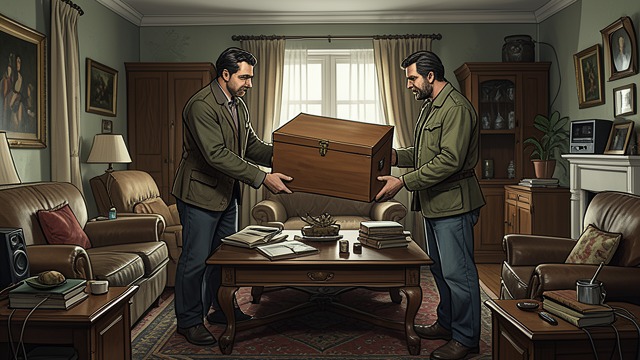
When Colton’s apartment floods, Marcel offers him a place to stay. What begins as emergency shelter becomes a shared domestic life: furniture shopping, arranging the new kitchen, cooking, and learning how each person moves through the home. Their care is practical as well as romantic, grounded in the details of living together.
Ordinary Care as a Choice
Marcel’s home is not a rescue project imposed on Colton. Marcel insists that Colton is welcome because they are friends, while Colton contributes through everyday consideration and companionship. That distinction matters to both of them: support can exist without reducing the person receiving it to a problem that someone else must solve.
The household gradually gives substance to the quiet future Marcel once described. They do not need to prove that they have overcome every obstacle before they can enjoy domestic closeness. Their shared meals, familiar spaces, and plans for later are themselves evidence that an ordinary life can be made through mutual choice.
Stars in Familiar Things

Stars in Familiar Things
A Sensory Description
On the porch swing, Marcel asks Colton how he sees the stars. Colton answers that stars look like the first sip of ginger ale. Instead of reaching for an impressive explanation, he offers a familiar sensation: bright, fizzy, and briefly surprising. Marcel receives the comparison as a vivid description rather than as an inadequate substitute for sight.
The Modest Future Arrives
The scene brings Marcel’s earlier dream of an ordinary household into focus. The couple has a home, shared routines, and animals that complicate their plans; their life is affectionate but imperfect, not a polished triumph over hardship. What matters is that Marcel feels wanted and at home within it.
The image also condenses the book’s resistance to grand definitions of happiness. Marcel cannot see the stars as Colton does, but he can share the moment, understand its meaning, and love the person who describes it. Their everyday language and presence make a future feel tangible without requiring either man to become extraordinary.
During Colton Davidson’s childhood in Utah
At eighteen, during Marcel’s conversation with Antoine on the porch
After Marcel and Brad move to Fairfield
After Colton’s apartment floods and Marcel secures a new home
Near the end, on the porch swing in the epilogue
