
Self-Reliance and the Right to Receive
TemptationThis flow examines Colton’s difficult effort to build an independent adult life without mistaking every act of support for a debt or a loss of agency.
increasing Bearing strength in each event
 decreasing
Bearing strength in each eventdecreasingA Future With an Expiration Date

A Future With an Expiration Date
Security That May End
Colton knows that his place at Ted House is tied to age and graduation. Even as Sage reassures him that he will not be abandoned, Colton struggles to believe that care will continue after the formal placement ends. He interprets every promise through the expectation that people eventually stop being responsible for him.
Trying to Earn Belonging
He works, helps with the children, and tries to manage his behavior, partly because he wants a future and partly because he hopes usefulness will make others keep him. His anxiety turns the ordinary transition to adulthood into a looming test of whether he deserves a place in the family that has taken him in.
The age-out policy makes a genuine practical challenge out of a deeper emotional fear. Colton needs material plans for housing and work, but he also needs to learn that his worth is not measured by whether he can repay every person who has helped him.
The First Small Apartment
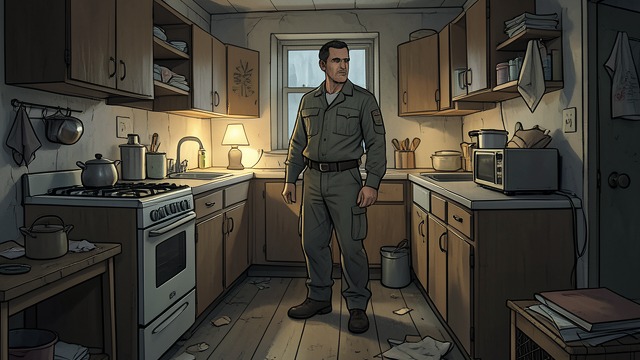
The First Small Apartment
Independence With Uneven Foundations
After leaving Ted House, Colton has a small apartment and keeps working at Masala. These are concrete signs of adulthood, but they do not instantly make him feel secure. He has little money, limited experience, and a mind that can make routines and work difficult even when he is trying hard.
Belonging Is Not a Paycheck
Colton is grateful for the people who helped him find housing and employment, yet he worries that dependence on their generosity proves he has failed. He wants to become the person who rescues others instead of the person who is continually rescued. That aspiration comes from compassion, but it also risks making self-sufficiency the only form of dignity he will accept.
His apartment gives him privacy and a measure of control, while his continuing relationships provide a safety net he has not learned to trust. The tension between those needs becomes a central adult task: he must build a life of his own without treating connection as evidence that the life is not truly his.
A Crisis of Housing and School

A Crisis of Housing and School
Two Foundations Give Way
A burst in Colton’s apartment leaves the room and much of his property water-damaged. At nearly the same time, his financial aid is denied because his parents retain legal custody and their income is counted against him. The housing crisis and the education barrier converge, leaving him afraid that every step toward stability can be taken away at once.
Refusing an Easy Rescue
Marcel offers Colton a room, and the community gathers around him, but Colton is distressed by how quickly his choices seem to depend on other people. He wants to accept help without feeling that he has surrendered the right to direct his future. His hesitation is not ingratitude; it is an attempt to preserve agency after years in which adults made consequential decisions for him.
The crisis forces a distinction between support and control. Marcel does not demand that Colton repay him or agree to a romantic relationship, and he makes clear that the invitation comes from friendship. That reassurance lets Colton begin to consider receiving care without translating it into obligation.
The Panic of Going It Alone

The Panic of Going It Alone
An Unaffordable Route
Colton learns that the available payment plan still demands money he cannot reliably spare. Taking fewer classes would make school last much longer, while appealing the financial-aid decision would require documentation from parents he is afraid to contact. The options sound reasonable in the abstract but are financially and emotionally difficult in his actual circumstances.
Naming the Boundary
The pressure tips into a panic attack, and Derek helps him slow his breathing. Colton tells Derek that he does not want help solving the problem yet; he needs the chance to understand it and choose what to do. Derek respects that boundary while reminding him that support will still be available if he falls.
This exchange reframes independence as the freedom to make decisions, not the requirement to suffer privately. Colton can ask for space without rejecting the people who care about him. He begins to recognize that being caught by a trusted person does not erase his own effort or authority.
Support That Expands Choice

Support That Expands Choice
A Practical Opportunity
At Elliot’s clinic, Colton admits that veterinary school is financially out of reach. Elliot offers him a position and explains that the clinic’s tuition program can cover the costs, making support specific and linked to Colton’s genuine commitment. Unlike a vague promise to fix his life, the offer gives him a route into work he already wants to do.
Receiving Without Surrendering
Colton questions whether Elliot is acting out of pity, and Elliot answers honestly: concern is part of his motivation, but Colton’s dedication also matters. The distinction allows Colton to accept help as an agreement between adults rather than as proof that he cannot manage his future. His decision to pursue veterinary training is still his own.
The opportunity does not end Colton’s need for relationships or make earlier assistance meaningless. Instead, it converts care into expanded possibility. By the end of the book, he can remain grateful to his chosen family and pursue a professional future without believing that either one cancels his independence.
In the months before Colton turns eighteen
After Colton graduates and moves into his own apartment
After Colton’s apartment floods and his financial aid is denied
After Colton learns the community-college payment schedule
Near the end, when Elliot offers Colton paid training and tuition support
