Candlemas–Lady-Day hiring custom for English agricultural workers
Tess of the d'UrbervillesThe Candlemas–Lady-Day hiring custom for English agricultural workers organized rural employment around a yearly cycle: workers seeking new places attended hiring fairs at Candlemas, and the agreements they made for outdoor service began at Lady-Day. The arrangement was more than a calendar. It structured the movement of laborers between farms, while exposing those without secure employment or a farmer’s support to the costs and risks of migration.
The hiring cycle
At Candlemas Fair, farm workers who planned to change employers gathered in the county town to enter engagements for the year beginning at the ensuing Lady-Day. The custom separated the moment of hiring from the moment of taking up the new place: agreements were made in advance, then fulfilled when the agricultural year turned. In February, nearly all the laborers at Flintcomb-Ash intended to leave, and the fair drew them on a ten-to-twelve-mile journey across hilly country. Tess meant to leave at the quarter-day too, but did not attend; she remained behind with a vague hope that circumstances would spare her the need to take another outdoor engagement.
The custom’s two dates also organize the novel’s account of rural mobility. On the eve of Old Lady-Day, workers who had agreed at Candlemas to serve elsewhere began moving to their new farms. The old place and the new one were not simply points on a route: the change of employer meant a change of household, work, and lodging. Annual migration had become increasingly common, though it was not universal. The narrative contrasts this growing mobility with an earlier pattern in which most field workers near Marlott remained on one farm throughout their lives, often following parents and grandparents who had done the same.
Moving between farms
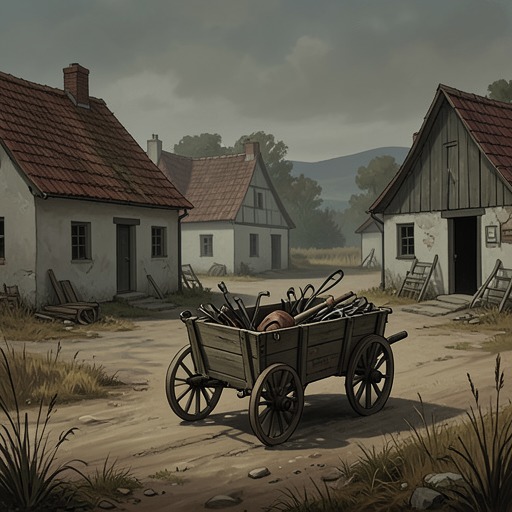
The departure at Lady-Day was carried out through a practical system of transport. During the small hours, empty wagons and teams rumbled along the highways to collect the belongings of migrating families. A hired man was ordinarily conveyed to his destination in the vehicle of the farmer who needed his labor, and the teams set out after midnight so they could reach departing households by six in the morning and load their goods within the day. The agricultural employment cycle therefore included not just a promise of work but a means of getting workers and their possessions to the next farm.
That support did not extend equally to everyone. No farmer sent a team for Tess’s household: they were women, not regular laborers, and not considered particularly needed anywhere. They had to hire a wagon at their own expense and received no free conveyance. Their move makes visible the boundary built into the customary arrangement: the hired worker’s journey was attached to the employer’s demand for labor, while people outside that recognized relation bore the expense themselves. Even the weather mattered materially. Tess was relieved to see that the morning was windy and overcast but dry, since a wet Lady-Day could leave furniture, bedding, and clothes damp and bring a train of further troubles.
Tess’s family was also moving under pressure beyond the hiring calendar. At the first Lady-Day on which the household could be expelled, its roomy cottage was required for a carter with a large family. Tess, her widowed mother, her sisters, her brother Abraham, and the younger children had to leave Marlott. Their displacement thus coincided with the general movement of agricultural workers, but they could not rely on the ordinary employer-provided wagon. The season’s labor arrangements supplied a route for workers needed by new farms; they offered no equivalent security to a family being forced from its home.
Employment, labor, and insecurity
The custom is linked to the changing character of agricultural work. At Flintcomb-Ash, nearly all the laborers expected to flee the farm, and Marian and Izz Huett later told Tess they had left after finding the life too rough, departing almost without notice and leaving Farmer Groby to prosecute them if he chose. Their movement shows how the annual hiring cycle could offer workers an occasion to seek another place, but did not erase the hardship or conflict of farm employment. The prospect of a new engagement coexisted with exhausting work and the threat of legal action by an employer.
The work awaiting those who stayed or moved could be shaped by mechanization as well as by the hiring calendar. On a vast swede field at Flintcomb-Ash, Tess and Marian were set to grub the earthy lower halves of turnips with hooked forks after livestock had eaten the tops and leaves. Later, at the threshing, Tess worked on the platform beside the man feeding the machine, untying each sheaf passed to her by Izz. Because the revolving drum could not stop without disrupting the work, Tess could not stop either unless Marian took her place. Farmer Groby had selected her for her strength, quickness, and endurance. The annual movement between farms therefore led not to a uniform kind of service but into specific conditions of labor, in which a worker’s stamina could be treated as a resource to be extracted.
Rural change and social cost
The novel places annual migration within a wider transformation of village life. Earlier, many agricultural workers had stayed on a single farm, while Marlott also contained carpenters, smiths, shoemakers, traders, and other people whose livelihoods and local knowledge gave the village greater stability. As long holdings ended, they were seldom let again to similar tenants; cottages were demolished or taken for farm workers, and people not directly employed on the land were regarded with disfavor. Those displaced families had to seek refuge in larger centers, while the remaining cottages were increasingly reserved for agricultural laborers.
The yearly movement from farm to farm could appear to younger families as an exciting change, and one household’s former place might look like another’s promised land. But a new place could in turn become a new version of the old hardship, prompting another move. The image of families changing and changing captures both the attraction and the uncertainty of mobility: movement offers the possibility of improvement without guaranteeing it. The custom thus forms part of a broader account of rural depopulation and agricultural restructuring, in which older village communities contract and work, housing, and transport are increasingly organized around the demands of farming.
The consequences fall unevenly. Tess’s household depends on the judgment of its two adults, while the younger children have no say in the conditions under which they live or move. Later, when the family is made to leave Marlott, its members must pay for transport that hired workers would ordinarily receive through a farmer’s team. The hiring cycle is therefore presented both as a functional mechanism for matching laborers to farms and as a measure of who counts as useful labor. For Tess and her family, the calendar’s orderly sequence of fair, engagement, and moving day offers no protection from poverty, eviction, or the expense of being left outside that system.