Christianity and institutional religion
Tess of the d'UrbervillesChristianity and institutional religion in Tess Durbeyfield’s story are tested where doctrine meets vulnerable lives. Tess’s urgent baptism of her dying infant arises from faith and maternal fear, but the church’s power to recognize a sacrament and permit Christian burial remains in the hands of its clergy. In a separate conflict, Angel Clare refuses ordination because he cannot honestly affirm the Church’s Articles in their required literal sense. The novel thus sets personal conscience and compassion against institutions whose rules can console, exclude, or demand assent.
Sacrament in the cottage
When Tess fears that her infant may die, she turns the shared bedroom into a place of worship. She lights a candle, wakes her younger brothers and sisters, pours water from a jug, and arranges the children around the washing-stand with their hands joined. Her sister holds open the Prayer-Book, while Tess takes the baby in her arms and prepares to baptize him. The scene makes religious action both intimate and improvised: the rite is conducted not by a minister in a church, but by a young mother in the crowded family room, with the children as its congregation.
The children’s response gives the ceremony a gravity beyond its makeshift setting. Tess’s confidence in the sacrament grows, and her earnest thanksgiving appears to them to transform her from their familiar sister into a towering, almost divine figure. The narration presents her religious feeling as intense and embodied, while the improvised rite gives her a moment of authority the formal church has not supplied. That authority, however, cannot settle the question that troubles her after the infant dies: whether the baptism will count doctrinally and secure a Christian burial.
The boundary between rite and recognition
Tess goes after dusk to seek the new parish vicar. At first she stands by his gate, unable to summon the courage to enter; she speaks only when she happens to meet him as he returns home. She recounts the illness and the baptism, then asks whether the child’s standing before God will be the same as if the vicar himself had baptized him. The encounter sets a mother’s need for reassurance against the minister’s institutional position: the rite has already taken place, but its recognition still appears to depend on the person authorized to administer it.
The vicar’s first instinct is to say no. He feels like a tradesman whose proper work has been performed badly by customers without calling him in, and his professional and ecclesiastical assumptions pull against the tenderness of Tess’s appeal. Yet the man’s compassion prevails over the minister’s technical belief, and he tells her the result will be the same. Tess immediately asks whether the baby can therefore receive Christian burial. The answer is less straightforward: the vicar had gone to the house during the illness intending to perform the rite, but he does not know that Tess’s father, rather than Tess, refused to admit him. That misunderstanding leaves him unwilling to accept the necessity of the baptism she performed herself.
The vicar eventually assures Tess that the burial, too, will be the same. In practice, however, the child is taken to the churchyard in a small deal box beneath an old woman’s shawl and buried by lantern-light in a neglected corner where unbaptized infants and others considered outside the favored community are laid. Tess pays for the burial and makes a cross from two laths and string, binding it with flowers. She places another bunch in a jar of water at the grave. The humble label on the jar does not displace the meaning she gives it: maternal care creates a small act of remembrance in a space marked by religious exclusion.
Conscience and the refusal of office
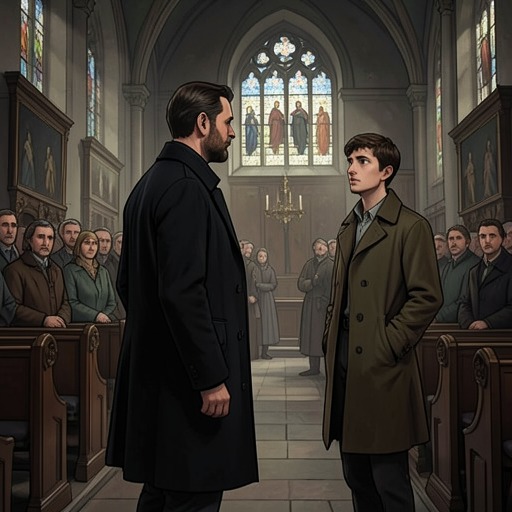
Angel Clare’s disagreement with institutional religion takes a different form. When his father raises the matter of his future, Angel says he would prefer not to take Orders. He loves the Church and admires its history, but believes he cannot honestly serve as its minister while it refuses to free its thinking from what he regards as untenable doctrines of redemption. His position is not simple hostility to religion: affection for the institution persists alongside his refusal to represent beliefs he cannot conscientiously affirm.
The conflict sharpens around the formal requirements for ordination. Angel tells his father that he cannot subscribe even to Article Four in the literal and grammatical sense required by the Declaration, and therefore cannot become a parson under the present arrangements. He describes his religious instinct as one of reconstruction, invoking his father’s preferred Epistle to the Hebrews to argue for removing what can be shaken so that what cannot be shaken may remain. The appeal exposes a family as well as institutional divide: his father has economized to provide a university education intended for religious service, while Angel sees honesty as a reason not to enter the ministry.
The contrast between father and son is not simply between belief and unbelief. The father is described as an earnest Evangelical whose settled convictions leave little room for revising foundational principles; Angel’s attachment to the Church coexists with a demand that its doctrines be reconsidered. The institution therefore tests conscience in opposite ways: for the father, fidelity means adherence to a definite creed; for Angel, fidelity to religion means refusing an official declaration he cannot affirm. The narrative places sincere religious commitment on both sides without making institutional conformity a reliable measure of inward conviction.
Rules, vulnerability, and the novel’s moral contrast
Across these episodes, religious procedure has material consequences. Baptism is not merely a private expression of faith when it bears on whether a dead infant can be buried as a Christian; access to the rite and the cemetery depends on clerical recognition. Yet the vicar’s responses are shaped not only by rules but by personal feeling and incomplete knowledge. His compassion overcomes his initial resistance, while the mistaken belief that Tess herself refused him helps produce the distinction he first draws between baptism and burial. The novel shows how institutional outcomes can turn on both formal authority and ordinary misunderstanding.
The story also keeps the official system beside forms of religious and moral care that emerge outside it. Tess acts because her child is dying, and her siblings participate without fully understanding the ceremony. After the burial, her cross and flowers express a continuing maternal devotion in the churchyard’s neglected corner. Neither the improvised sacrament nor the handmade memorial removes the institution’s power to classify, but both make visible a human meaning that classification cannot contain.
Angel’s refusal of ordination extends this concern from ritual practice to doctrinal authority. His conflict is not about a single burial decision but about whether a person may serve the Church while rejecting the terms on which it demands assent. Taken together, the episodes distinguish religion as lived care, conscience, and hope from religion as regulated rite and binding declaration. The resulting tension is not resolved by declaring faith irrelevant: it is precisely because the characters’ convictions matter that the institution’s rules—and the people who interpret them—carry such weight.