Church of England ordination requirement to affirm the Articles literally
Tess of the d'UrbervillesThe Church of England ordination requirement to affirm the Articles literally makes a private crisis of conscience into a practical limit on Angel Clare’s future: because he cannot honestly make the required declaration, he refuses ordination and forgoes Cambridge. The novel places this formal test of belief beside other institutional rules governing baptism, burial, marriage, and divorce, showing how abstract requirements acquire force in intimate lives.
The declaration and Angel’s refusal
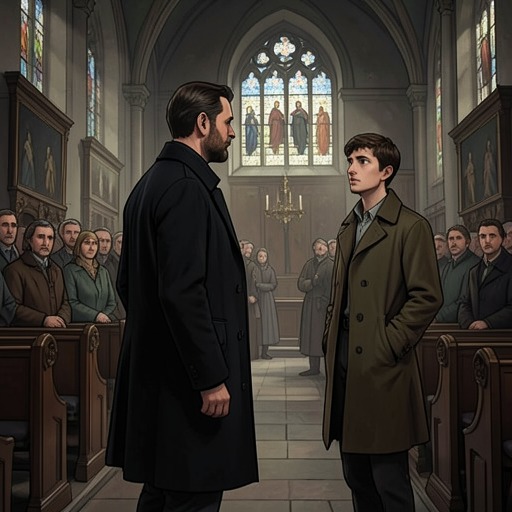
Angel tells his father that he would prefer not to take Orders, though he loves the Church and admires its history. His objection is not to religious inquiry as such, but to serving an institution that, in his view, refuses to free itself from an untenable theology of redemption. He identifies Article Four as a specific obstacle: he cannot affirm it, “leave alone the rest,” in the literal and grammatical sense prescribed by the Declaration.
For Angel, the declaration makes ordination impossible under the Church’s present conditions. He describes his religious instinct as oriented toward reconstruction, invoking the removal of what can be shaken so that what cannot be shaken may remain. The conflict is therefore between institutional assent to fixed articles and his conviction that belief must remain open to revision; he will not treat an official formula as words he can sign without intellectual honesty.
The cost of conscience
Angel’s father responds with argument, persuasion, and entreaty. His distress reflects a family understanding of education as preparation for religious service: he asks what purpose there was in economizing to pay for university if the education would not be used for God’s honour. Angel answers that it may serve humanity instead, but the exchange does not resolve their disagreement.
The family’s expectation that Cambridge should lead to ordination is so deeply rooted that Angel comes to regard continuing toward the university without intending to enter the Church as a misuse of the trust placed in him. He decides that he has no right to go and gives up Cambridge. The requirement thus has consequences beyond eligibility for a clerical office: joined to family sacrifice and duty, it redirects his education and helps shape the independent, unconventional course he follows afterward.
Other institutional boundaries
The novel also shows church practice operating through decisions about a child’s burial. When Tess asks the Vicar whether the baby will receive a Christian burial, he distinguishes that question from the earlier refusal to admit the Vicar to perform the baptism. The baby is ultimately buried by lantern-light in the churchyard’s neglected corner, among those treated as conjecturally damned because they were unbaptized or otherwise excluded. Tess marks the grave with a flower-bound cross made from two laths and string. This episode does not establish the Articles declaration as the cause of the burial rule; rather, it places Angel’s ordination dispute within the wider pressure exerted by religious procedure and judgment.
Other formal conventions likewise govern private choices. The requirement for three Sunday readings of marriage banns threatens a delay when only two Sundays remain before Tess and Angel’s intended New Year’s Eve wedding. Later, Tess believes her confession may give Angel grounds to divorce her, while he tells her that she does not understand the law and asks how he could divorce her. These distinct rules and assumptions expose a recurring gap between personal understanding and institutional authority: formal systems define what may be declared, solemnized, buried, or dissolved, but their effects fall on individuals confronting grief, marriage, and conscience.