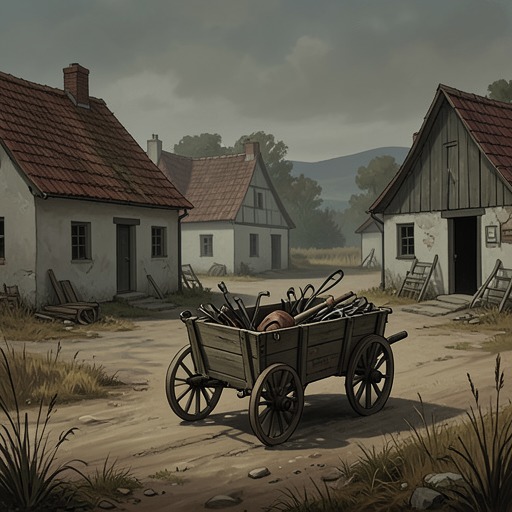
Farmer Groby
Tess of the d'UrbervillesFarmer Groby is Tess Durbeyfield’s employer at Flintcomb-Ash Farm, a bleak, poorly supported agricultural village where she takes work after separating from Angel Clare. He is a comparatively minor character, but his authority over Tess makes the farm’s hardship personal: he uses the power of an employer to retaliate for an earlier rejection, while her need to keep working limits her freedom to answer him. His episodes expose the economic dependence beneath the apparent formality of a labor agreement.
Identity and Setting
Flintcomb-Ash is described as a place uncared for either by itself or by its absentee landlord, with farming carried on through the management of the land rather than the care of a resident lord. Tess’s work there is physically demanding: she and her companions hack the remaining roots from a broad swede field and later labor with sheaves in a barn. Groby is the farmer who supervises this work and enforces its pace. The farm’s harsh conditions are not merely scenery; they define the setting in which his authority over workers has immediate consequences.
Tess arrives at Flintcomb-Ash after her marriage to Angel has failed and she has become economically vulnerable. She writes to her parents with her new address in case a letter from her husband reaches them, but withholds how distressing her situation is, fearing that disclosure might bring reproach on him. Against that private restraint, Groby’s open hostility becomes one more burden in a life already narrowed by separation, poverty, and the need to earn a living.
Conflict with Tess
Groby recognizes Tess as the young woman who had previously taken his civility badly and fled from him on the road after he alluded to her history. When he finds her working at the barn, he recalls that she had once escaped him and boasts that this time he has the advantage. He presents the conflict as a contest of mastery, asking whether she will beg his pardon and reminding her that she has agreed to work for him until Lady-Day. Tess refuses to accept his account of their encounter and tells him that he ought to ask her pardon instead.
Tess understands that Groby’s attention does not arise from romantic interest. The narrator attributes his treatment of her to mortification over Angel Clare’s treatment of him, and identifies the result as tyranny. Though Groby would, Tess believes, have cuffed her if he had dared, his hostility is in one sense easier for her to endure than the threat represented by men who pursue her sexually. The distinction offers no real safety: she still has to work under a master who resents her and can make the terms of her employment oppressive.
Authority and Labor
Groby’s control is clearest when Tess falters during the exhausting barn work. After she sinks down on a heap of wheat-ears, he enters and rebukes her for stopping while he is away. Tess answers that the loss is her own, not his, but Groby insists that the work must be finished. His response dismisses her account of her own limits and makes the employer’s demand, rather than the worker’s condition, decisive.
The agreement to work through Lady-Day gives Groby a practical hold over Tess, who is reluctant to leave because the possibility of losing her place has become frightening since Alec d’Urberville began appearing around her again. When Groby sees her away from her work talking with Alec, he rides over to discover what they are doing in his field. After Alec intervenes on Tess’s behalf and then leaves, Groby continues his reprimand and reiterates that he will see the agreement carried out. Tess walks back toward the field and resumes the position of a worker subject to his supervision.
A Limited Concession
At the threshing, Groby’s conduct briefly changes. As the rick is worked down and people on the ground can speak with those at the machine, he approaches Tess and tells her that, if she wants to join her friend, he does not wish her to continue working; he will send someone else to take her place. Tess recognizes that the friend is Alec, whom she regards as an enemy as well as a pursuer, and understands that Groby is making the concession in response to Alec’s request. She shakes her head and keeps working.
The offer is significant because it contrasts with Groby’s earlier insistence that Tess must finish the work and honor the term of her agreement. Yet it does not erase the coercive structure between them: her employment remains subject to a farmer’s decisions, and the new permission comes through the intervention of the man she fears and rejects. Tess’s refusal to leave the machine shows her effort to retain control over her work and choices amid competing claims on her.
Narrative Significance
Groby’s treatment of Tess connects private resentment to material power. His hostility is not presented as the same kind of threat as Alec’s pursuit; rather, it is the pressure of a harsh employer, intensified by Tess’s limited economic options. That distinction makes the farm’s labor conditions part of the novel’s broader account of vulnerability: Tess can recognize Groby’s motives and still be compelled to meet his demands because losing work would carry consequences.
His appearances also frame the unstable nature of Tess’s protection. Groby’s ordinary authority can feel less dangerous than Alec’s attention, but he remains capable of making her work and enforcing the length of her engagement. Conversely, when Alec asks that Tess be released from a task, Groby grants the request. The episode thus places Tess between two men with different forms of power, neither of which gives her secure independence.