Hereditary status and the decline of the rural gentry
Tess of the d'UrbervillesHereditary status and the decline of the rural gentry are presented as a widening gulf between what ancestry can signify and what it can provide. The Durbeyfields descend from the old d’Urberville line, once associated with county power and a long-established home at Kingsbere. By Tess’s time, however, that lineage survives chiefly in her father’s claims, family legend, and a defaced ancestral tomb. Its symbolic prestige remains potent, but it cannot secure the family’s livelihood or shelter. The novel’s central irony is that the past can make Tess appear distinguished to an observer while leaving her exposed to the same material vulnerability as the landless people her ancestors once dominated.
Ancestry as Symbolic Inheritance
The d’Urberville descent is more than a genealogical detail because its meaning shifts according to who considers it. Angel Clare had once dismissed the family as a spent force. After leaving Tess, he begins to see her descent differently: it has little economic value, he recognizes, but substantial imaginative value for a dreamer or moralizer contemplating the rise and decline of families. He imagines in her face a trace of the dignity of her ancestors and understands that the link between her and the old monuments at Kingsbere will soon be forgotten. Ancestry thus becomes a source of romantic and historical interpretation rather than practical advantage. Angel’s altered response reveals the difference between possessing inherited distinction and possessing the means to benefit from it.
That distinction also exposes the limits of Angel’s earlier judgment. His reconsideration does not restore Tess’s security; it changes the significance he assigns to her. He recognizes a historical dimension in her identity only after the separation has made his failure to understand her more consequential. The family name can shape his imagination, but it has not protected Tess from hardship or altered the conditions that govern her life.
The Name and the Material Decline
Tess’s return to the family home makes the gap between inherited rank and present circumstance concrete. Her father, still unwell, proposes asking local antiquarians to support him as a living remnant of the past. He reasons that people spend money preserving ruins and finding ancient remains, so a living descendant of an old family might also interest them. The scheme turns ancestral identity into a possible appeal for charitable attention, but it remains a hopeful proposal rather than a source of dependable support. Tess postpones arguing with him while she attends to immediate household needs.
The family’s vulnerability becomes decisive when John Durbeyfield dies. His personal achievements are not what make his death consequential: the house and premises are held under a lease that lasts for the lives of three people, and he is the last of those lives. The tenant-farmer has long wanted the accommodation for regular laborers, who lack cottages, and the lease will not be renewed. The family’s local independence, itself viewed with disfavor, offers no protection once the lease ends. The circumstances show status collapsing not in a grand public downfall but through the everyday mechanisms of tenancy, housing, and labor.
The narrator places this reversal within a longer history of power. The Durbeyfields, once d’Urbervilles, now experience the fate that their ancestors may repeatedly have imposed on landless people. The image of social position moving through cycles makes decline more than an individual misfortune: privilege and dispossession alternate, but the descendants of former rulers are not thereby spared the consequences of a changed economic order. Their ancestry supplies the irony of the reversal, not a remedy for it.
Kingsbere: Home in Memory, Not in Practice
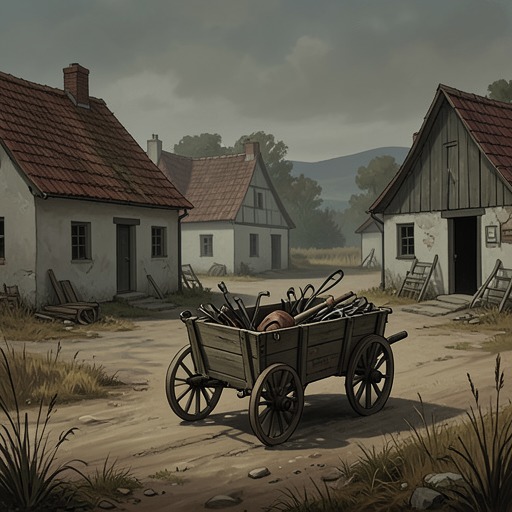
The family’s journey to Kingsbere gives ancestral belonging a geographical destination. The difficult trip takes too long for a single day, and the worn family wagon reaches the upland late in the afternoon. Below lies the townlet where the d’Urbervilles had lived for five hundred years, the place most readily understood as their ancestral home. Yet reaching the historic seat does not amount to recovering it. The journey carries the family toward the visible past while their present need is for a place to live.
Inside the church, Tess finds the family tombs beneath the window near the bedstead where the children are housed. They extend across several centuries, but their canopies and carvings are damaged; the brasses have been torn away, leaving only the holes where they were fixed. The condition of the monuments gives physical form to the family’s social extinction. The tombs preserve dates and names, yet their mutilation records neglect rather than continuing authority.
Tess recognizes the Latin inscription as marking the entrance to the ancestral sepulchre and understands that the knights celebrated in her father’s stories lie within. The contrast between his repeated evocation of the family’s past and the stripped, damaged monument sharpens the difference between inherited legend and historical remains. Kingsbere confirms the family’s connection to its former standing at the very moment that the ruin of its memorials makes that standing powerless in the present.
Legend, Recognition, and Social Meaning
The family’s inherited identity also persists through legend. At Kingsbere, Tess hears that the sound of a nonexistent d’Urberville coach is said to be heard only by someone of d’Urberville blood and is regarded as an ill omen. One version of the tale links the coach to a centuries-old abduction and a death, though even the teller is uncertain about who killed whom. The story turns lineage into an uncanny inheritance: blood supposedly makes the past audible, but what it passes on is ominous legend rather than security or command.
Angel’s later explanation to his parents gives the same ancestry a more explicit social meaning. In response to his mother’s dismissal of Tess as a mere child of the soil, he says that Tess’s father descends in the male line from one of the oldest Norman houses, like others living obscure agricultural lives in the villages. His explanation challenges the assumption that rural labor and ancient descent cannot coexist. Yet the fact that he must explain her background also shows how easily that history is obscured by her present position.
Across these scenes, hereditary status is neither simply erased nor restored. The name can still move Angel, furnish Tess’s father with a scheme, anchor a legend, and identify a ruined family tomb. But none of these forms of recognition changes the family’s insecure tenure or prevents its displacement. The novel makes ancestry emotionally and imaginatively legible while insisting on its material insufficiency: a distinguished past can survive in stories and stones even as the people who inherit it lose the home associated with it.