Horses
Tess of the d'UrbervillesThe Durbeyfield family's horses are not background decoration: their labor is the means by which a precarious household earns money, and the death of Prince turns that dependence into immediate crisis. Through the family's work, Tess's self-reproach, and the animal's burial, the horses connect everyday rural labor to the plot's irreversible losses.
Identity and Work
The evidence centers on Prince, the Durbeyfield family's horse, whom Tess leads out to draw a rickety, already-loaded wagon on a nighttime journey with her younger brother Abraham. The vehicle and horse are both in poor condition, and Tess and Abraham walk beside Prince on uphill stretches so as not to overburden him. Their lantern, bread and butter, and conversation make an improvised morning before daylight has arrived; the journey is work performed with little equipment and a tired animal.
The household's haggling business depends mainly on the horse. Prince is therefore not simply a means of transport but part of the family's livelihood: after his death, the business becomes disorganized, and distress, potentially amounting to penury, looms. John Durbeyfield is strong enough to work at times, but he is unreliable in the regular toil of a day laborer, leaving the family especially exposed to the loss of its working animal.
Prince's Death and Its Immediate Consequences
The night journey ends in a collision. The mail-cart, traveling along the lane, strikes the slow, unlighted wagon; its shaft fatally wounds Prince. Tess jumps down and tries to help, but cannot save him. The mail-cart driver must continue with the mail-bags, leaving Tess and Abraham to wait beside their load. The practical failure of the journey is also a decisive change in the family's circumstances: Prince is dead, and they cannot continue with the wagon as planned.
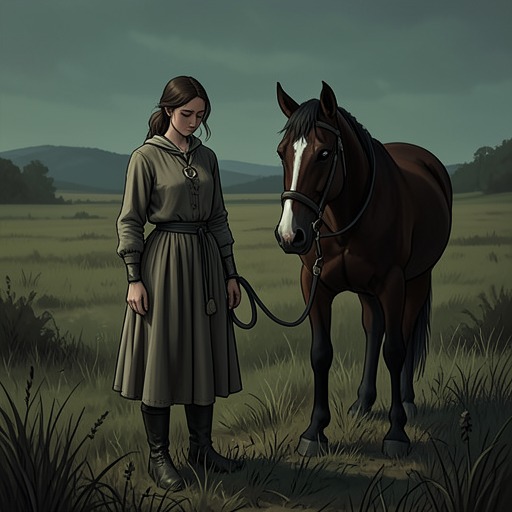
Tess immediately takes the loss upon herself. She calls it her doing and worries about what her parents will live on now, waking Abraham to tell him that the horse has been killed. Her distress is bound to the family's material dependence on Prince, but her parents do not blame her as she blames herself. The episode also changes her relation to travel by horse: afterward, although naturally courageous, she becomes exceedingly timid on wheels, and even the least irregular motion startles her.
Burial, Value, and Family Memory
When the knacker and tanner offer only a few shillings for Prince's body because of his decrepitude, John refuses to sell it. He invokes the family's supposed aristocratic ancestry, saying that the Durbeyfields once would not have sold their chargers for cat's meat, and insists that Prince served him well in life. The gesture links a present-day working animal to the family's imagined past, while also rejecting the small payment that might otherwise be recovered from the loss.
John digs a grave in the garden, working harder at this task than he has worked for months to grow a crop. The family drags Prince to the grave, and the children gather in a funeral-like procession. Abraham and 'Liza-Lu sob; Hope and Modesty grieve aloud. The burial gives the animal a place in the household's shared mourning, even as it makes the practical cost unmistakable: the family has lost its breadwinner. Tess's face remains dry and pale, and she regards herself as responsible while the others grieve openly.
Other Horses and the Accident's Afterlife
Prince's death continues to shape Tess's later encounters with horses. On the drive toward Trantridge, Alec d'Urberville takes the reins and drives rapidly along a hilltop before the road descends in a long, straight slope of nearly a mile. Tess, already made timid by the accident, is uneasy at his reckless driving and asks whether he will go down slowly. Her fear is grounded in the earlier collision, and the scene carries that consequence into a new journey in which another person's handling of a horse determines her sense of safety.
In a later ride, Tess clings to Alec while the horse canters; her seat is precarious, though she is not alarmed by the animal's condition. She asks him to slow the horse to a walk, and he does. The contrast with the earlier loss is telling: horses continue to carry people through the story, but their movement is never wholly separate from risk, control, and Tess's vulnerability. Prince's death remains the event that gives those later rides their weight.