Marian
Tess of the d'UrbervillesMarian is a dairymaid at Talbothays, the eldest and most outspoken of the three young women who love Angel Clare. Her story joins unreturned desire to hardship: when Angel chooses Tess, Marian and her companions make room for their friend rather than punish her, though the loss leaves Marian vulnerable to despair. Later, as work and poverty displace the women, Marian’s attachment to Angel survives as both a source of suffering and a motive for helping Tess reach him again.
Identity and Desire
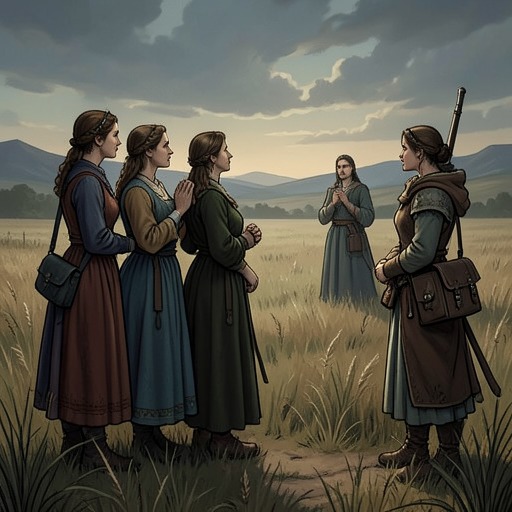
At Talbothays, Marian is distinguished by her jovial, round face and her frankness. She watches Angel with Retty Priddle and Izz Huett, teasing Retty that his thoughts are elsewhere; when pressed, she admits that all three are in love with him. Her declaration that she would marry him tomorrow makes her desire plain, but so does her willingness to name it without pretending that it gives her a claim on him. The women can acknowledge their feelings among themselves while keeping them from outsiders.
That candor does not make the attachment light. After Angel’s attentions to Tess have clarified his choice, Marian’s mood sinks. She says she had been asked twice to marry a dairyman at Stickleford, but would rather end her life than become his wife now. Her response exposes the disproportion between an ordinary, available match and the love she cannot have: marriage is not simply a practical alternative when her hopes have fixed on Angel.
Marian also reads the feelings of the other women with a bluntness that prevents their disappointment from turning into rivalry. When the reserve between the women falls away, she and Izz and Retty draw close to Tess. Their common love for Angel remains painful, but none claims that Tess has wronged them by being chosen. In Marian’s account, they tried not to hate Tess, did not hate her, and could not hate her because she was Angel’s choice, while they themselves had never expected to be chosen.
Tess’s Choice and the Women’s Solidarity
The news that Tess is to marry Angel first reaches the women as something almost unbelievable. Retty puts her hands on Tess’s shoulders, as if to assure herself that her friend is really there; Izz and Marian embrace her, and Marian kisses her. The gestures turn the announcement into a collective scene of recognition: Tess’s good fortune is at once intimate joy and confirmation of the other women’s exclusion.
That night, Marian makes their generosity explicit in a whispered farewell to the old intimacy. She asks Tess to remember them when she is Angel’s wife and to remember that they loved him, tried not to hate her, and never hoped to be his choice. Their honesty does not spare Tess pain. Hearing Marian’s words, Tess weeps and resolves to tell Angel her history rather than keep silent at her mother’s bidding. Marian’s openness thus becomes part of the pressure that moves Tess toward confession: friendship, not accusation, makes silence seem like a wrong.
The women’s bond endures after Tess’s marriage. On New Year’s Eve, Marian is reported to have been found dead drunk by a willow bed, while Retty has been discovered in the water and brought home alive. The account presents their crises as consequences of a shared emotional blow, though their immediate circumstances differ. Marian’s later drinking is not a passing embarrassment: when Tess meets her again, Izz says simply that Marian drinks and that the dairyman has got rid of her.
Poverty, Drinking, and Repeated Loss
Tess encounters Marian again in a village street, where Marian appears stouter, redder-faced, and shabbier than before. Tess herself has fallen into hardship during her separation from Angel and is trying to return to agricultural work. Marian receives her respectfully and is moved that Tess is still in such poor condition. When Tess asks her to use her old name, not her married title, and to find her a place, Marian says that workers are always wanted at the bleak farm: few choose to go there, and it is a place where the land yields corn and swedes.
Their reunion brings out a contrast in how each bears deprivation. Marian offers Tess a drink from a pint bottle stopped with white rag. Tess takes only a small sip, while Marian drinks the spirits and says she is used to it and cannot leave it off; it is her only comfort. She explains the difference through loss: she has lost Angel, whereas Tess has not. Tess thinks Marian’s loss as great as her own, but still holds to the distinction that she is Angel’s wife, at least in law. Their exchange shows how marriage and separation divide their situations without erasing the affection that links them.
Marian’s drinking accompanies physical labor rather than replacing it. At Flintcomb-Ash, she works near Tess as the threshing machine whirls; when the machine stops for dinner, Tess can scarcely walk, her knees shaken by the work. Marian urges her to drink, noticing how pale and exhausted she looks. Her own use of alcohol is a damaged form of comfort, but her concern remains practical and immediate: she sees Tess’s fatigue and tries to care for her.
Helping Tess and Reaching Angel
Marian’s loyalty also extends to the danger surrounding Tess’s separation. She learns that Angel had wanted Izz to go with him to Brazil. When Tess asks whether Izz refused, Marian cannot say; she only knows that Angel changed his mind. The report gives Tess another painful measure of Angel’s distance and of the alternatives that briefly existed around his departure.
Later, while Tess is working at the threshing machine, Izz objects to a married woman being courted by a preacher merely because her husband is abroad and she is, in a sense, a widow. Marian is present as the laboring scene continues, and she notices Tess’s trembling exhaustion when the machine stops. The danger is not resolved by Marian’s sympathy, but the episode places her among the women who see how precariously Tess is situated.
After Tess and Angel have separated again in circumstance and distance, Marian and Izz turn their knowledge into action. As they travel with a ploughman’s belongings toward a new place of work, they discuss Tess, Angel, and the persistent lover whose connection with Tess’s past they have partly heard and partly guessed. Marian argues that Angel’s earlier place in Tess’s life matters, and that it would be a pity if the other man drew Tess away again. She does not grudge Angel to Tess; instead, she wants him to know the straits Tess faces and to come protect his wife.
The move initially takes up the women’s attention, but a month later they hear of Angel’s approaching return. They still know nothing more about Tess, and Marian’s attachment to Angel is not erased; nevertheless, she and Izz write to him together. Their warning says that he should look to his wife if he loves her, because an enemy disguised as a friend is near her and a woman should not be tried beyond her strength. Marian’s feelings therefore end not in possession of Angel but in an act of solidarity with Tess: the former admirer uses her knowledge, shared with Izz, to try to bring a husband back to a wife in danger.