Religious conversion, dogma, and morality
Tess of the d'UrbervillesReligious conversion, dogma, and morality are sharply distinguished in Tess of the d’Urbervilles: a public conversion can change a person’s language and appearance without resolving the moral meaning of his past, while ethical conduct need not depend on doctrinal certainty. Through Tess’s resistance to Alec d'Urberville’s religious revival, her account of belief, and Angel Clare’s later reassessment of moral judgment, the novel tests whether goodness is a matter of profession, belief, action, or inward purpose.
Conversion and the appearance of change
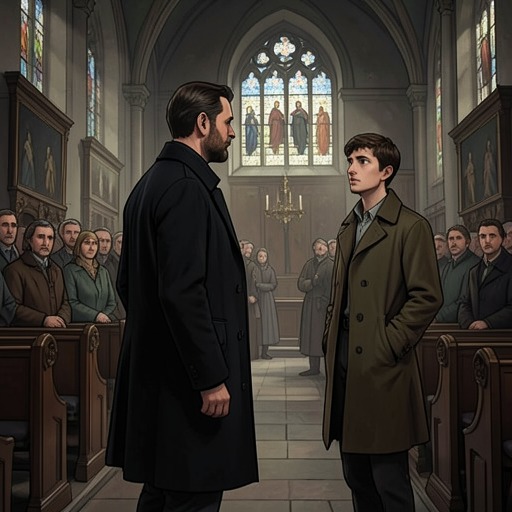
When Tess encounters Alec preaching, his altered appearance makes him momentarily difficult to recognize. The familiar face now carries a clerical aspect, and the change seems to rewrite its expression: what had signified seductiveness appears as devotional passion, and former defiance as religious zeal. Yet the narrator describes this not simply as reform but as a transformation of the same features into a new expressive vocabulary. The visible elevation unsettles Tess because it seems both real in its present form and at odds with what she remembers.
Tess initially experiences the preaching as an irony: the same voice that had once brought her words of a very different purpose now delivers Scripture. But she checks her first, ungenerous judgment. Wicked people can turn from wrongdoing, she reasons, and a sinner may become a saint; she recognizes that her shock may arise partly from hearing good words in old, troubling tones. The episode therefore refuses an easy equation between a compromised past and permanent moral incapacity. At the same time, the possibility of genuine conversion does not require Tess to trust Alec’s transformation on sight.
Tess’s challenge to Alec
Alec explains that his conversion followed a missionary preacher’s visit to Trantridge. He had insulted the preacher, who answered without resentment and predicted that those who came to scoff might remain to pray. Alec says the words stayed with him, while his mother’s death affected him more deeply; gradually, he came to see a new direction for his life. He presents preaching as a desire to pass this understanding to others, and acknowledges that addressing former companions from his earlier life is a particularly severe test of sincerity.
Tess rejects the moral asymmetry she sees in this account. Alec, she says, had helped make her life bitter, and it strikes her as unjust that he might first take pleasure in earthly life and then seek heavenly consolation by converting. Her anger is not an abstract denial that people can change: she objects to Alec speaking of religion to her while knowing the harm he has done. When he asks what she does not believe, she identifies his conversion and religious scheme. She fears that the sudden flashes of spiritual feeling he describes will not last.
The scene gives that doubt an immediate dramatic form. When Alec recognizes Tess, his preaching falters; his words fail, and his attention repeatedly returns to her before she walks on. The contrast between his new public vocation and his unsettled response to Tess makes the limits of outward conversion visible without proving that every element of his religious experience was false. Tess’s skepticism is grounded in what she knows of him and in the continuing conflict between his professed faith and his conduct toward her.
Belief without dogma
In a later conversation, Tess tells Alec that she does have a religion, although she does not believe in anything supernatural. She says that she believes in the spirit of the Sermon on the Mount, as did her husband, Angel Clare. Her position separates ethical teaching from supernatural belief and from the institutional or doctrinal claims Alec expects religion to contain.
Tess explains that Angel did not force her judgment or argue her into agreement. Rather, she trusts conclusions he reached after deep inquiry more than conclusions she might reach without having studied doctrine herself. Her faith in his judgment is therefore personal and dependent, but the passage also makes clear that she understands it as trust in a more informed inquiry, not as an argument imposed on her. Alec challenges this reliance as intellectual dependence; Tess answers that Angel’s thought deserves confidence because it rests on investigation she has not undertaken.
The disagreement concerns not only what either person believes but what makes a moral life possible. Tess proposes loving-kindness and purity as ethical commitments that can remain meaningful without dogma. Alec, by contrast, says he cannot feel responsible for his actions and passions unless there is someone to whom he is responsible and consequences beyond death attached to conduct. His view makes moral accountability depend on a supernatural authority; Tess’s separates humane ethical principles from that framework. Their exchange leaves the difference exposed rather than resolving it through a shared creed.
Alec’s relapse and the test of sincerity
Alec admits that he has come to see Tess instead of keeping an engagement to preach at Casterbridge Fair. He recognizes the contradiction: he believes he ought to preach, yet abandons that duty when his passion for her takes over. This is not merely a disagreement about doctrine. His own description reveals a conflict between the obligation he professes and the behavior he chooses.
Tess’s use of Angel’s reasoning unsettles him. After leaving her, Alec continues turning over the possibility that his position is untenable. The narrator suggests that his conversion may have been an impulsive search for a new sensation, temporarily intensified by his mother’s death, rather than a change grounded in reason. Tess’s arguments cool his religious enthusiasm; Alec then abandons the preaching project and resumes pursuing her. His relapse gives consequence to her earlier fear that his spiritual intensity might not endure.
When Alec later discusses religious ideas with Tess again, he says that he has been reconsidering the propositions that had once fired him. He cannot make sense of his earlier enthusiasm for them and does not see how to adopt the non-dogmatic ethical system Tess described. She again distinguishes religion from morality, arguing that loving-kindness and purity remain possible without doctrinal belief. Alec rejects this as insufficient to make him feel accountable. Their positions thus remain sharply different: Tess preserves an ethical standard beyond supernatural reward and punishment, while Alec finds morality difficult to sustain without such an authority.
Moral judgment and intention
The novel’s account of these disputes extends beyond Alec’s religious revival. During his absence in Brazil, Angel Clare has watched the hardship endured by agricultural laborers drawn abroad by promises of independence. Their suffering, including mothers forced to continue travelling after losing infants, contributes to a broader change in how he evaluates human life. The narrator says that Angel has begun questioning not only older systems of mysticism but older appraisals of morality.
Angel’s revised standard asks who is moral, and whether character should be judged only by achievements. He comes to consider aims and impulses, and to locate a person’s true history not solely in what was done but also in what was willed. Applied to Tess, this change makes him regret his earlier judgment. He can no longer say that he will always reject her; the refusal to maintain that absolute judgment is, in spirit, an acceptance of the possibility of taking her back.
Together, these strands distinguish conversion from ethical change and moral judgment from rigid reliance on a single outward fact. Alec’s religious language cannot by itself undo the conflict between his professed duty and his renewed pursuit of Tess. Tess’s non-supernatural belief retains moral commitments without doctrinal certainty, while Angel’s reconsideration challenges the assumption that actions alone exhaust a person’s character. The novel does not offer a simple formula that settles their disagreement; it makes the testing of belief against conduct, intention, and responsibility the subject itself.