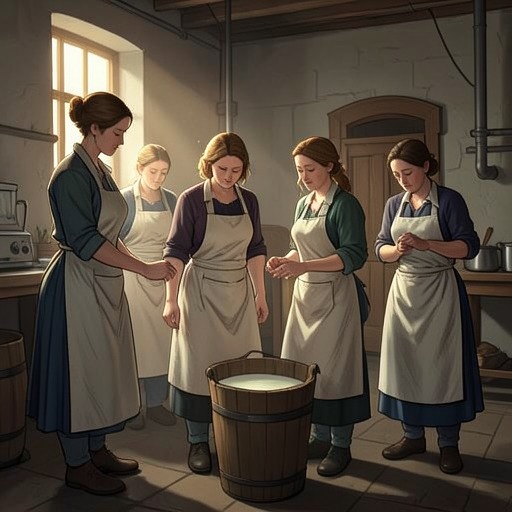
Retty Priddle’s attempted suicide
Tess of the d'UrbervillesRetty Priddle’s attempted suicide is a reported crisis that changes the course of Tess’s wedding-night conversation with Angel. The news arrives at the dairy after the newly married couple have driven away; hearing of another woman’s despair, Tess resolves that she cannot accept love while concealing her own past. The event thus links the dairymaids’ heartbreak to Tess’s decisive movement toward confession.
Report from the Dairy
On New Year’s Eve, Jonathan Kail tells Angel that the people at the dairy have been alarmed by what might have become a terrible affliction. He recalls the cock’s afternoon crow, which some take as a sign, but the concrete news is that Retty has tried to drown herself. Angel is astonished: Retty had said goodbye with the others when he and Tess left that afternoon, and nothing in that farewell had disclosed what followed.
Kail recounts the evening’s movements. After Angel and Tess drove away, Retty and Marian put on their bonnets and went out. With little work to occupy them on New Year’s Eve, and people distracted by drink, their departure attracted little notice. They went first to Lew-Everard, where they had something to drink, then on to Dree-armed Cross, where they appeared to part: Retty crossed the water-meads as if heading home, while Marian continued toward another village and its public-house.
Found at the Great Pool
No one saw or heard from Retty again until a waterman, returning home, noticed her bonnet and shawl packed together beside the Great Pool. He found Retty in the water. He and another man carried her home, at first believing her dead, but she gradually recovered. The account establishes both the seriousness of the attempt and its outcome: Retty survives, though the people at the dairy have been shaken by how close the incident came to death.
Kail’s report places Retty’s crisis amid the other maids’ abrupt distress. Marian, too, has been found dead drunk by a withy-bed, though she was not known to drink anything stronger than shilling ale. The report does not explain either woman’s state in detail; it conveys the dairy’s bewilderment at seeing the young women’s behavior change so sharply. The contrast between an ordinary leave-taking and these alarming discoveries gives the story its force.
The News Reaches Tess
Angel realizes that Tess has been overhearing Kail’s account and moves to shut the door between the passage and the ante-room. But Tess has already come into the outer room with a shawl around her shoulders. She listens while looking absently at the luggage, where raindrops glisten. The scene brings the report into the newlyweds’ private space: their departure from the dairy is the very circumstance around which the maids’ evening has unfolded.
Angel tries to soften the impact, apologizing that Tess has heard the sad story and saying that Retty was naturally morbid. Tess answers that Retty had the least cause to suffer, whereas women who do have cause hide it and pretend otherwise. Her reply resists treating Retty’s attempt as an isolated oddity or as proof of some natural defect; it turns attention to suffering that remains unseen, including her own.
Tess’s Decision to Confess
The incident tips the balance for Tess. She thinks of the dairymaids as simple, innocent girls struck by the unhappiness of unrequited love, and believes they deserved better from Fate. She judges herself more harshly, feeling that she has received the love and happiness denied to them without paying for it. In that moment, she decides she will pay by telling Angel everything, and resolves to do so there and then.
The narration fixes her decision in a specific tableau: Tess looks into the fire while Angel holds her hand. The embers have gone flameless, but their steady glare still colors the fireplace and nearby objects; reflected in the gems she wears, the light breaks into changing white, red, and green flashes with each pulse. That brightness surrounds a moment of moral reckoning. When Angel asks whether she remembers their morning agreement to tell each other their faults, and says he wants to make a confession, Tess remains immovable. Retty’s survival does not undo her crisis; the attempt instead makes Tess’s own concealed history impossible for her to treat as a private exemption from the truth. The reported event therefore becomes a turning point in the confession that follows.