Richard Crick
Tess of the d'UrbervillesRichard Crick is the master-dairyman at Talbothays Dairy, a working farmer whose authority rests on close, hands-on knowledge of milking and whose genial presence gives the dairy a voice beyond its daily labor. Called Dairyman Dick, he moves between the practical management of a large herd and the communal world of church, breakfast-table talk, and country anecdote. Through him, the dairy appears not merely as Tess’s place of employment, but as a tightly organized workplace animated by local memory and humor.
Identity and Work
Crick is introduced among the milkers as a sturdy, middle-aged man wearing a long white pinner cleaner and finer than the others’ wraps, with a jacket beneath it that has a presentable, market-going look. His clothes signal a double life: for six days he works as a dairyman and butter maker; on the seventh he appears in shining broadcloth in his family pew. A rhyme captures the distinction between the working man and his Sunday presentation, calling him Dairyman Dick during the week and Mister Richard Crick on Sundays.
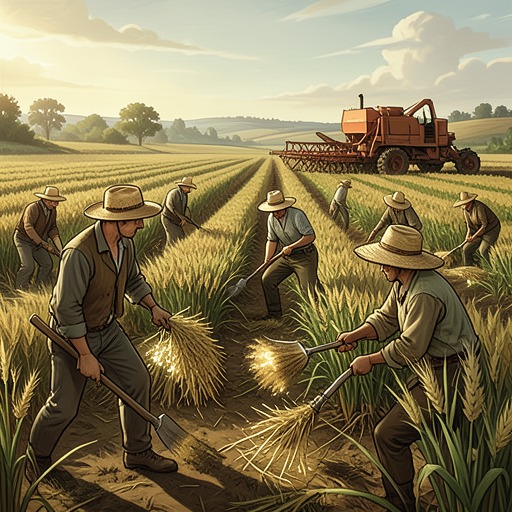
His status does not separate him from the labor he supervises. He milks cows himself, carries his three-legged stool and pail from animal to animal, and takes responsibility for the hardest-yielding members of the herd. The scale of the operation is substantial: nearly a hundred milkers are under his management, including the hired men and maids, while Crick personally milks six or eight especially difficult cows when he is at home. He keeps these animals out of the hands of casual journey-milkmen, who might leave them incompletely milked, and out of the maids’ care when he doubts their finger-grip. If the cows are not milked fully, they may go dry; reduced demand then means reduced supply and can ultimately end it. His authority is therefore grounded in the detailed economic consequences of everyday technique.
Reception of Tess and the Dairy Community
When Tess arrives looking for the master-dairyman, Crick crosses to meet her. Unlike the cross manner commonly associated with dairymen at milking time, he is glad to have another hand during the busy season and receives her warmly. He asks after her mother and family, though the interest is largely a matter of form: he had not known of Mrs Durbeyfield’s existence until a brief business letter about Tess brought her to his attention.
Crick’s first conversation with Tess also touches on her family’s origins. He recalls knowing her part of the country as a boy and repeats what an old woman, long dead, had once told him: a family of a name like hers in Blackmoor Vale had come from that region and belonged to an ancient race nearly vanished from the earth. He admits that he had dismissed the woman’s story as rambling. The passing anecdote places Tess’s family history inside the dairy’s ordinary talk, while Crick’s indifference to its significance contrasts with the weight that ancestry will carry elsewhere in her life.
At the start of her work, Tess changes her bonnet for a hood and settles on a stool beneath a cow. As milk streams from her hands into the pail, she feels that she has laid a new foundation for her future. Crick’s dairy gives that feeling a concrete setting: a large, ordered workforce, with men assigned the hard-teated animals and maids the more tractable cows. The quiet of the barton is broken mainly by the purr of milk entering pails, the movements of hands, and occasional instructions to the animals. Crick’s management belongs to this collective rhythm, even as his own labor marks him out as its most experienced practitioner.
Practical Judgment and Storytelling
Crick’s attention to the cows is alert to small changes. After finishing one animal and moving to the next, he observes that they are not giving down their milk as usual and worries that Winker, if she begins holding it back, will not be worth milking by midsummer. The concern is specific rather than abstract: a shift in one cow’s behavior is a warning about the productivity on which the dairy depends. His speech makes his knowledge audible, revealing a manager who reads the herd through repeated work and treats a temporary change as a possible long-term loss.
He is also a lively teller of local stories. In a conversation about singing and instruments, Crick says that bulls, in his experience, respond more to music than cows, and recounts a tale about William Dewy, an elderly man from Mellstock known to him by sight. Returning from a wedding by moonlight, Dewy cuts across Forty-acres and is chased by a bull. He draws his fiddle while running and plays a jig; the bull stops and appears to soften, but lowers its horns whenever the fiddler stops. Dewy has to keep playing for hours, exhausted and with no one expected to pass by.
The story turns on Dewy’s recollection that cattle were said to kneel on Christmas Eve. Though it is not Christmas, he plays the Nativity hymn, and the bull kneels, allowing him to escape over a hedge before the animal gets back on its feet. Crick relishes the bull’s supposed pious feelings and its foolishness when it discovers the trick. The episode is more than comic relief: his way of telling it draws on familiar places, names, seasonal belief, and the practical danger of an animal in the field. The dairy’s social life thus includes its own oral archive, carried in stories told between tasks.
The Dairy’s Shared Life
Crick’s role extends from the milking yard into the household and the breakfast table, where the work’s results become matters for collective judgment. One morning he stamps about the house after receiving a customer’s complaint that the butter has a twang. Holding a wooden slice with a lump of butter on it, he acknowledges that the criticism is right and invites those present to taste it. Angel, Tess, the other indoor milkmaids, one or two milking-men, and finally Mrs Crick all try it; they confirm that the butter does have a twang. Crick neither conceals the defect nor treats quality control as solely his private responsibility: he makes the problem available for the household to assess.
At another breakfast, he draws the men and maids into a guessing game by asking whom he has heard news of that morning. After several guesses, he announces that Jack Dollop has married a widow. Mrs Crick already knows, but the rest of the group is invited to share the disclosure. The exchange shows Crick using news as a small social performance, turning breakfast into a scene of expectation and communal amusement. Across these episodes, he is both the dairy’s working manager and a link among the people who labor and live there. His significance lies in that combination: exacting practical responsibility, unceremonious hospitality, and a storytelling voice that gives the dairy its particular community texture.