Sorrow
Tess of the d'UrbervillesSorrow, the infant son of Tess Durbeyfield, is given a name and an emergency baptism before dying in the blue of the morning. His short life is framed by the efforts of his mother and siblings to recognize and care for him, and by the social and religious categories that mark him as an unwanted, illegitimate child. The contrast between those acts of love and the indignity of his burial makes him more than a passing loss: his story exposes the costs of judging a child for circumstances he did not choose.
Identity and Naming
Sorrow is the child born to Tess outside marriage. The narrator calls him an intrusive creature and a bastard gift of Nature, language that places him under the social condemnation attached to his birth even as it emphasizes that he has no knowledge of that condemnation. He is named during his baptism, when Tess draws on a phrase from Genesis. The name carries the grief surrounding his arrival, but the naming is also a deliberate act: Tess addresses her child as someone who can be welcomed into a community of faith, rather than merely treated as evidence of a social transgression.
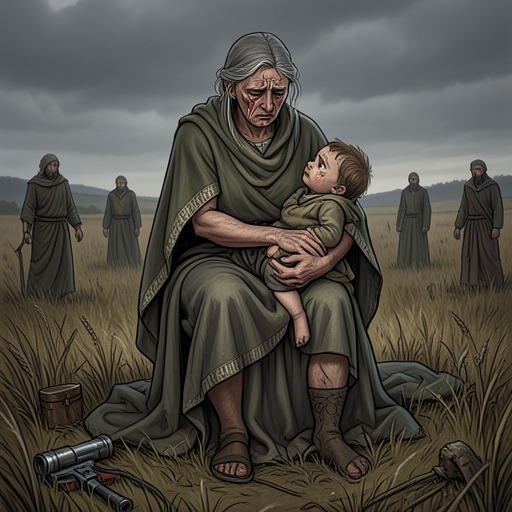
Tess conducts the baptism herself, speaking the words, sprinkling water, and tracing an immense cross on the baby. His older siblings answer the prayers and repeat the responses, turning the makeshift rite into a family ceremony. The children initially question and watch their sister; as her faith intensifies, they regard her with reverence. Sorrow’s place in the scene is therefore shaped both by his helplessness and by the care gathered around him. The family gives him a name, a religious welcome, and the company of his siblings, even where its resources and standing cannot protect him.
Brief Life and Death
The baptism is followed by a short interval of calm for Tess. In daylight, she no longer feels the same terror about her child’s soul, reasoning that she would not value a heaven that rejected the child on account of an irregularity in the rite. That thought does not undo the importance she has placed on baptism; it shows her trying to reconcile religious fear with the tenderness and responsibility of motherhood.
Sorrow dies in the blue of the morning. The narrator describes his campaign against sin, the world, and the devil as doomed to limited duration, transforming the language of the baptism into a bitterly brief account of the life it was meant to bless. The other children wake and cry, begging Tess to have another baby. Their response registers his death not as an abstract consequence of doctrine or social shame, but as the loss of a particular little brother whom they had just helped welcome.
The account also measures Sorrow’s life against the scale of human time. For him, the cottage interior had been the universe, the week’s weather its climate, and new-born babyhood the whole of human existence. Years and centuries had no meaning to a child whose life lasted only days. This contrast gives the narrative a pointed irony: the categories and judgments imposed on him reach far beyond anything he could know, while his own world remains bounded by immediate existence and instinct.
Burial and Tess’s Care
After his death, Tess worries whether her improvised baptism will count as sufficient for a Christian burial. She tries to ask the new parish parson, but first cannot summon the courage to enter his house. When she meets him by chance as he returns home, she tells him about the baby’s illness and the ceremony, then asks whether it will be just the same as if he had baptized the child. The parson is initially inclined to treat the rite as an unskilled substitute for his proper services, but Tess’s dignity and tenderness move him to affirm that it will be the same.
Sorrow is carried to the churchyard at night in a small deal box, beneath an old woman’s shawl. The burial takes place by lantern-light, for a shilling and a pint of beer paid to the sexton, in the neglected corner where unbaptized infants and others thought conjecturally damned are laid. The ceremony’s unequal standing is made physical in the burial ground: the child is buried within the churchyard, but in a shabby place set apart from its more honored ground.
Tess answers that indignity with a private memorial. When she can enter the churchyard unseen, she places a small cross made from two laths and string at the head of the grave, binds it with flowers, and sets another bunch in a little jar of water at the foot. The jar bears the commercial label Keelwell’s Marmalade, a mundane detail that does not diminish the meaning of her offering to her. The narrator contrasts the eye that sees only the label with maternal affection, which sees the flowers and cross as acts of remembrance. The grave thus holds both the social disregard inflicted on Sorrow and the care Tess continues to give him.
Narrative Significance
Sorrow’s story turns on a conflict between institutional rules and acts of human care. His baptism begins outside formal church authority because his mother fears he may die before a clergyman can perform it; the parson’s later assurance and the burial in the churchyard partly confirm her effort, yet the child still ends up in the designated corner for those treated as religious outsiders. The novel does not make his short life a test of his own character. Instead, it reveals how religious conventions and social judgments attach themselves to someone too young to understand them.
His name and burial also bring the novel’s language into sharp focus. The baptism promises a soldier fighting sin, the world, and the devil, but the narrator’s account makes that promise painfully disproportionate to a life measured in days. The label of unwanted child is set against Tess’s cross, flowers, and continuing concern for his soul. Sorrow cannot escape the circumstances into which he is born, but his mother refuses to let those circumstances define the entirety of his place in the family. The brief arc from naming to death to burial therefore exposes a disparity between public condemnation and private love without assigning blame to the child who bears its consequences.