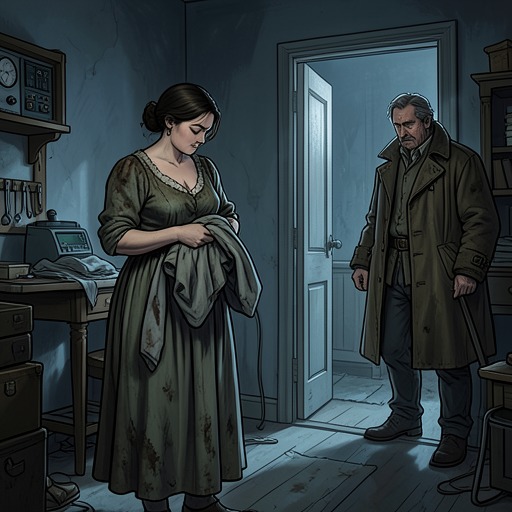
Tess's poverty during separation
Tess of the d'UrbervillesTess's poverty during separation is not a single moment of want but a tightening material condition: she avoids living on Angel Clare's allowance, gives money to her parents when their house needs repair, and ultimately depends on scarce seasonal work. Her reluctance to seek further aid is bound up with pride, shame, and a wish to shield Angel from reproach; the result is that the cost of the separation falls on her own labor and dwindling resources.
From separation to precarious work
More than eight months after the parting, Tess appears not as a bride whose luggage is carried for her but as a lonely woman bearing her own basket and bundle. Her purse is flattened, and the comfortable support once projected by Angel has not become a secure living. After leaving Marlott again, she spent spring and summer doing light, irregular dairy work near Port-Bredy, west of the Blackmoor Valley. She preferred earning what she could to living on her husband's allowance, though the work was only supplementary and ended as the milk supply diminished.
The change of season offered work, but not stability. Tess moved from pasture to stubble for the harvest, and her employment lasted only as long as the harvest did. This pattern made poverty cumulative: a short engagement might bridge one interval without providing a dependable place for the next. As winter approached, work grew harder to find, while the separation continued and Tess remained emotionally fixed on the earlier dairy and the lover who had vanished from her life.
Money spent and family obligations
Of the fifty pounds Angel had left, Tess had retained twenty-five after giving the other half to her parents in recognition of the trouble and expense she had caused them. She had spent little until a period of wet weather forced her to draw on the remaining sovereigns. The coins were difficult to part with because Angel had placed them in her hand, and their newness and personal history made them seem like keepsakes. Necessity nevertheless turned these tokens of intimacy into the means of subsistence, spent one by one.
When Tess's money was nearly gone, a letter from Joan brought a fresh claim on her limited resources. Rain had penetrated the thatch of the family house, which needed complete renewal; unpaid thatching, new rafters, and an upstairs ceiling together would cost twenty pounds. Joan appealed to Tess on the assumption that her husband was a man of means and had probably returned. Tess soon had thirty pounds coming from Angel's bankers. She sent twenty pounds to her parents as soon as it arrived, then used part of the balance for winter clothing, leaving only a nominal sum for the season ahead.
The transfer relieved her family but sharpened her own insecurity. Once her last pound was spent, Angel's suggestion that she apply to his father for further resources remained an option she could not bring herself to use. Tess feared that his parents already despised her and that approaching them as a mendicant would deepen that judgment. Her concern was not simply whether money could be obtained: asking would mean exposing the impoverished reality of a separation she had kept hidden.
Concealment, shame, and limited choices
Tess periodically sent her parents her address so that a letter from Angel could reach her, but concealed her circumstances. They still believed she was awaiting her husband's return in comfort, or might soon be summoned to join him in Brazil. After sending them money, she could not face telling them that she was herself dependent on her hands for a living. She feared that acknowledging the estrangement as abandonment would bring reproach upon Angel, as well as expose the contrast between the éclat of her marriage and her present hardship.
Her options were narrowed further by the kind of work she could imagine herself taking. With her money exhausted and winter making employment harder to find, Tess refrained from seeking indoor service. She feared towns, large houses, wealthy people, and unfamiliar social manners, associating gentility with the harm that had entered her life. The small dairies west of Port-Bredy no longer needed help. Although she might have found a place at Talbothays, even out of compassion, she could not bear to return to the setting of her former happiness, face pity, or risk whispered discussion of her situation. Instead, a letter from Marian, who had heard through Izz Huett that Tess was separated from her husband, directed her toward an upland farm where there was room for additional workers.
This flight from scrutiny did not protect Tess from material and social vulnerability. Her appearance and bearing attracted attention; after she had to exchange her marriage clothes for a fieldworker's wrapper, she was subjected more than once to rude remarks. Her poverty thus altered not only what she could afford but also the clothes in which others saw and addressed her. The pressure to keep her story private coexisted with the visible signs of her reduced circumstances.
Flintcomb-Ash and the bodily cost of survival
At Flintcomb-Ash, a farm the narrative calls a starve-acre place, Tess's precarious search for work becomes hard physical labor. The farm belongs to a village neglected by both its own community and its absentee owner, and its bleak setting makes the limited character of rural employment plain. Tess nevertheless sets to work, sustained by patience that combines moral courage with physical timidity.
In a swede field of more than a hundred acres, Tess and Marian hacked the uneaten lower halves of turnips from the soil with hooked forks. The leaves and upper parts had already been consumed by livestock, leaving the field a drab, stripped expanse. Later, at the threshing, Farmer Groby assigned Tess to the platform beside the feeder. Izz Huett passed her sheaves; Tess untied them so the feeder could spread the corn over the revolving drum. Because the machine had to keep running, the feeder could not stop, and Tess, who supplied him, could not stop either. Marian sometimes exchanged places with her for half an hour despite Groby's objections, but the work's unbroken pace made Tess regret having come.
The machinery reorganizes the labor around relentless continuity, while the older workers recall hand-threshing with flails on the barn floor. Tess is selected for her strength, quickness, and staying power, qualities that make her useful to the farm but do not make the work secure or humane. Poverty here is measured in bodily exertion as well as coins: after seasonal dairy work, uncertain harvest employment, and an almost exhausted purse, survival depends on enduring the machine's ceaseless demand.
Significance
Tess's hardship is bound to obligations that pull in opposite directions. She declines Angel's allowance as a preferred means of support, gives money to the parents whose household remains in difficulty, and will not ask Angel's family for help. These choices are made under conditions of estrangement and shame, not from a position of financial independence. Her labor sustains both herself and, through the remittance, her family, while her silence preserves the appearance that she is waiting comfortably for her husband.
The episode also shows how poverty is produced and intensified by circumstance rather than by a single failure of effort. Tess works at dairies and harvests, moves when employment ends, seeks a place through Marian, and takes on punishing farm labor; nevertheless, seasonal demand, winter scarcity, family expenses, and social exposure keep her resources precarious. The contrast between Angel's intended provision and Tess's actual reliance on her own hands makes the separation material as well as emotional: money once associated with his touch is spent, family need takes a large share of the replacement funds, and the remaining means of survival are work and endurance.