Tess’s return to harvest work with her infant
Tess of the d'UrbervillesTess’s return to harvest work with her infant is a tentative act of self-recovery after months of seclusion: she goes back to the fields near Marlott because harvest labor is in demand and pays better than anything she can do indoors. The work gives her a measure of independence, but it also places her and her baby in public view. In the lunch break, she nurses the child among the harvesters, then kisses it with startling force after first seeming almost indifferent. The scene makes neither shame nor maternal attachment simple: Tess tries to resume an ordinary life while carrying the consequences of an experience she did not know how to guard against.
Return to Outdoor Work
A resolve that surprises Tess herself brings her back to the fields for the first time in many months. She has spent that long alone, exhausting herself with regret; now, as the agricultural world enters its busiest season, she decides that usefulness may let her taste independence again. Nothing she can do at home will earn as much for the time. The decision is practical as well as inward: labor offers a way to support herself and re-enter familiar surroundings without pretending that the past has not happened.
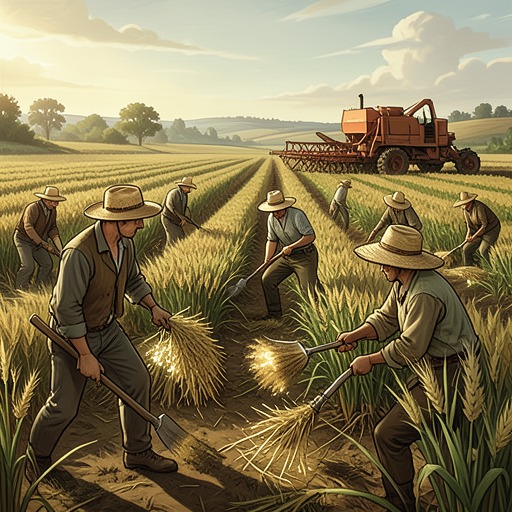
The narration presents her changed appearance through the repeated motions of sheafing. She draws ears of corn from the last sheaf, evens their tips with her palm, gathers the stalks against her knees, and ties the bundle while kneeling on it. Her work continues with clock-like monotony; the stubble scratches her exposed arm until it bleeds. When she stands to rest, her dark eyes and heavy hair frame a face the narrator describes as changed, yet still recognizable. Tess is living as a stranger in her native place: the land is not foreign, but her relation to it and to the people around her has been altered by what has happened.
Her return does not begin with a grand declaration. She dresses neatly, comes out to work when hands are needed, and bears herself with dignity, sometimes meeting people’s eyes even while holding the infant. The contrast between the ordinary task and the altered social meaning of her presence gives the scene its force. She is once again a worker among other workers, but the baby makes her position as an unmarried mother impossible to conceal.
The Harvest Meal and the Infant
At the approach of eleven, Tess repeatedly glances toward the hill without stopping her work. A group of children appears, and the eldest girl carries what first looks like a doll but proves to be the infant in long clothes; another child brings lunch. Tess is among the last to suspend her labor. At the shock of sheaves, she turns somewhat away from the others as she sits down, and declines a harvest worker’s offer of ale.
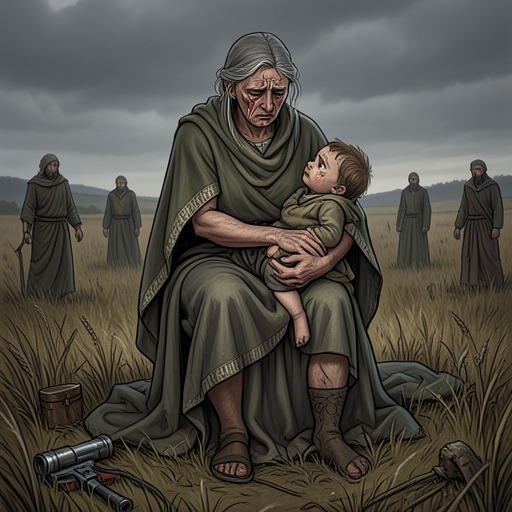
She calls her eldest sister over and takes the baby from her. The girl, evidently glad to be relieved of the burden, goes to join the other children at the next shock. Tess unfastens her dress and nurses her child with a movement described as stealthy yet courageous, her color rising. The surrounding workers respond with a careful mixture of privacy and observation: the men nearest her turn their faces away, while the other women talk and adjust their hair. The moment belongs to public working life, but the people around Tess make room for an intimate act within it.
When the baby has finished feeding, Tess sits it upright on her lap and dandles it while looking into the distance. At first her manner suggests gloomy indifference, almost dislike; suddenly she kisses it again and again, so vehemently that the child cries. Passion and contempt occupy the same gesture. The abrupt change does not resolve Tess’s conflicting feelings into a single, settled emotion; instead, it makes visible how grief, social shame, and attachment coexist in her response to the infant.
Shame, Work, and Companionship
Tess’s decision to work follows a change in how she understands her misery. She has been consumed by the thought of what the world makes of her situation, but begins to see that other people do not carry her experience with the intensity she does. Their judgments and passing notice are not the whole of her inner life. She imagines that, without the conventions through which society interprets her, she might have met the condition of being an unmarried mother more calmly. In this account, much of her suffering has been produced not by her innate feelings alone, but by the social meaning attached to them.
That recognition does not mean the stigma disappears. On the return journey, the women show sympathy and welcome Tess back into the open air, but cannot resist verses from a ballad about a girl who went to the merry green wood and returned changed. Their friendliness and teasing arrive together. The episode that made Tess a social warning also makes her, for a time, the village’s most interesting person. Their liveliness draws her attention away from herself, and she becomes almost gay—not because her circumstances have been repaired, but because companionship briefly interrupts her isolation.
Her mother’s reproaches reveal another pressure behind the return. Joan complains that Tess failed to get Alec d’Urberville to marry her and did not think of doing something for the family. Tess answers that she was a child when she left home and asks why no one warned her of the danger in men. Joan admits that she feared a warning would make Tess wary and cost her the chance of a match. Their exchange exposes the gap between the mother’s calculation of marriage as family security and Tess’s account of her own inexperience and vulnerability. The return to work is therefore not only recovery from seclusion; it is also a choice to seek support through her own labor rather than through the marriage her family had hoped for.
Maternal Attachment and Renewed Loss
The harvest scene refuses an easy division between the mother who appears detached and the mother who loves her child. Tess’s first look after nursing is gloomy and distant; her sudden succession of kisses is fierce enough to make the infant cry. That unsettling contrast belongs to the larger strain of her circumstances: the child is at once someone she cares for and a visible reminder of the social and personal injury that has reshaped her life. The tenderness is real, but it does not cancel pain or make her situation secure.
For the length of the working day, ordinary routine and collective company offer a fragile counterweight. Tess eats, returns the baby to her sister, fastens her dress, puts on her buff gloves, and bends to tie another sheaf. She and the other harvesters continue until dusk, then ride home together in a large wagon beneath the moon. The women’s songs, sympathy, and mischievous ballad verses accompany her back into village life. Yet the respite ends at home: Tess learns that the infant has suddenly fallen ill during the afternoon. The narrator notes that such a collapse was probable given the child’s tender, puny frame, but Tess still receives the news as a shock. The return to work has briefly restored movement, company, and purpose; it cannot protect the child from the next crisis.
Significance in the Plot
The episode brings Tess’s economic vulnerability, social exposure, and maternal attachment into one working day. Her return is prompted by the need for remunerative employment, while the field becomes the setting in which she must live publicly with the consequences her community attaches to unmarried motherhood. The practical details of harvesting matter: she keeps working, pauses to nurse, and returns to the sheaves. They make recovery an effort enacted through labor rather than a sudden release from grief.
The scene also places society’s judgment beside Tess’s own emerging perspective. The other women welcome her and mockingly sing about her altered state; Tess can be both the object of village attention and a person whose inner experience exceeds that attention. Her mother’s disappointment over the failed marriage proposal further shows how economic need can turn a woman’s vulnerability into a family’s imagined opportunity. Against these pressures, Tess’s paid work is a modest bid for autonomy, not a solution to poverty or stigma.
Finally, the passage makes the apparent return to ordinary life precarious. The harvest continues in its familiar rhythm, and Tess almost recovers a degree of gaiety through the company of her fellow workers. But the infant’s sudden illness, disclosed as soon as she reaches home, shifts the action from social sorrow to immediate natural danger. The day’s movement—from seclusion, to labor and companionship, to renewed fear—shows that regaining a place among others does not end the losses still gathering around Tess.